Berlin Wall Sites Near Alexanderplatz Demonstration
On 4 November 1989, between 200,000 and 500,000 people filled this square in the largest non-state demonstration in East German history and the first legally permitted protest organised by private citizens. Twenty-six speakers addressed the crowd from a flatbed truck, among them Christa Wolf, Stefan Heym and Jens Reich, while East German television broadcast it live. The demands were free elections, press freedom, an end to Stasi surveillance and a new constitution. Five days later the Berlin Wall fell. No monument marks the event, but the square where half a million people found their voice is unmistakable.
15 Berlin Wall Sites Within Walking Distance

Alexanderplatz Demonstration
On 4 November 1989, between 200,000 and 500,000 people filled this square in the largest non-state demonstration in East German history and the first legally...

U-Bahnhof Alexanderplatz (U8)
East Berlin's busiest transport hub was simultaneously a ghost station. The U2 and U5 platforms served East Berliners normally, while the physically separate U8 platform...

U-Bahnhof Weinmeisterstraße
A ghost station on the U8 line in the Scheunenviertel quarter. One of the last to reopen on 1 July 1990, it retains elements of...

DDR Museum
An interactive museum dedicated to everyday life in East Germany. Visitors can sit in a Trabant, explore a reconstructed East German apartment, and learn about...

U-Bahnhof Jannowitzbrücke
The first ghost station to reopen, on 11 November 1989, just two days after the Wall fell. A provisional border checkpoint was hastily set up...

U-Bahnhof Rosenthaler Platz
One of the first ghost stations to reopen after the Wall fell, on 22 December 1989, with a provisional border checkpoint hastily set up on...

S-Bahnhof Oranienburger Straße
The first ghost station on the north-south S-Bahn tunnel to reopen, on 2 July 1990. During the Wall era it lay sealed underground while the...

Internationales Pressezentrum
The GDR's official press centre for foreign correspondents, where Günter Schabowski held his historic press conference on 9 November 1989. Asked when new travel regulations...

Sebastianstraße Tunnel
In 1962, Siegfried Noffke and Dieter Hötger dug a tunnel approximately 30 metres long from this building in West Kreuzberg under the Wall to Heinrich-Heine-Straße...

Tränenpalast
The "Palace of Tears" was the departure hall at Friedrichstraße station where East Germans said goodbye to visiting Western relatives, often not knowing when they...

Bahnhof Friedrichstraße
As an important travel hub between the West Berlin sectors, despite it being located entirely in the Soviet occupied West Berlin, its underground U and...

U-Bahnhof Französische Straße
After serving as a U6 ghost station from 1961 to 1990, this station operated normally for 30 years before being permanently closed on 4 December...

U-Bahnhof Oranienburger Tor
Named after the historic Oranienburger Tor gate that once stood here, this U6 ghost station is just one stop north of Friedrichstraße, the border crossing...

Heinrich-Heine-Straße
A former border crossing between the Russian and US sectors. There isn't much to see here today. The route of the Berlin Wall is marked...

Nordbahnhof – Geisterbahnhof
This S-Bahn station was sealed from 1961 to 1989 while Western trains passed through East Berlin territory without stopping. Today the station houses "Grenzübergänge" (Border...
Explore Berlin Wall Sites Near Other Landmarks
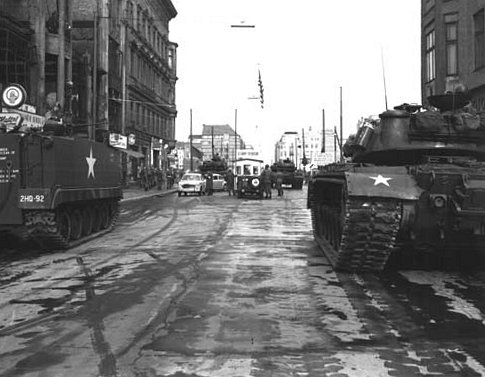
Checkpoint Charlie
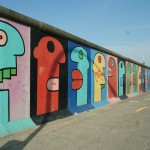
East Side Gallery
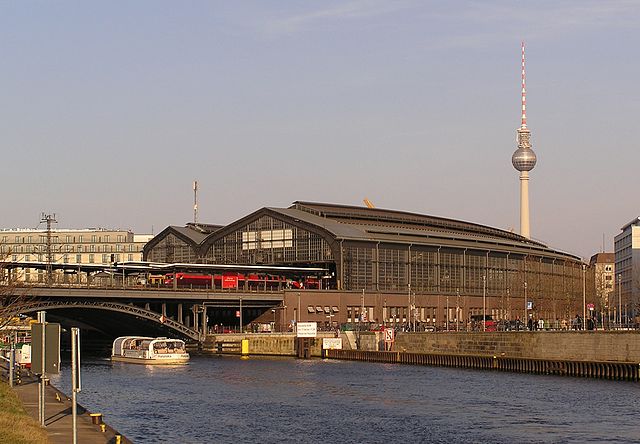
Bahnhof Friedrichstraße
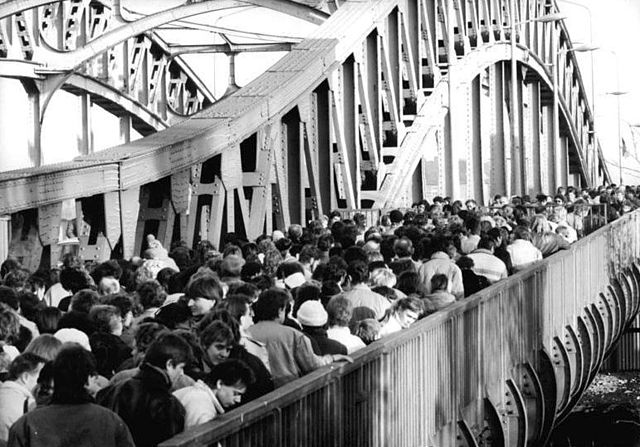
Bornholmer Straße
65 Years Ago: US and Soviet Tanks Faced Off at Checkpoint Charlie
The Border Guards of the Berlin Wall: Conscripts, the Order to Shoot, and the Trials That Followed
9 November in Berlin: 37 Years Since the Wall Fell, and What’s On
Gethsemanekirche
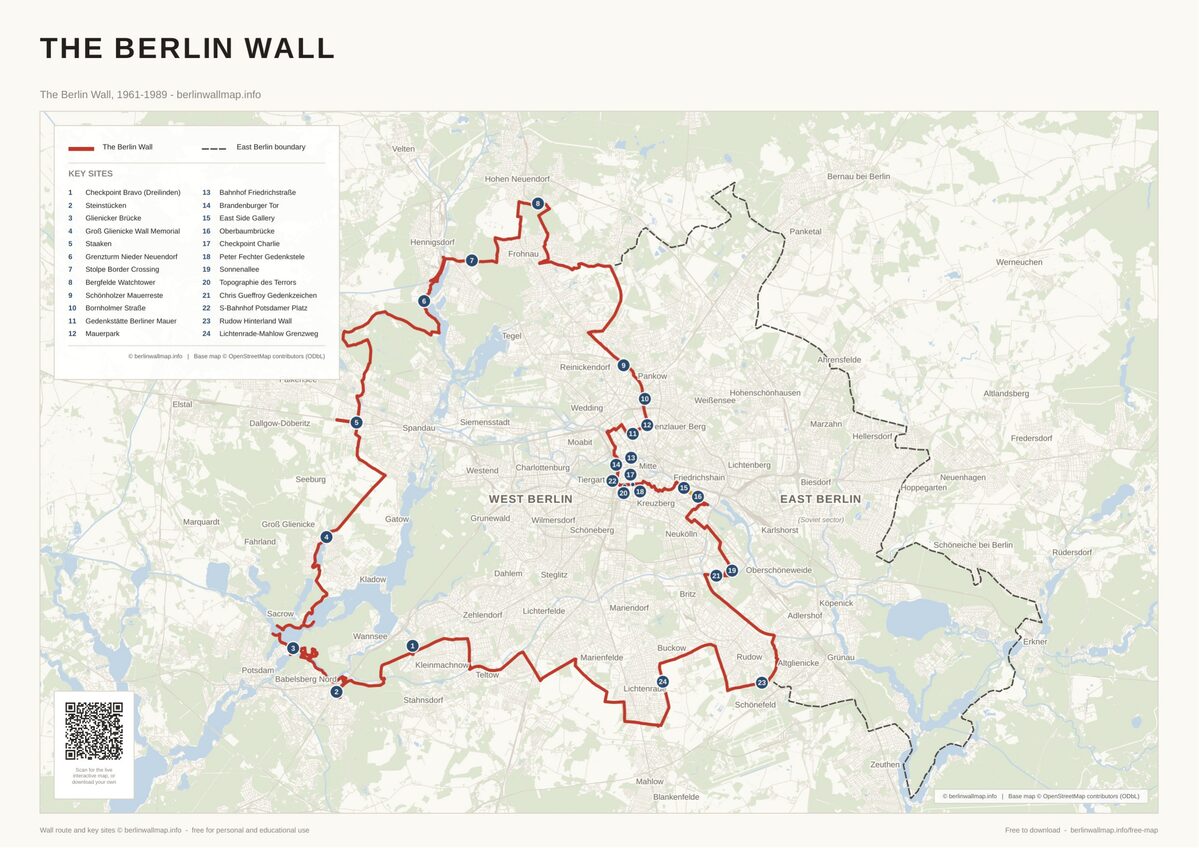
Free map downloads
Free printable PDF maps of the Berlin Wall.
Get the free maps →Explore the Timeline
Journey through Berlin Wall history from 1945 to 1990.
View Timeline →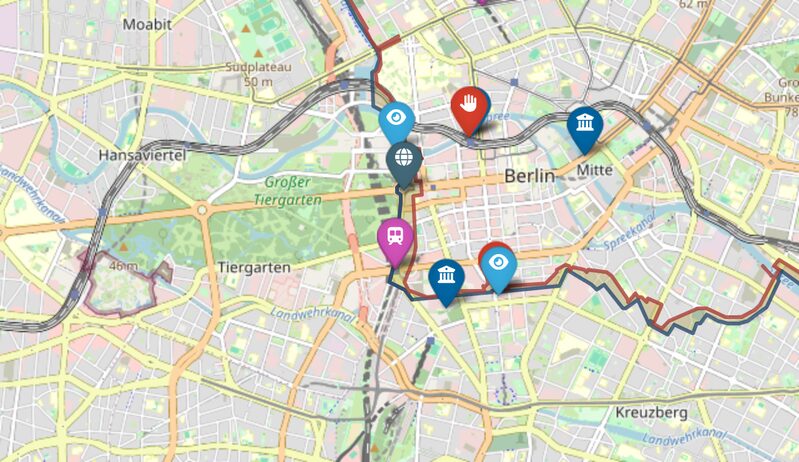
Embed Our Map
Add a free interactive Berlin Wall map to your website or blog.
Get embed code →