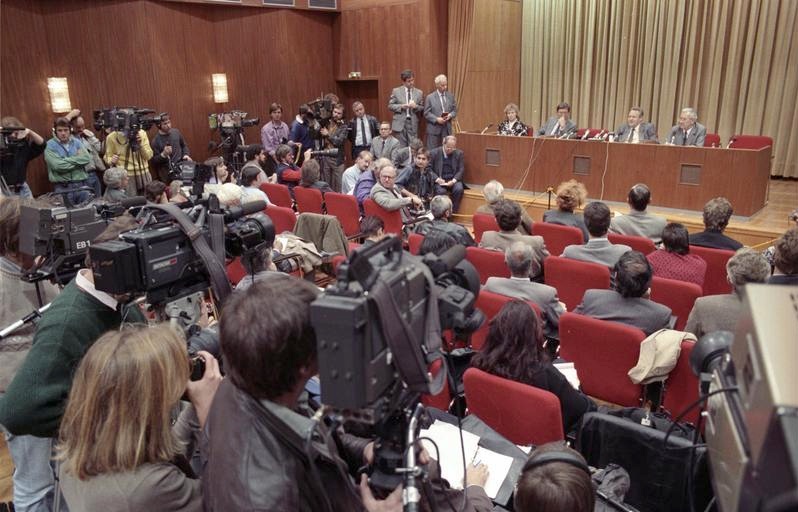
Internationales Pressezentrum
The International Press Centre on Mohrenstrasse (now Anton-Wilhelm-Amo-Strasse) where Gunter Schabowski held his historic press conference on 9 November 1989, accidentally announcing the opening of the Berlin Wall. The building served as the GDR’s official press centre for foreign correspondents throughout the Cold War.
The building at Mohrenstrasse 36/37, known as “Haus Stern”, was originally designed by architect Carl Bauer in 1901 for the Stern family’s clothing business. Under the GDR it became the Internationales Pressezentrum (IPZ) — the official venue where foreign correspondents based in East Berlin attended government briefings and press conferences. For decades it was one of the few places where Western journalists had regular, controlled access to East German officials.
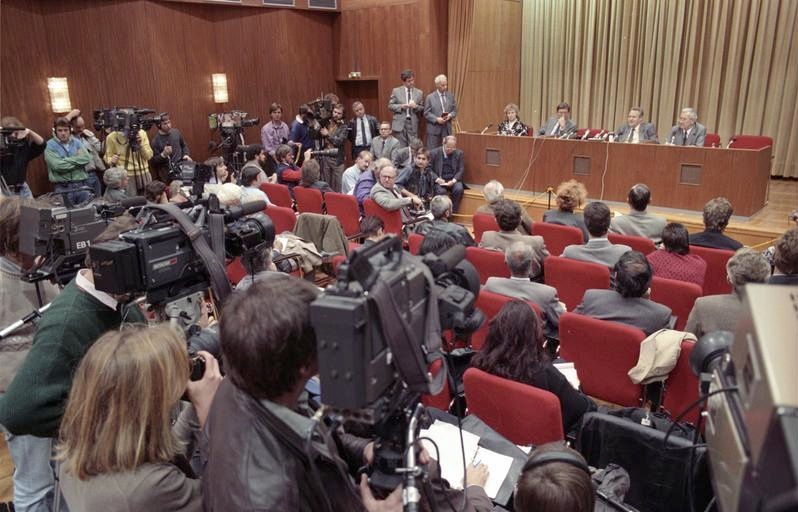
Gunter Schabowski at the press conference that opened the Berlin Wall, 9 November 1989 (Photo: Bundesarchiv)

On the evening of 9 November 1989, this room became the setting for one of the most consequential moments in modern history. At 18:53, SED spokesman Gunter Schabowski began a routine press conference. Just before stepping in front of the cameras, party leader Egon Krenz had pressed a sheet of paper into his hands containing new travel regulations — telling him only “This will be the world news.” Schabowski had missed the earlier discussion about the regulations and did not know they were supposed to take effect the following day, with orderly processing at border offices.
Near the end of the conference, Schabowski read the note aloud: East German citizens would be permitted to travel freely, including through all border crossings with West Berlin and West Germany. When a journalist asked when the new rules would take effect, Schabowski paused, shuffled through his papers, and replied: “Das tritt nach meiner Kenntnis… ist das sofort, unverzuglich” — “As far as I know, that takes effect… immediately, without delay.”
West German television broadcast the exchange on the evening news, which was watched across East Germany. Within hours, thousands of East Berliners headed to the border crossings. At 23:30, Stasi officer Harald Jaeger, overwhelmed by the growing crowd, made the decision to open the gates at Bornholmer Strasse — the first crossing to open. By midnight, all crossings were flooded with people. The Wall had fallen.
The building today belongs to the Federal Ministry of Justice and has been extensively renovated. The original press room no longer exists — it was converted into a skylight atrium during reconstruction. The lectern where Schabowski read the note that changed history is now in the Haus der Geschichte in Bonn. An art installation by Ulrich Schroeder, “Die Verkundung der Reisefreiheit” (The Proclamation of Travel Freedom), with rows of chairs and memorial plaques, marks the event in the building’s former entrance area. The street was renamed from Mohrenstrasse to Anton-Wilhelm-Amo-Strasse in August 2025, honouring the first known German scholar of African descent.
Show me on the mapGallery

Nearby Berlin Wall Sites
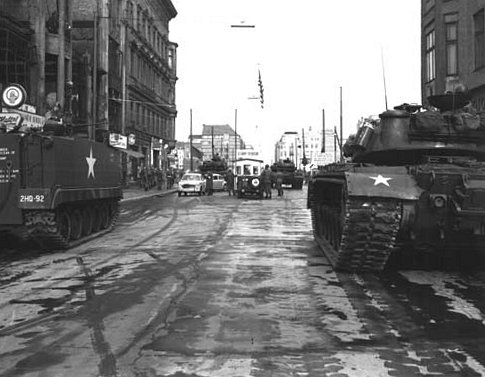
Checkpoint Charlie
East Side Gallery
Bahnhof Friedrichstraße
History of the Berlin Wall: A Complete Guide (1961-1989)
65 Years Ago: US and Soviet Tanks Faced Off at Checkpoint Charlie
The Border Guards of the Berlin Wall: Conscripts, the Order to Shoot, and the Trials That Followed
9 November in Berlin: 37 Years Since the Wall Fell, and What’s On
Gethsemanekirche
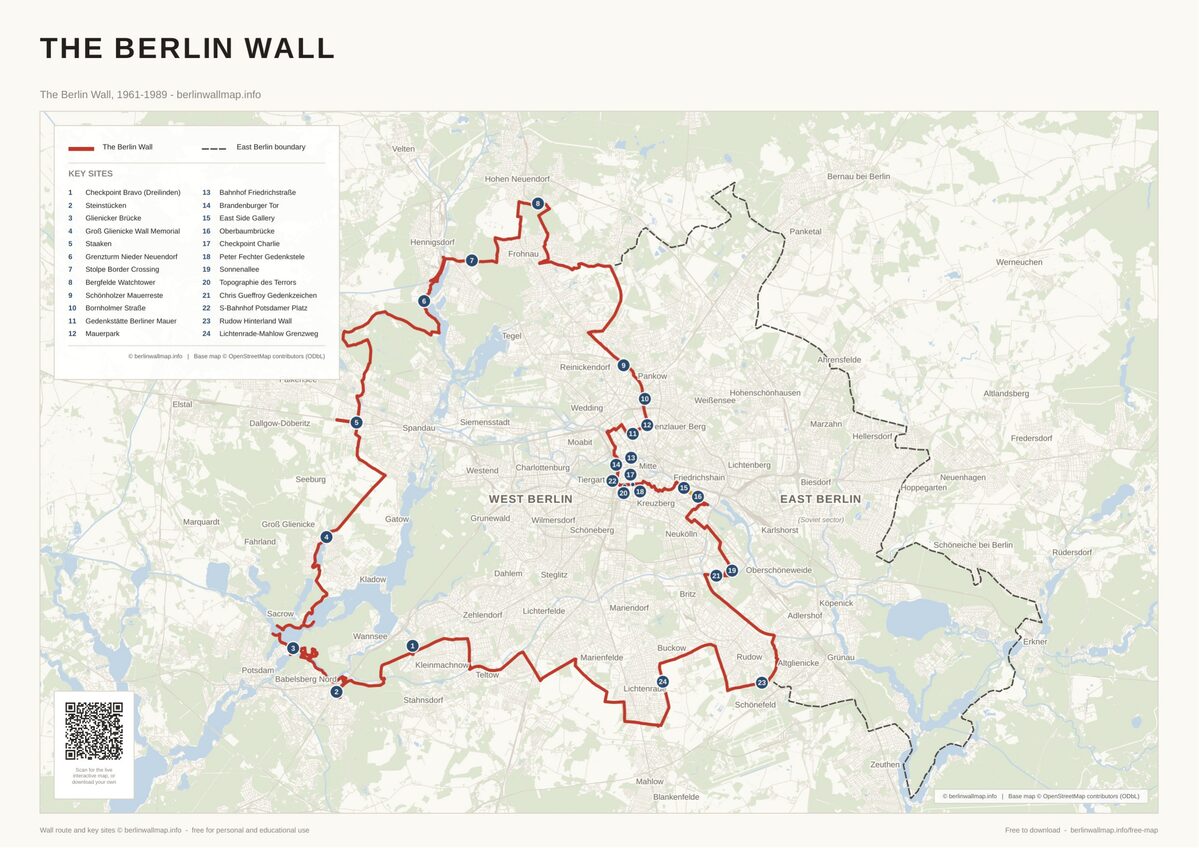
Free map downloads
Free printable PDF maps of the Berlin Wall.
Get the free maps →Explore the Timeline
Journey through Berlin Wall history from 1945 to 1990.
View Timeline →
Embed Our Map
Add a free interactive Berlin Wall map to your website or blog.
Get embed code →