Music Behind the Wall: Rock, Punk and Wolf Biermann in East Germany
The Berlin Wall did not only inspire the rock stars of the West. On the far side of the concrete lay a whole other musical world – one the East German state tried, by turns, to own, to license and to silence. This is the story of music behind the Wall: the home-grown rock the GDR tolerated, the tiny punk scene it hunted through the churches, and the banned singer-songwriter whose exile helped crack the country open. It is the companion to our main guide to the Berlin Wall in music, which follows the songs and concerts on the Western side.
Rock in the GDR: Licensed and Censored
East Germany did not ignore rock and roll; it tried to own it. From the mid-1960s the state alternately banned and licensed a domestic scene, afraid of the pull of Western pop. In October 1965 the ruling party withdrew the performing licences of most beat bands, and when fans gathered in Leipzig on 31 October to protest, police broke up the crowd with dogs and water cannon, arresting more than 250 and sending around a hundred to forced labour in the brown-coal pits – the largest unauthorised demonstration in the GDR between the uprising of 1953 and the autumn of 1989. A standing rule required that at least sixty per cent of the music played in public be Eastern-bloc rather than Western, and every band needed a state licence, granted or withheld by a commission that judged lyrics for ideology as much as for quality. You could sing about almost anything except crossing the border.
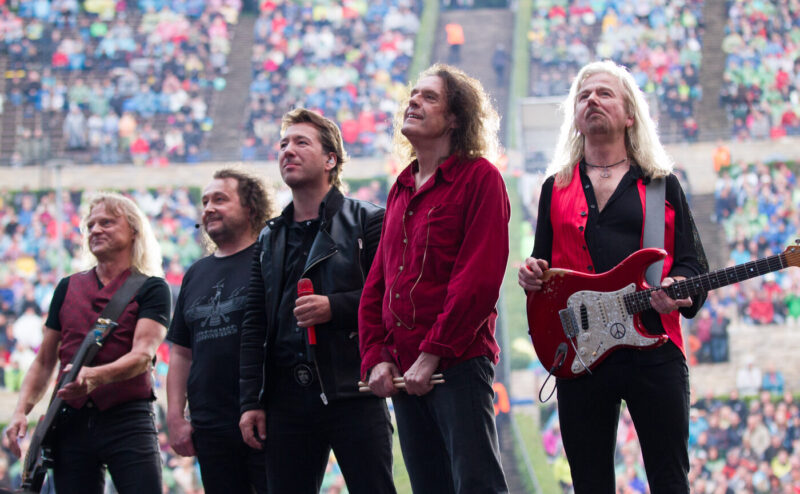
Within those limits a real East German rock culture grew up. The Puhdys, formed in 1969, became the biggest and most tolerated GDR band and the first allowed to tour the West; City’s “Am Fenster” (1977), carried by a soaring violin, became a rare Eastern record to chart on both sides of the Wall. The strangest crossing was Karat’s “Über sieben Brücken musst du gehn” (1978), a wistful song about life’s road that the West German star Peter Maffay covered in 1980 and drove to number four in the West – while Karat themselves, as GDR artists, were barred from Western television and could only watch their own song become someone else’s hit.
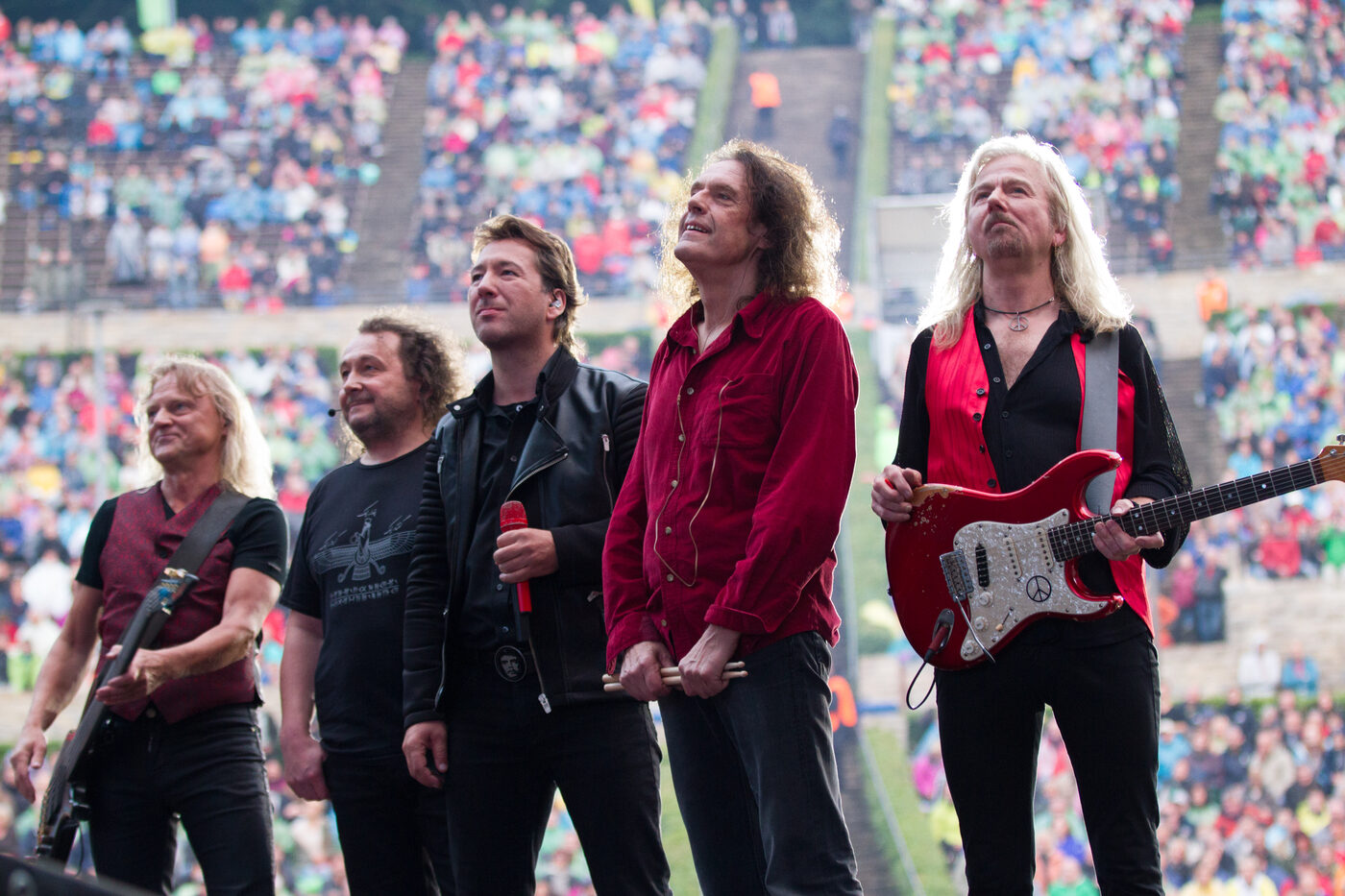
And when a band went too far, the state simply erased it. In September 1975 the authorities refused to renew the licence of the Klaus Renft Combo, the GDR’s most popular rock group, and declared that it no longer existed – largely over “Rockballade vom kleinen Otto”, a song about a man who tries to escape to the West by barge, is caught and jailed. Its members were interrogated, imprisoned or pushed into exile; Renft himself left for West Berlin. A band was destroyed for a three-minute song about someone trying to cross the Wall.
Too Much Future: Punk Under the Wall
By the early 1980s a tiny, ferocious punk scene had appeared in East Berlin, Leipzig and beyond – never more than around 900 registered punks in the whole country, and treated by the Stasi as a threat to the state. Where the Sex Pistols had screamed “No Future”, East German punks turned the slogan inside out: their curse was “too much future”, the grey, guaranteed, walled-in life the socialist state had already mapped out for them. Bands like Planlos, Wutanfall and Namenlos played wherever they could, mostly in the one space the regime could not fully control – the Protestant churches, where the Zionskirche in Prenzlauer Berg became a hub.
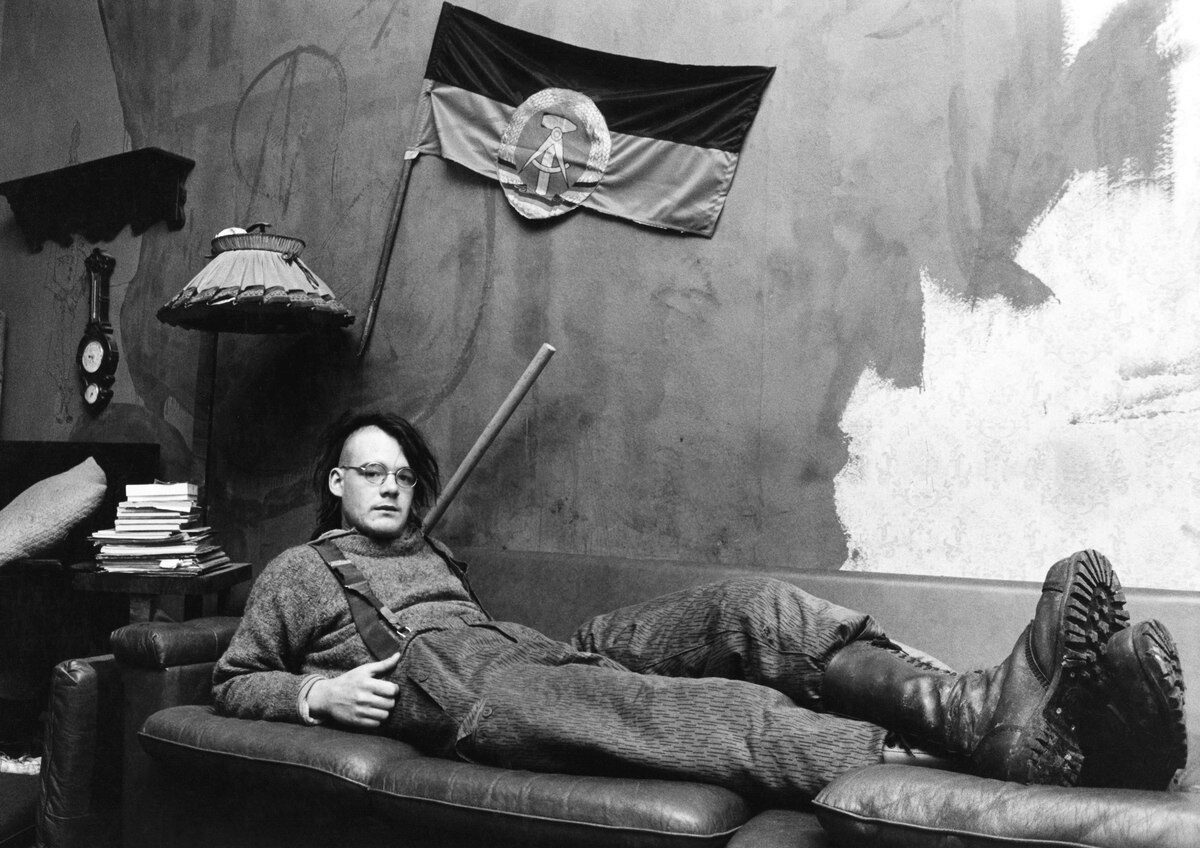
The state answered with informers, broken-up concerts and prison. After a church concert in 1983 the entire band Namenlos was arrested for songs about the border and the secret police; two of its members were sentenced to eighteen months, another to a year. Yet the scene survived, and one thread runs straight out of it into global fame: Feeling B, formed in East Berlin in 1983, included the musicians Flake Lorenz and Paul Landers, who after the Wall fell went on to co-found Rammstein. The most walled-in youth in Europe made some of its angriest music, and some of it outlived the country that tried to silence it.
Wolf Biermann and the Song That Got Him Exiled
The most consequential musician on the Eastern side never had a chart hit at all. Wolf Biermann was born in Hamburg, in the West, the son of a Jewish communist dockworker murdered at Auschwitz – and in 1953, aged sixteen and a convinced communist, he moved the other way, emigrating to East Germany by choice. It is the great irony of his life: the GDR’s most famous dissident had chosen the East. His sharp, satirical songs – performed alone with a guitar in the tradition of the Liedermacher – soon made him an enemy of the state, and from 1965 he was banned from performing or publishing anywhere in the country. He recorded his best-known album, “Chausseestraße 131”, in secret in his own Berlin flat, on equipment smuggled in from the West.

In November 1976 the regime made a fatal mistake. It let Biermann travel to Cologne to give a concert, broadcast on West German television, and there – on 13 November – he performed a new song, the “Ballade vom preußischen Ikarus”, which pictured the GDR as an island ringed by barbed wire and shoot-to-kill orders, an Icarus who fears he will crash if he ever tries to fly to freedom. Three days later, on 16 November 1976, the East German leadership stripped him of his citizenship and refused to let him back in.
The response inside the GDR was unprecedented. An open letter of protest – signed first by twelve of the country’s most respected writers, among them Christa Wolf, Stefan Heym, Sarah Kirsch and Heiner Müller, and then by more than a hundred other artists – circulated in open defiance of the party. The regime answered with expulsions, reprimands and arrests, and set off a slow exodus of the GDR’s cultural elite that many historians now call one of the beginnings of the end of East Germany. Among those who left in Biermann’s wake was his own stepdaughter, a young singer named Nina Hagen: she got out in 1976, moved to West Berlin, and reinvented herself as one of the defining figures of German punk. A single banned songwriter had cracked the cultural foundations of the state a full thirteen years before its Wall came down.
The Sound of a Lost Country
When the Wall fell, the music that had been licensed, censored and banned did not vanish with the state that made it. The East German records are now cherished as the sound of a country that no longer exists; Wolf Biermann, stripped of his citizenship in 1976, would one day sing again in the German parliament; and the punks the Stasi had hunted turned out to be building something that outlasted the GDR – Feeling B’s Flake Lorenz and Paul Landers went on to form Rammstein, the biggest German-language rock band in the world. The state that tried hardest to control its music ended up producing some of the most defiant sounds of the Cold War.
Frequently Asked Questions
Who was Wolf Biermann?
Wolf Biermann was an East German singer-songwriter and the GDR’s most famous dissident, banned from performing at home from 1965. In November 1976 the regime let him tour the West, then stripped him of his citizenship while he was in Cologne. The protest by East German artists that followed is often seen as one of the first cracks in the GDR.
What is Ostrock?
Ostrock is the rock music of communist East Germany – a state-licensed, German-language scene led by bands such as the Puhdys, City, Karat and Silly. Groups needed an official permit to perform and their lyrics were censored, but the best Ostrock records, like City’s “Am Fenster”, were loved on both sides of the Wall.
Was there punk in East Germany?
Yes, though never more than around 900 registered punks in the whole country. The scene, with bands like Namenlos and Planlos, was treated as a threat by the Stasi and survived largely by playing in Protestant churches; members were spied on, arrested and imprisoned. Feeling B, from this scene, later gave rise to Rammstein.
Which East German bands were banned?
The most famous banning was the Klaus Renft Combo, declared “no longer to exist” in 1975, largely over a song about a failed escape to the West. Wolf Biermann was banned from 1965 and expatriated in 1976. Many other artists were censored, refused licences, or pushed into exile.
This is the Eastern half of the story – for the songs and concerts on the Western side, and the music that marked the Wall’s fall, see the Berlin Wall in music. The Wall shaped painting and film too: explore the Berlin Wall in art and on screen, trace every surviving site on our interactive map, or follow the division on the history timeline.
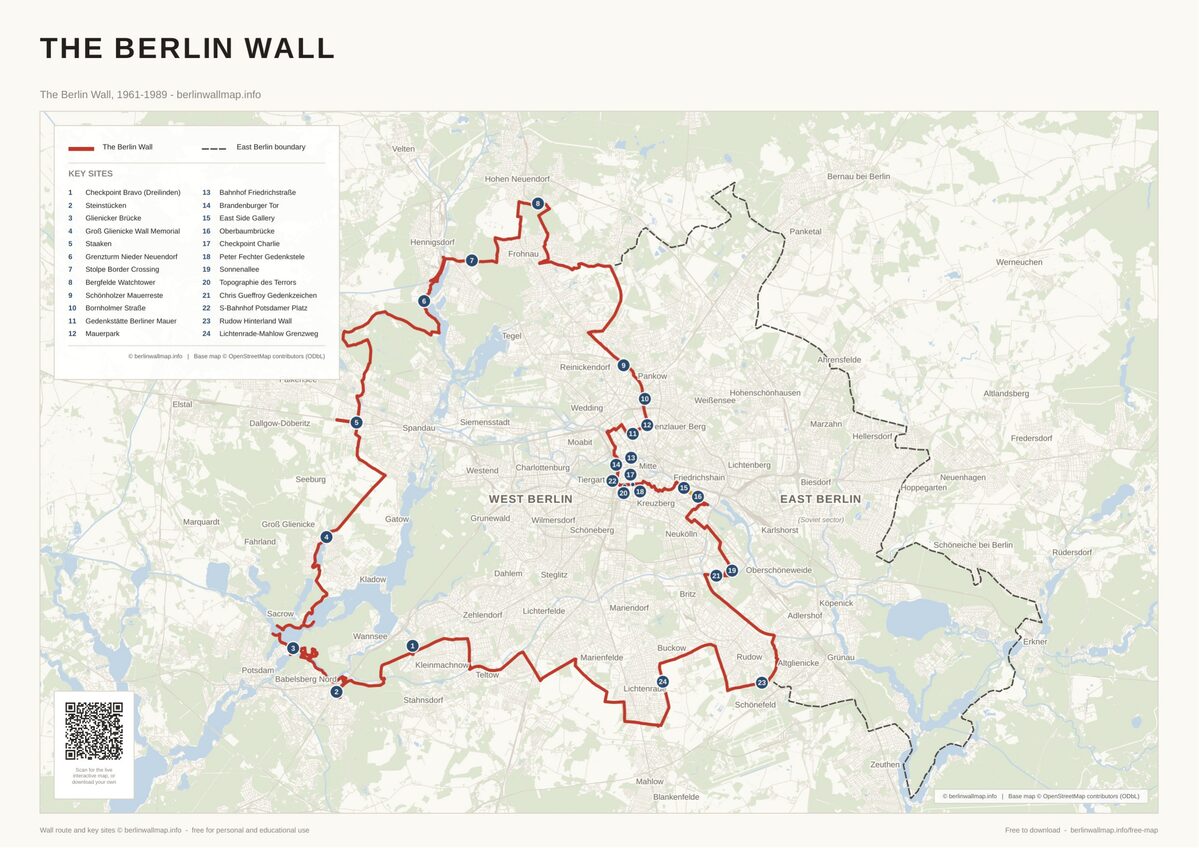
Free map downloads
Free printable PDF maps of the Berlin Wall.
Get the free maps →Explore the Timeline
Journey through Berlin Wall history from 1945 to 1990.
View Timeline →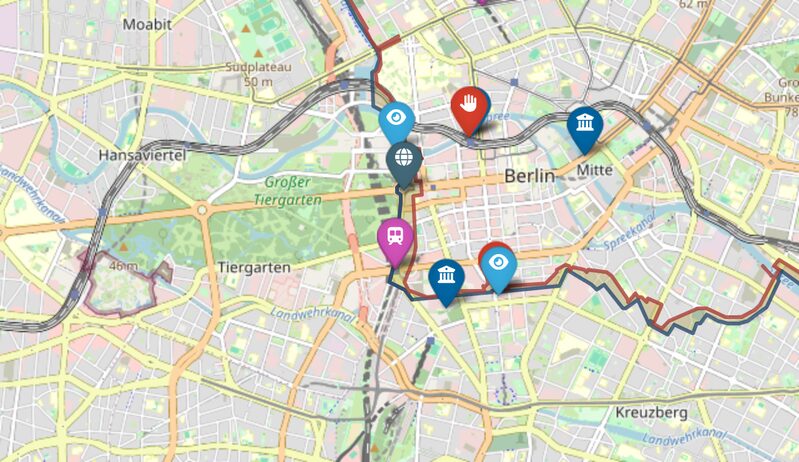
Embed Our Map
Add a free interactive Berlin Wall map to your website or blog.
Get embed code →