East Side Gallery: Berlin Wall Murals & Visitor Guide
For 28 years the Berlin Wall was something to be feared, not admired. Then, in the first months of 1990, with the border already open and the concrete still standing, 118 artists from 21 countries arrived on a 1.3-kilometre stretch beside the River Spree and began covering its bare grey concrete in art. The result was the East Side Gallery – the longest surviving section of the Berlin Wall, and, as its creators like to say, the longest open-air gallery in the world. This is the story of how it came to be, the murals that made it famous, the fight to save it from the wrecking ball, and how to walk its full length today.
The Longest Surviving Stretch of the Wall
The East Side Gallery runs along Mühlenstraße in Friedrichshain, on the eastern bank of the Spree between the Ostbahnhof and the Oberbaumbrücke. At just over 1.3 kilometres it is by far the longest continuous piece of the Berlin Wall left standing anywhere – most of the rest was broken up for hardcore or sold off in fragments within a couple of years of the border opening.
What survives here is the Hinterlandmauer, the smooth concrete inner wall that faced into East Berlin. Crucially, the artists painted the side that looked east – the face East Berliners lived alongside but were forbidden to go near, patrolled by border guards, with the death strip and the river hidden just behind it. That is what gives the gallery its charge: the paintings cover the very surface that, a year earlier, no one on this side of the Wall was allowed to touch.
The Side That Was Never Painted
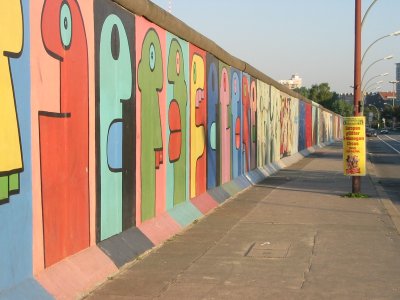
To understand why the East Side Gallery matters, it helps to know exactly which wall you are looking at, because the geography here is unusual. For most of the 1980s the Berlin Wall was already one of the most painted objects on earth – but only where its outer wall stood directly against the streets of West Berlin. In districts like Kreuzberg you could walk straight up to the concrete, and artists smothered it in graffiti and murals: Thierry Noir’s giant cartoon heads ran for hundreds of metres there, and in 1986 the American pop artist Keith Haring painted a chain of linked figures near Checkpoint Charlie. It was riskier than it looked – the wall stood a metre or two inside East German territory, and guards could swing open doors camouflaged in the concrete and step out to seize spray cans or drag painters into the death strip. We tell that story – the outlaw pioneers and the hidden doors – in full in our guide to the Berlin Wall in art.
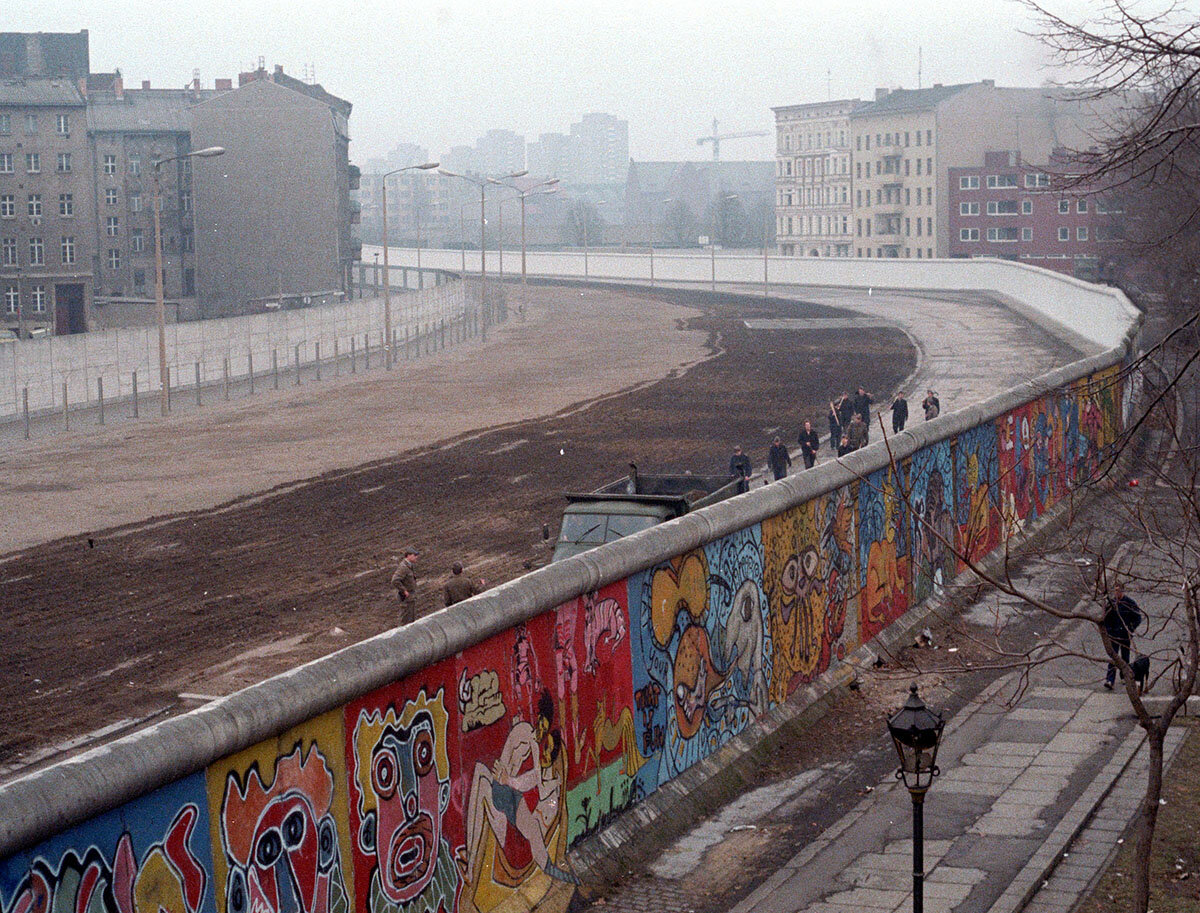
That outlaw West-side art belongs to a different story from the East Side Gallery. It grew up wherever the wall happened to be reachable, in scattered spots right across the western side of the city rather than as one planned gallery; it was made in secret years before the border opened; and it was almost all demolished along with the outer wall. A few painted segments do survive – among them Thierry Noir and Kiddy Citny originals standing on the green at Leipziger Platz.
The East Side Gallery sits on a completely different piece of the border. At Mühlenstraße the frontier was not a wall against a pavement but the River Spree itself. The whole width of the water belonged to East Berlin; West Berlin began only on the far Kreuzberg bank. There was no outer wall at all – the river did that job, patrolled by GDR border boats – and what survives today is the Hinterlandmauer, the inner wall that stood between the East Berlin streets and the water, built to block the view of the death strip beyond. Nobody was going to paint it: West Berliners were across a guarded river, and East Berliners could not go near their side of the Wall without facing the border troops and the Stasi. For nearly three decades it stayed exactly as it had been cast, bare grey concrete, facing back into the East.
That is the quiet meaning folded into the gallery’s name. When the artists arrived in 1990, they were not adding to the well-worn West-side canvas – they were painting the eastern, inner face of the border, a surface no one had ever been allowed to touch, turning the blankest and most forbidding side of the Wall into its most colourful.
From Death Strip to Open-Air Gallery
The idea came together with extraordinary speed. It was born within weeks of the Wall opening on 9 November 1989, when the West Berlin artist David Monty and the East Berlin artist Heike Stephan proposed turning the newly harmless barrier along Mühlenstraße into a gallery. Both dropped out before the painting was finished, and it was the Scottish artist Christine MacLean who saw the project through to completion. An open call went out, and 118 painters from 21 countries answered it – a few well known, most not, arriving from as far away as Japan, Israel and the United States.
They worked through the spring and summer of 1990 on a border that still technically belonged to a country in the act of disappearing; German reunification would not be complete until that October. When the gallery was officially opened on 28 September 1990, it carried more than 100 individual paintings, most of them raw, hopeful and unmistakably of their moment – a collective exhale that the division was finally over. In 1991 the whole stretch was placed under monument protection, which is a large part of why it is still here.
The Murals You Cannot Miss
Two paintings have become shorthand for the entire gallery, and both sit within a short walk of each other.
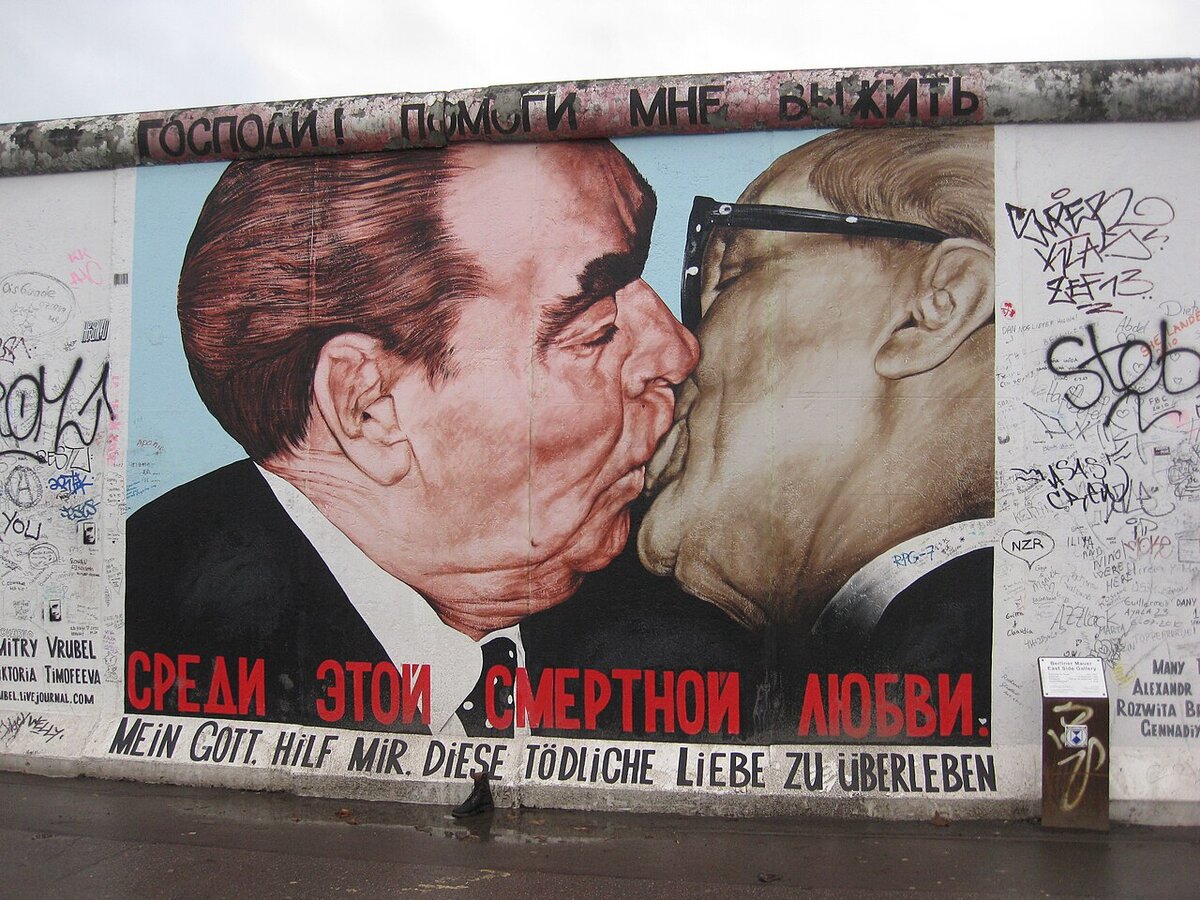
The most photographed is Dmitri Vrubel’s My God, Help Me to Survive This Deadly Love, universally known as the “Fraternal Kiss.” The Russian-born artist reproduced a 1979 news photograph of Soviet leader Leonid Brezhnev and East German leader Erich Honecker locked in the socialist “fraternal kiss,” a genuine diplomatic ritual between communist heads of state. Painted at wall scale, with its handwritten caption arcing overhead, the ritual curdles into something absurd and faintly grotesque – a fitting epitaph for the regime that had just collapsed.
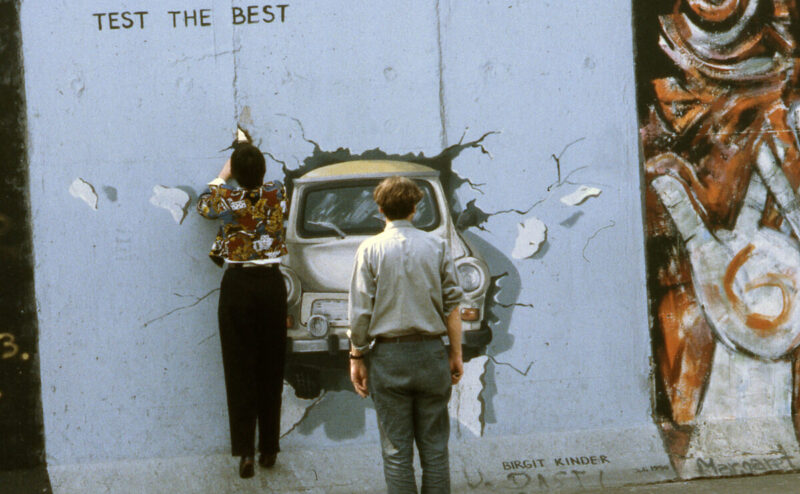
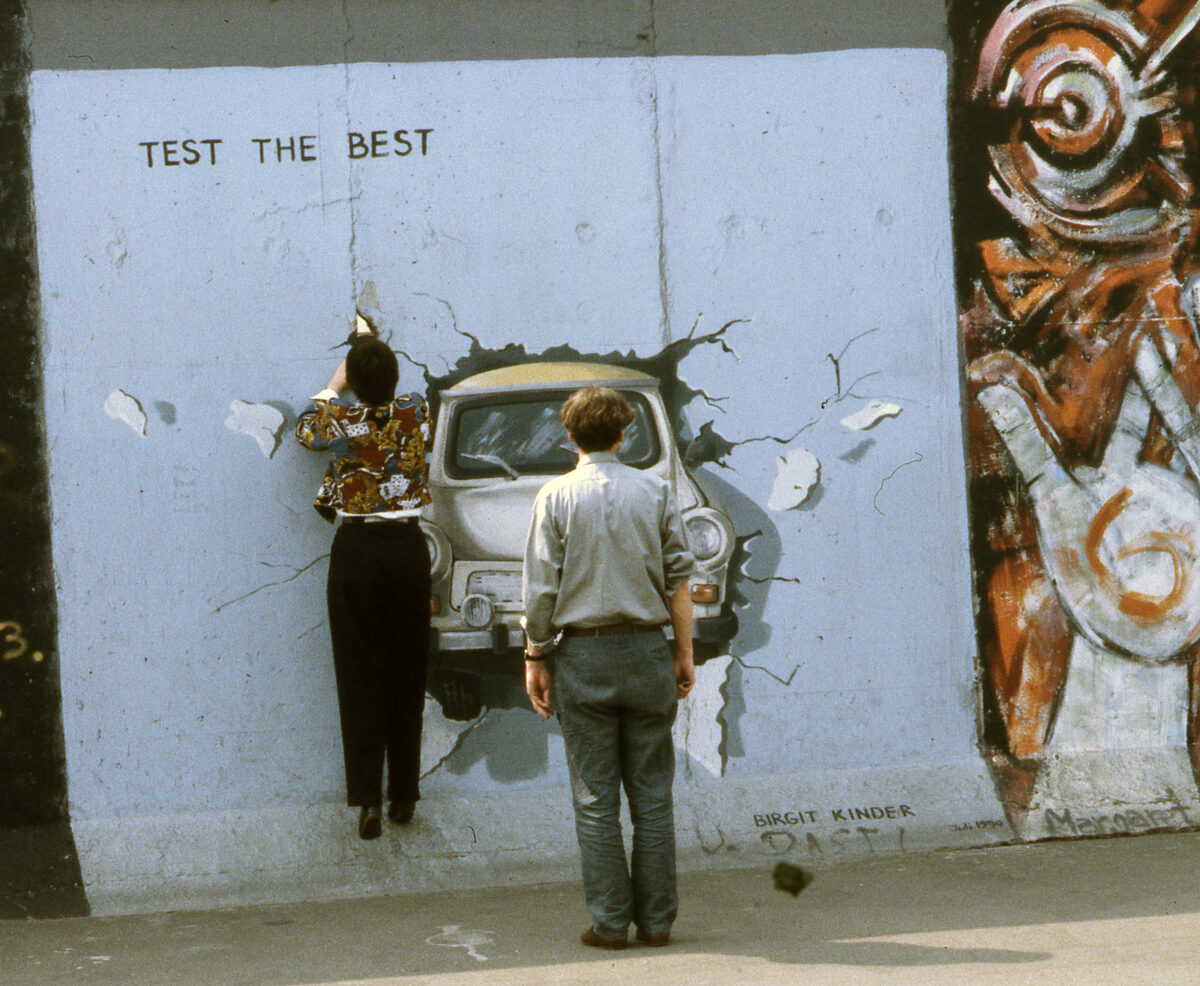
A few metres away is Birgit Kinder’s Test the Best, in which a Trabant – the flimsy, two-stroke people’s car of the GDR – bursts head-on through the concrete, headlights blazing, its number plate reading “NOV 9-89.” No car ever really crashed through the Wall, but the image caught what millions of East Germans actually did that November better than any photograph could: they simply drove west in the little cars they had queued for years to buy. When Kinder repainted the mural in the 2009 restoration, she pointedly retitled it Test the Rest – a jab at the city’s neglect of the gallery it was fighting to save.
Kani Alavi’s It Happened in November turns the night itself into paint. The German-Iranian artist had watched the crowds surge past his window near Checkpoint Charlie on 9 November 1989, and his mural renders that memory as a torrent of faces pressing through a breach in the Wall – eyes wide with joy, disbelief and, here and there, fear. Alavi later co-founded and long chaired the artists’ initiative that has fought to protect the murals ever since.
Not every wall here looks back at 1989. Thomas Klingenstein’s Detour to the Japanese Sector raises a red sun over Mount Fuji and a pagoda – the childhood dream of a boy who grew up in East Berlin, was jailed at nineteen and expelled to the West for wanting to leave, and was finally free to reach the Japan the GDR had forbidden him even to study. Its title mimics the old Cold War sector signs, inventing a “Japanese sector” that never existed on any map of Berlin.
Beyond them the gallery runs to more than 100 works in every register, from New York-style graffiti to classical allegory. Thierry Noir, who had risked those hidden doors painting the western wall throughout the 1980s, returned to paint one of the gallery’s longest stretches – Hommage an die junge Generation (Homage to the Young Generation), the same bright cartoon heads he had pioneered in the West, now facing East, and repainted by his own hand in the 2009 restoration. The man who helped begin it all on the reachable side had finally painted the other one.
A Gallery Under Threat
Paint on an outdoor concrete wall does not age well. By the 2000s the murals were fading, flaking and buried under later graffiti, and in 2008-09 the site underwent a full restoration. It was more drastic than it sounds: to repair the crumbling masonry beneath, the original paintings had to be destroyed and then repainted. More than 90 of the original artists were invited back to recreate their works – some produced faithful copies, some reworked them, and a handful refused on principle, leaving their sections blank. The restored gallery reopened on 6 November 2009, three days before the 20th anniversary of the fall of the Wall.
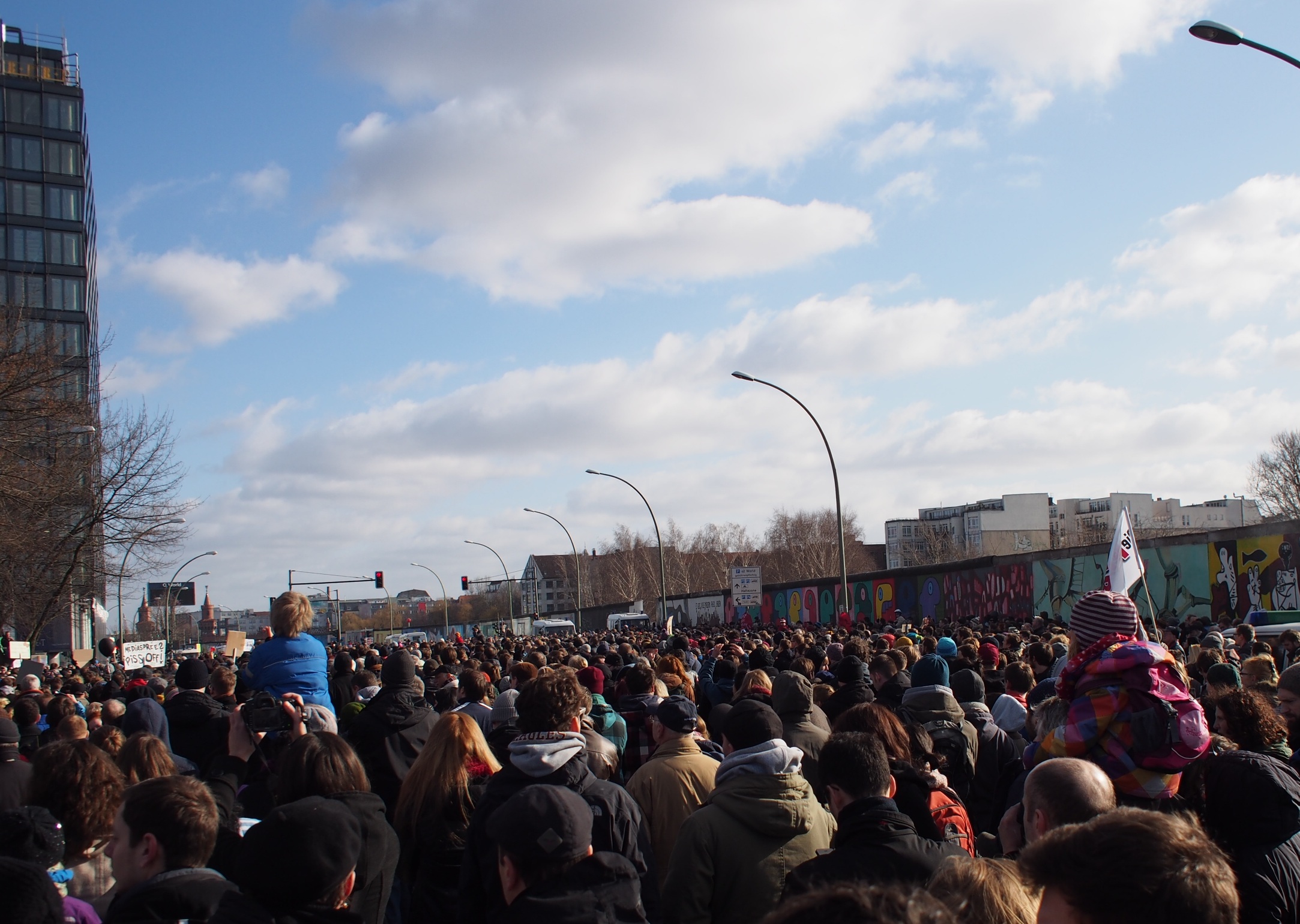
The bigger threat, though, was not the weather but the value of the land. The gallery sits on prime riverfront in the middle of the “Mediaspree” development zone, and as investors moved in, sections of the protected Wall stood in the way of luxury apartment towers and a hotel. In 2013 a stretch was removed at night, under police guard, to clear an access road for a high-rise called Living Levels – and the removal set off the largest protests the gallery has ever seen. Thousands formed human chains along Mühlenstraße; the actor and one-time Berlin Wall serenader David Hasselhoff flew in to join them. The demonstrations slowed but did not stop the developers, and further segments were relocated a short distance away.
The saga finally pushed the state of Berlin to act. In November 2018 the land was transferred to the Berlin Wall Foundation – the public body that also runs the Berlin Wall Memorial on Bernauer Straße – which now conserves the East Side Gallery as an official monument and memorial rather than leaving its survival to the property market.
Visiting the East Side Gallery
Visiting could hardly be simpler: the gallery is outdoors, open around the clock, and free. It runs along Mühlenstraße on the Friedrichshain bank of the Spree; the easiest arrival is the S-Bahn and U-Bahn interchange at Warschauer Straße, or Ostbahnhof at the northern end. Walking the full 1.3 kilometres and actually stopping at the murals takes most people 45 minutes to an hour.
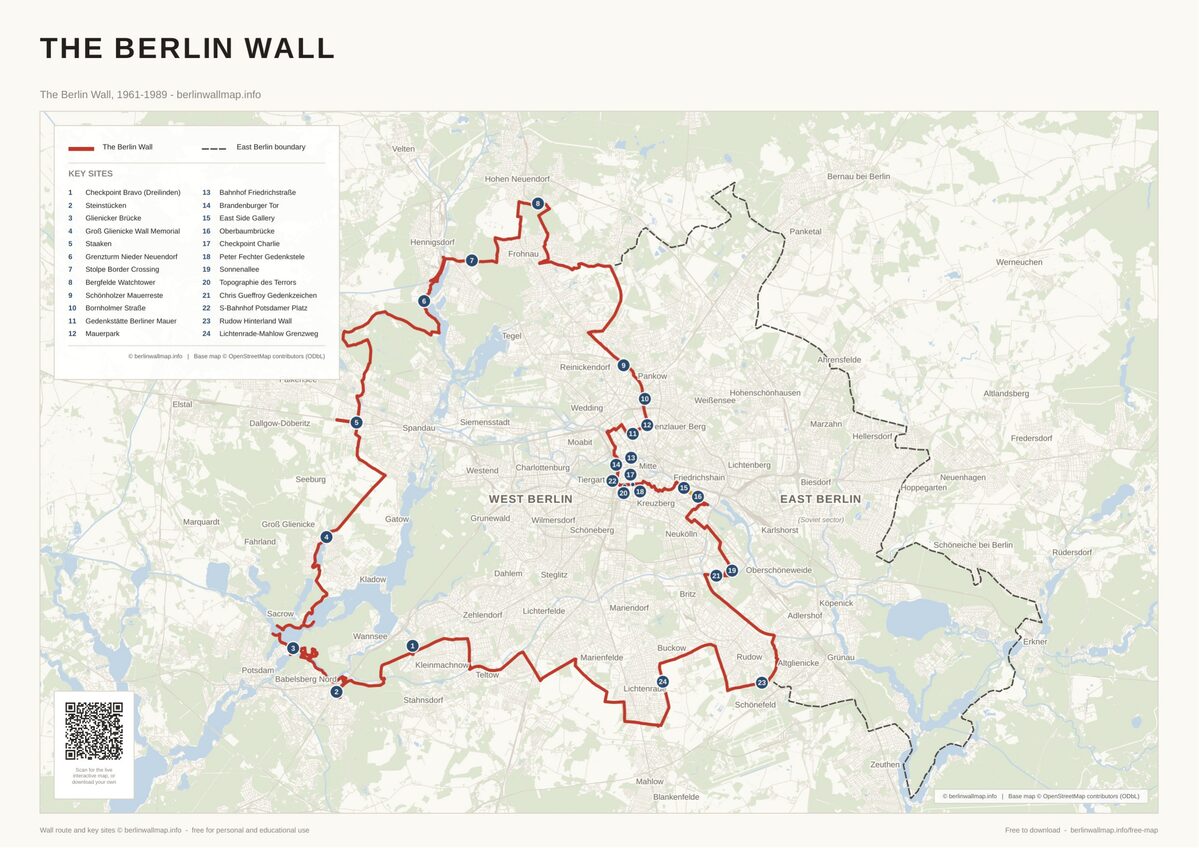
A few practical notes. The painted side faces the street, not the river, so walk along the Mühlenstraße pavement rather than the riverside promenade. Come early if you want the famous murals to yourself – by midday the Vrubel kiss and the Trabant are ringed with visitors. And do not simply turn back at the end of the Wall: the Oberbaumbrücke, the photogenic double-decker brick bridge at the southern end, is one of the finest spots in the city and carries you straight across the Spree into Kreuzberg. To place the gallery in the wider geography of the border, open it on our interactive map, or download the free Berlin Wall walking map before you go.
Frequently Asked Questions
What is the East Side Gallery?
It is a 1.3-kilometre section of the Berlin Wall on Mühlenstraße in Friedrichshain, painted by 118 artists from 21 countries in 1990 and preserved as an open-air gallery and protected monument. It is the longest surviving stretch of the Wall and Berlin’s most visited Wall site.
Is the East Side Gallery free to visit?
Yes. It is an open-air stretch of wall along a public street, free to visit at any hour – there is no ticket, gate or opening time. The murals are best seen in daylight and are least crowded early in the morning.
What is the most famous painting at the East Side Gallery?
Dmitri Vrubel’s “My God, Help Me to Survive This Deadly Love,” better known as the “Fraternal Kiss,” which shows the Soviet and East German leaders Brezhnev and Honecker kissing. Birgit Kinder’s “Test the Best,” a Trabant breaking through the Wall, is a close second.
Is the East Side Gallery the original Berlin Wall?
Yes – it is a genuine, in-place section of the border wall (the inner “hinterland” wall). The paintings, however, mostly date from the 2009 restoration, when the crumbling 1990 originals had to be destroyed and repainted, in many cases by the original artists. For a fuller comparison, see our guide to the difference between the Berlin Wall and the East Side Gallery.
How long is the East Side Gallery and how long does it take to see?
The gallery is just over 1.3 kilometres long. Walking its full length while stopping at the murals takes about 45 minutes to an hour.
See exactly where the East Side Gallery sits along the border on our interactive Berlin Wall map, or trace the events that led from the death strip to this open-air gallery on the Berlin Wall history timeline.
Free map downloads
Free printable PDF maps of the Berlin Wall.
Get the free maps →Explore the Timeline
Journey through Berlin Wall history from 1945 to 1990.
View Timeline →
Embed Our Map
Add a free interactive Berlin Wall map to your website or blog.
Get embed code →