The Berlin Wall in Art: Graffiti, Murals and the East Side Gallery
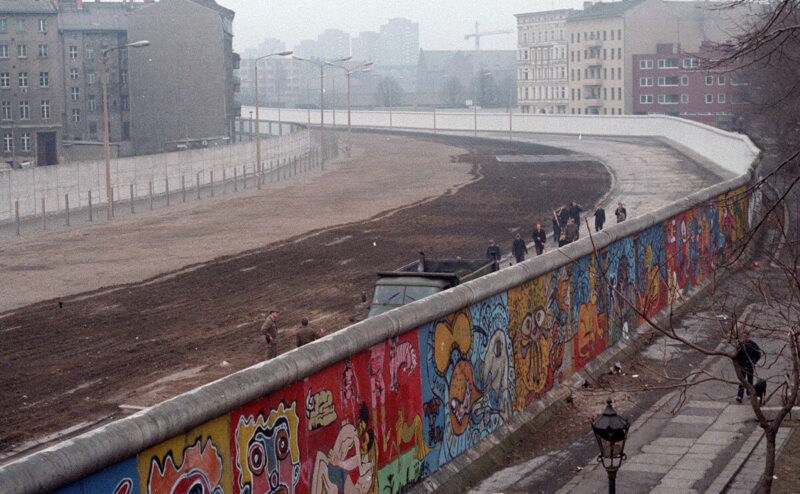
For nearly thirty years the Berlin Wall was one of the most heavily guarded borders on earth. It was also, on one side, the largest canvas in the world. The concrete facing West Berlin slowly filled with cartoon heads, slogans, hearts and murals, while the side facing East stayed blank and untouchable behind the death strip. This is the story of the Wall as a work of art – the graffiti pioneers who claimed it, the mural Keith Haring painted and lost in a single day, and the East Side Gallery, where the barrier finally became a canvas on the side that had always faced away.
The Wall as an Accidental Canvas
The Wall that tourists photograph today – a smooth, pale band of concrete standing well above head height – was the fourth and final version, the “Grenzmauer 75” built from the late 1970s. Its western face was a continuous grey surface almost four metres high, and, crucially, it was reachable. The actual border did not run along the concrete; it ran a metre or two in front of it, so the wall itself and the strip of ground before it technically stood on East German territory, but nothing stopped a West Berliner from walking straight up and touching it.
That geography created a lopsided artwork. The western face, standing in the middle of a free city, became covered in paint. The eastern face lay inside the death strip – floodlit, raked, patrolled by guards with orders to shoot – and no East Berliner could get within a hundred metres of it. The result was a wall that screamed colour towards the West and showed only bare concrete to the East.
The Most Dangerous Canvas in the World
What made the Wall such an extraordinary place to paint is that the artists were not, strictly speaking, standing in the West at all. The concrete rose a metre or two inside East German territory, and the ground in front of it belonged to the GDR as well. Anyone who stepped up to the wall to paint was, in the eyes of the East German state, standing on its soil and breaking its law. West Berlin’s own police generally left the painters alone; the real danger came from the other side of the concrete.
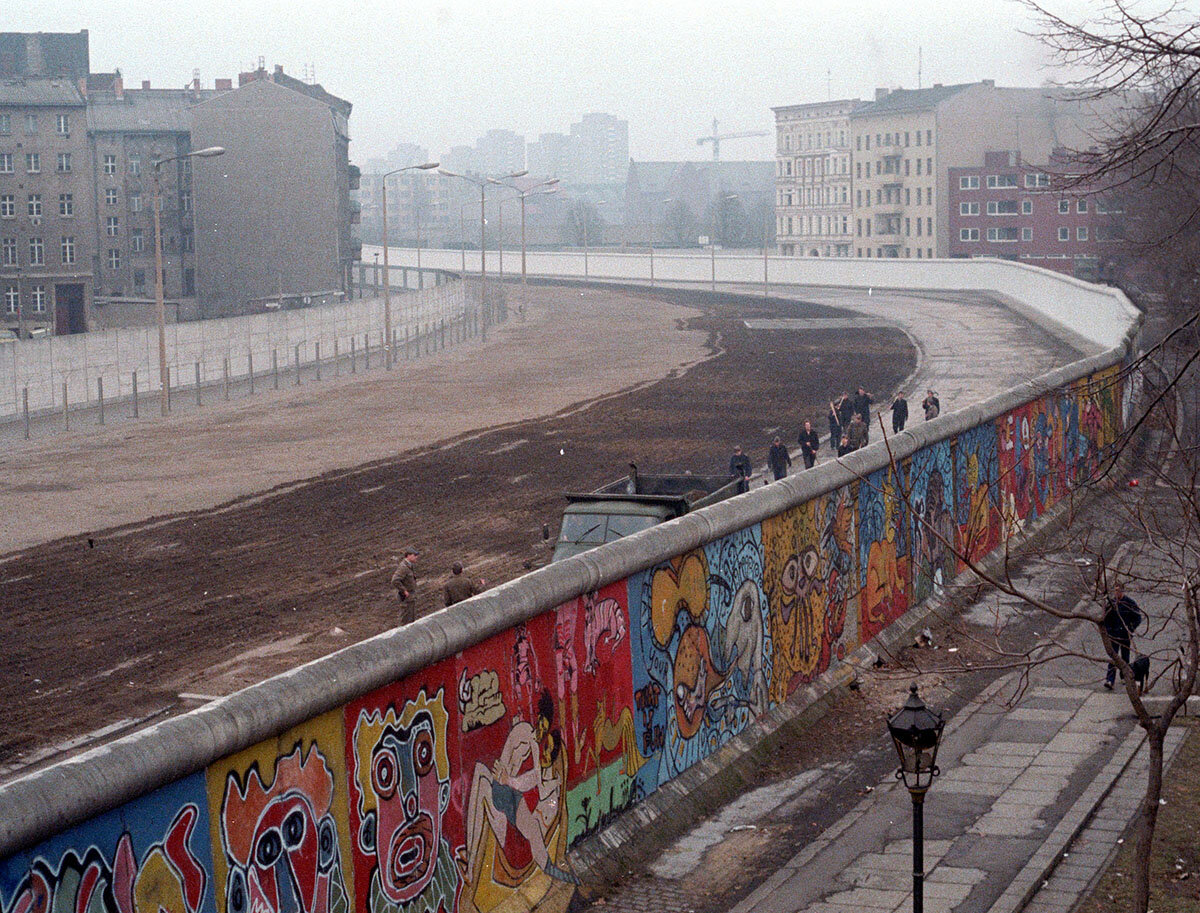
Built into the wall’s prefabricated segments were flush-fitting access doors, camouflaged against the grey concrete and almost invisible from the West. Each was locked with two keys in two separate keyholes, so that no single guard could open one alone. Their official job was maintenance – letting border troops out to repair the wall or scrub off the paint – but they doubled as a trap. A guard could unlock a door a few feet from an artist at work and step straight out onto the western face.
And they did. Border troops came through the doors to grab painters, seize their spray cans, and in the worst cases drag them back through into the death strip under arrest. The best-documented case came in 1986, when the activist Wolfram Hasch and four others were defacing the wall in the outer strip: guards appeared from a hidden door, the others scrambled back into West Berlin, but Hasch was pulled through, arrested, and convicted of illegally crossing the border – though he had never meant to leave the West at all.
Thierry Noir, who worked the wall almost daily, learned to read it for danger – above all to keep clear of those little doors – and was chased off by soldiers again and again. That constant threat is the whole reason the first Wall painters worked the way they did: there was no time for fine detail or second thoughts, only for big, simple shapes in a few bold colours. The speed you can still see in the paintings is the speed of people half-expecting a door to open behind them.
The Pioneers: Thierry Noir and Kiddy Citny
The first person to treat the Wall as a serious, sustained canvas was a young Frenchman. Thierry Noir arrived in West Berlin in 1982 and moved into the Künstlerhaus Bethanien on Mariannenplatz in Kreuzberg, an artists’ house that stood only metres from the border. In April 1984 he began to paint the Wall, often alongside his friend Christophe Bouchet, and he kept at it for years. His method was born of necessity: he called it his “fast form manifesto” – two ideas, three colours, and paint as quickly as possible before the guards appeared. What emerged were his signature giant heads, simple bright cartoon faces in profile, running for hundreds of metres.
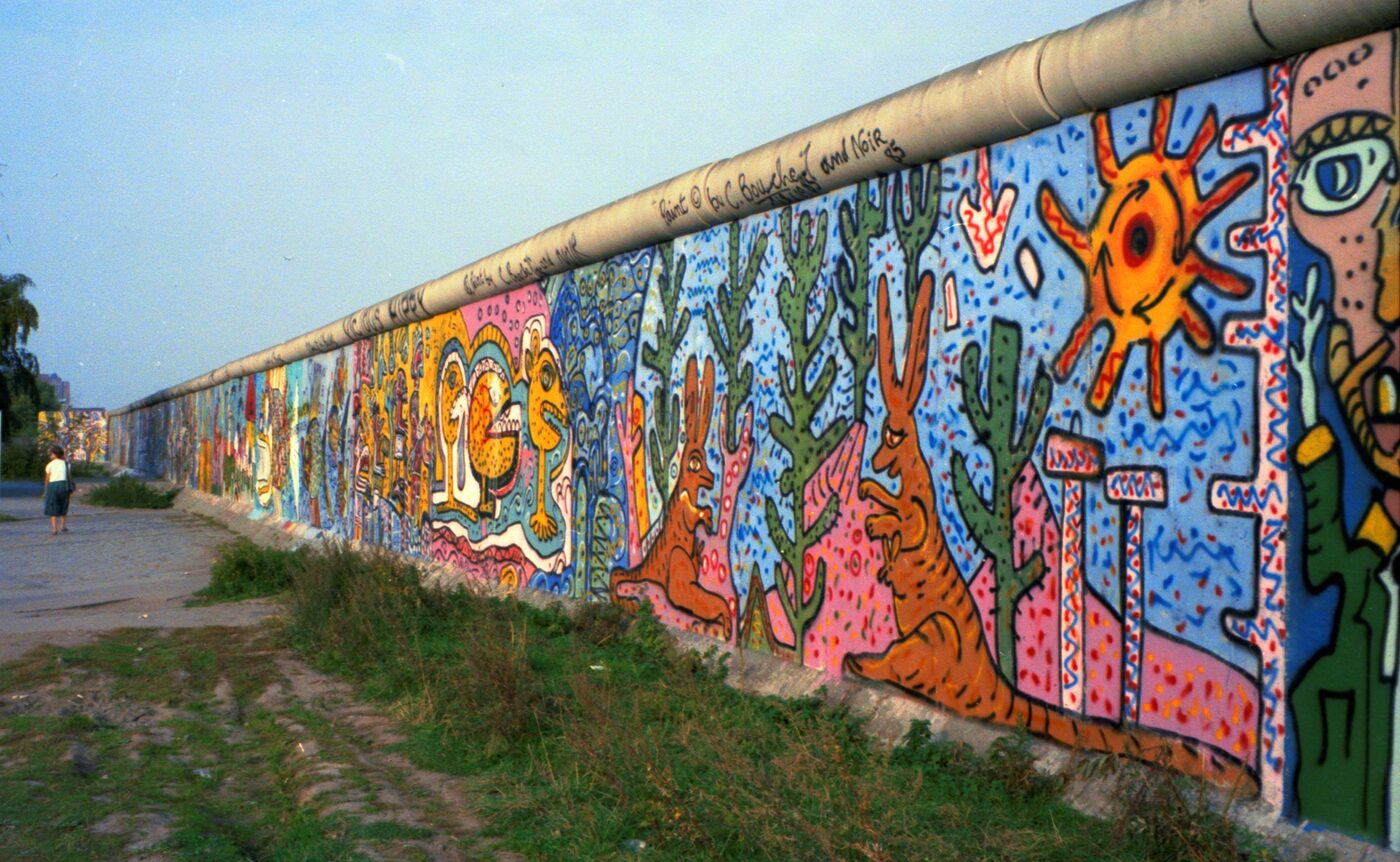
Noir always insisted the point was not to make the Wall beautiful. It was to transform it, to strip it of its power by making it ridiculous – to answer a monument of fear with something a child could laugh at. He was soon joined by others. The German artist Kiddy Citny painted the Wall through the mid-1980s in a language of red hearts and crowned figures, and the two men’s work, side by side, turned long stretches of the Kreuzberg wall into an open-air gallery years before that phrase was ever used.
There is a strange coda to their story. After the Wall fell, the very panels they had painted illegally became valuable objects. Painted segments were cut out and sold – a 1990 auction in Monaco scattered decorated sections to collectors around the world – and both artists spent years watching pieces of their outlaw art change hands as expensive relics, which raised an awkward question nobody had thought to ask in 1984: who owns a painting made without permission on the side of a dictatorship’s border wall?
Keith Haring’s Mural at Checkpoint Charlie
On 23 October 1986 the American pop artist Keith Haring, then at the height of his fame, was invited by the Checkpoint Charlie Museum to paint a stretch of the Wall near the famous crossing. Working quickly in his instantly recognisable style, he covered a long section in a single continuous chain of interlocking human figures, painted in the black, red and yellow of the German flag. The unbroken ribbon of linked bodies was a deliberate message: a divided people joined hand to hand, right across the barrier meant to keep them apart.
Haring knew exactly what he was doing. He was painting figures of national unity onto a monument of division, a few steps from armed guards, on concrete that legally belonged to the state on the other side. He also seems to have accepted that the work would not survive – and it did not. Within a day another painter had covered part of it over, and within months Haring’s mural had vanished under later layers of graffiti. Almost nothing of it remains but photographs. Haring, who died in 1990, treated that impermanence as part of the point: on the Berlin Wall, no image could ever be permanent. The irony is sharp. Haring’s visual language – the radiant baby, the barking dog, the linked dancing figures – went on to become one of the most reproduced styles on earth, stamped onto gallery walls, murals, T-shirts and shopfronts the world over; the one wall he most wanted to mark is the single place it did not last.
The East Side Gallery: Painting the Other Side
The great exception – the moment the eastern face finally became a canvas – came only after the Wall was already open. In the spring of 1990, with the guards gone and the border meaningless, 118 artists from 21 countries were invited to paint the longest surviving stretch of the Wall: about 1.3 kilometres of the inner “hinterland” wall running along Mühlenstraße in Friedrichshain. For the first time, artists worked on the side that had always looked inward, into East Berlin. That is where the name comes from – the East Side Gallery.
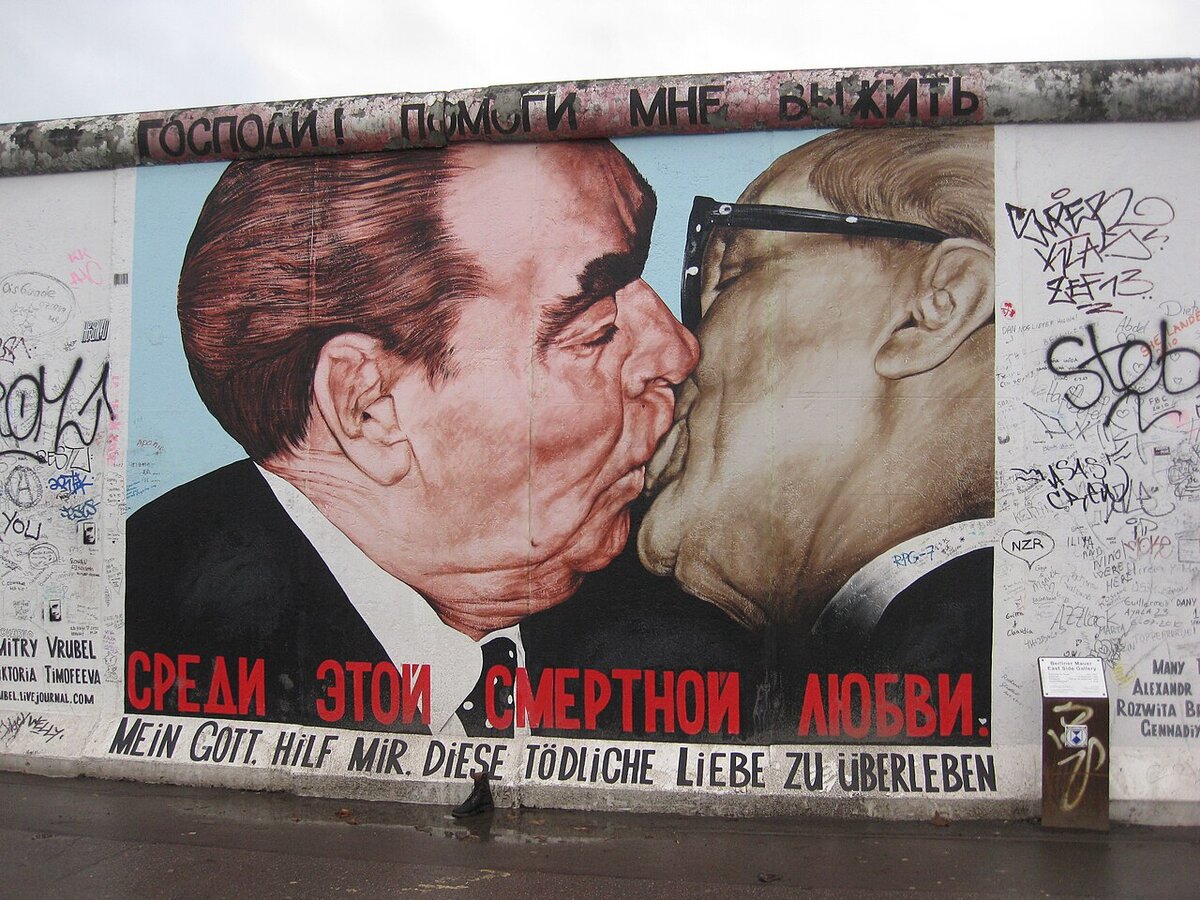
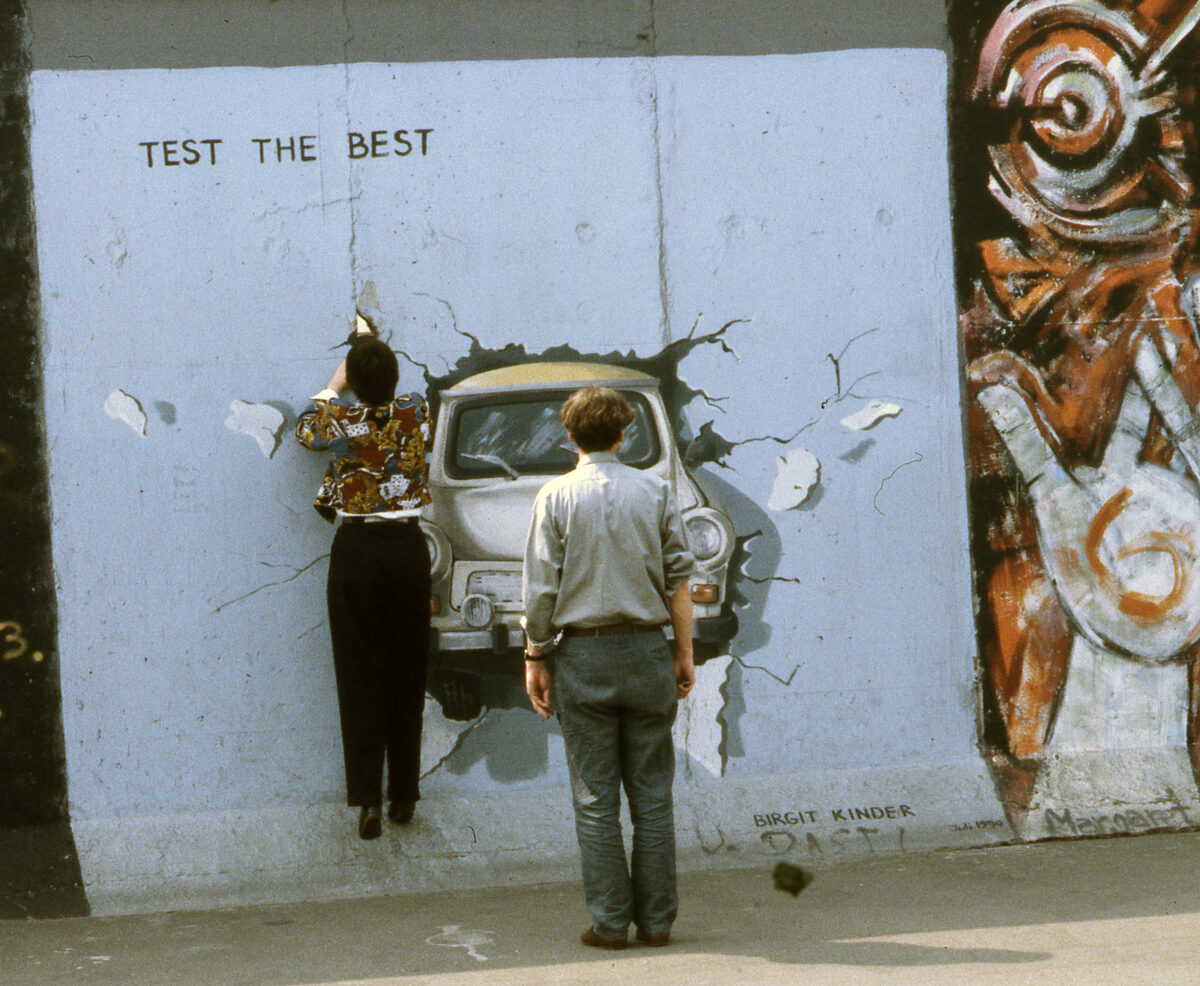
The gallery’s most famous image is Dmitri Vrubel’s “My God, Help Me to Survive This Deadly Love”, better known simply as the fraternal kiss: Soviet leader Leonid Brezhnev and East German leader Erich Honecker locked in the socialist greeting, copied from a real 1979 news photograph. A few metres away is the other icon of the gallery, Birgit Kinder’s painting of a Trabant – the boxy little East German people’s car – bursting head-on through the concrete. She titled it “Test the Best” when she painted it in 1990, and renamed it “Test the Rest” in 2009 in protest at the city’s neglect of the gallery.
Thierry Noir returned to paint his heads here too, so the pioneer of the West-side graffiti also has a place on the East-side gallery. Weathered and repeatedly vandalised, the murals were faithfully repainted by the original artists in a major 2009 restoration, and the stretch is now a protected historical monument and one of Berlin’s most visited sights. You can find it, and every other surviving fragment of the Wall, on our interactive Berlin Wall map. It is the quiet paradox at the heart of the whole story: the Wall only became a permanent, celebrated artwork once it had stopped being a wall.
After the Fall: Fragments as Art Around the World
When the Wall came down, its painted western panels were suddenly historical objects, and rather than grind all of them into road gravel the authorities and dealers preserved and dispersed hundreds of segments. Today painted sections of the Berlin Wall stand as public sculpture in dozens of cities far from Germany – among them the garden of the United Nations headquarters in New York, the Vatican Gardens in Rome, and plazas, museums and campuses from London to Seoul to Los Angeles. It was the most colourful fragments, the heads and hearts and slogans, that tended to travel, precisely because they carried the art with them.
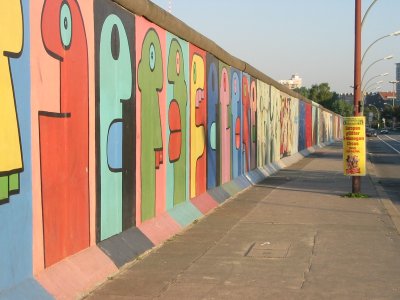
The paradox is that the clandestine 1980s art barely survives where it was made. The outer wall that carried it was almost entirely demolished, and the stretches kept in place as memorials – at Bernauer Straße and Niederkirchnerstraße – were left as bare, pockmarked Grenzmauer, preserved as the grim barrier rather than the painted one. The genuine paintings that were rescued from the wrecking crews mostly moved on: many hang in collections such as Berlin’s Allied Museum, while a few stand as open-air relics, among them a row of painted Thierry Noir and Kiddy Citny segments on the green beside Potsdamer Platz. The art outlasted the Wall, but largely by leaving the places where it was made.
The Wall also survives as photography. Because the western face was painted over continuously – a fresh layer every few weeks – the only lasting record of most of that art is the work of the documentary photographers who returned year after year to shoot it. Their pictures are the archive of an artwork that was, by its very nature, temporary. Between the fragments scattered across the globe, the restored East Side Gallery, and those photographs, the Berlin Wall has ended up as one of the most exhibited and most reproduced artworks of the twentieth century: a barrier built to keep people apart that the world remembers, above all, as a shared canvas.
Frequently Asked Questions
Why was only one side of the Berlin Wall painted?
Only the western face of the Wall was reachable. The concrete stood on East German territory, but the actual border ran a short distance in front of it, so West Berliners could walk right up and paint it. The eastern face lay inside the guarded death strip, where no East Berliner could get near it – which is why, until the Wall opened in 1989, the East side stayed bare concrete.
Was it dangerous to paint the Berlin Wall?
Yes. The wall stood a short way inside East German territory, so painters at the western face were technically on GDR soil. Border guards could open camouflaged doors built into the wall and step through to confiscate materials or make arrests – in 1986 the activist Wolfram Hasch was dragged through one such door and convicted of crossing the border. Artists like Thierry Noir learned to paint fast and keep clear of the doors.
Who were the main Berlin Wall artists?
The French artist Thierry Noir, who began painting the Wall in 1984 with his signature cartoon heads, is usually called the first. He was joined by Christophe Bouchet and by the German artist Kiddy Citny, known for his hearts and crowned figures. In 1986 the American pop artist Keith Haring painted a mural near Checkpoint Charlie. After 1990, 118 artists painted the East Side Gallery.
What is the East Side Gallery?
The East Side Gallery is a 1.3-kilometre stretch of the Berlin Wall along Mühlenstraße in Friedrichshain, painted by 118 artists from 21 countries in 1990 after the border opened. It is the longest surviving section of the Wall and the largest open-air gallery in the world, and includes Dmitri Vrubel’s fraternal-kiss mural and Birgit Kinder’s Trabant.
Did Keith Haring paint the Berlin Wall?
Yes. On 23 October 1986 Keith Haring painted a long section of the Wall near Checkpoint Charlie, at the invitation of the Checkpoint Charlie Museum – a chain of interlocking figures in the black, red and yellow of the German flag, symbolising a united people. Another artist painted over part of it within a day, and the mural was gone within months; only photographs survive.
Can you still see Berlin Wall art today?
Yes. The best place is the East Side Gallery in Friedrichshain, where the 1990 murals were restored in 2009. Painted original segments are also displayed in museums and public spaces around the world, and works by Thierry Noir and other Wall artists appear regularly in galleries and exhibitions.
The Wall shaped music and film as powerfully as it did painting – hear it in the Berlin Wall in music, read how David Bowie and Iggy Pop made their art in its shadow, or explore the Berlin Wall on screen. You can find the East Side Gallery and every surviving fragment on our interactive Berlin Wall map, or trace how the city was divided and reunited on the Berlin Wall history timeline.
Checkpoint Charlie
East Side Gallery
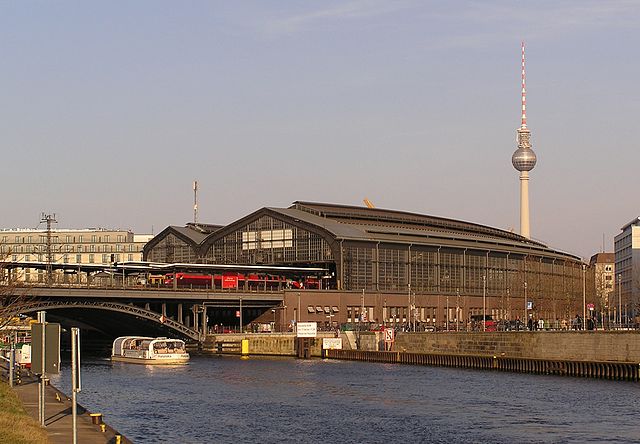
Bahnhof Friedrichstraße
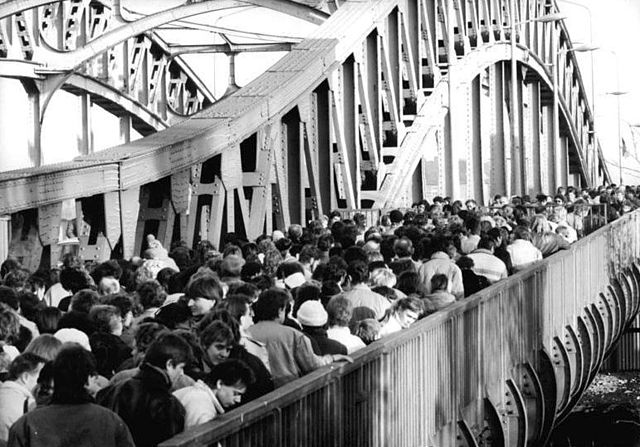
Bornholmer Straße
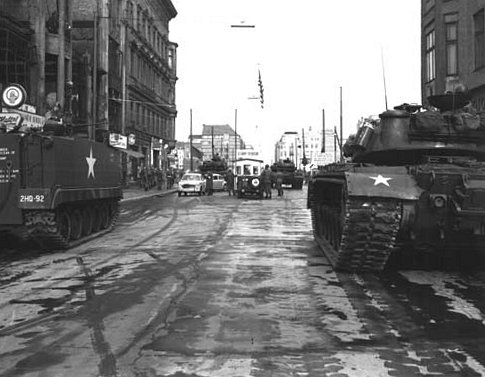
65 Years Ago: US and Soviet Tanks Faced Off at Checkpoint Charlie
The Border Guards of the Berlin Wall: Conscripts, the Order to Shoot, and the Trials That Followed
9 November in Berlin: 37 Years Since the Wall Fell, and What’s On
Gethsemanekirche
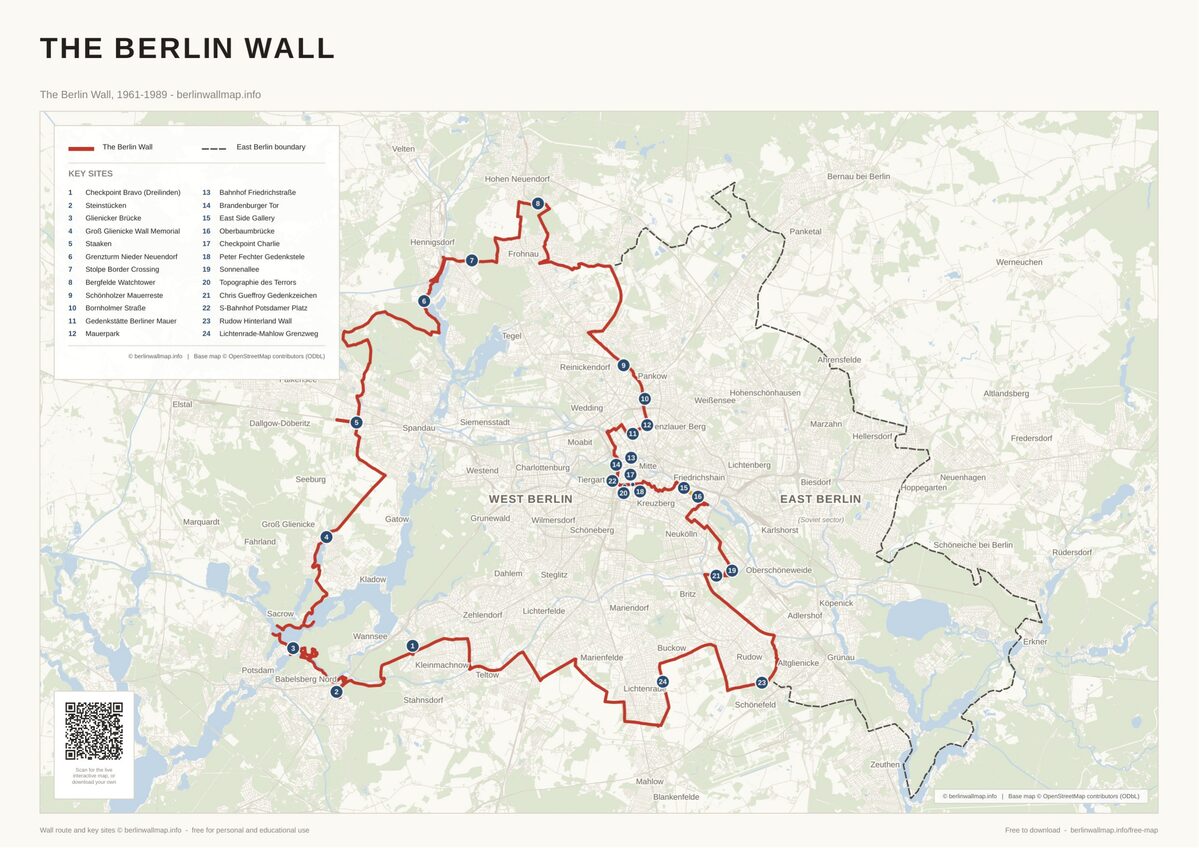
Free map downloads
Free printable PDF maps of the Berlin Wall.
Get the free maps →Explore the Timeline
Journey through Berlin Wall history from 1945 to 1990.
View Timeline →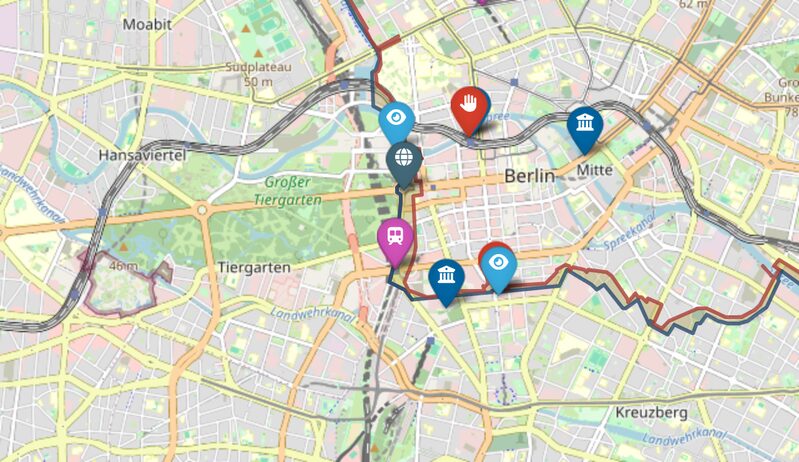
Embed Our Map
Add a free interactive Berlin Wall map to your website or blog.
Get embed code →