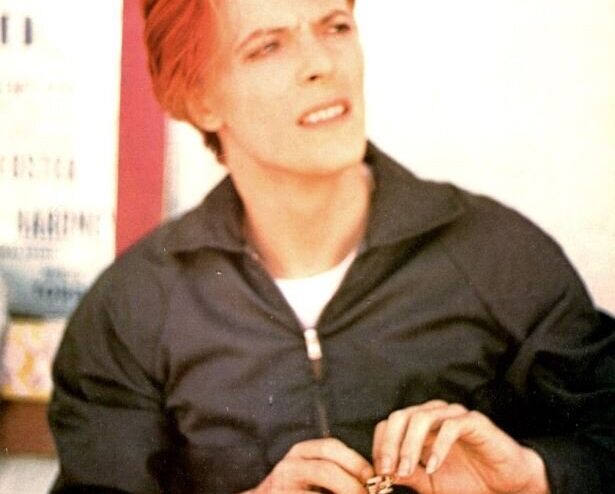
Bowie and Iggy Pop in West Berlin
In the late summer of 1976 David Bowie arrived in West Berlin and, for the next two years, made the divided city his home. He came to escape: from Los Angeles, from a deepening cocaine addiction, and from the brittle superstar he had become. He brought his friend Iggy Pop with him, and the two of them set up house in a Schöneberg apartment and went to work in a recording studio that stood right against the Berlin Wall. What came out of those rooms – Bowie’s Low and “Heroes”, Iggy Pop’s The Idiot and Lust for Life – is now regarded as some of the most influential music either man ever made. This is the story of their Berlin years, and where you can still trace them in the city today.
Why West Berlin?
Both men were only 29 when they arrived – David Bowie born in January 1947, Iggy Pop just three months later in April – and both had already burned through a complete first act. Bowie had created and then killed off Ziggy Stardust and was now cracking under the ice-cold Thin White Duke; Iggy had blazed through and burned out the Stooges. West Berlin was where two young veterans, famous and exhausted before thirty, came to begin a second.
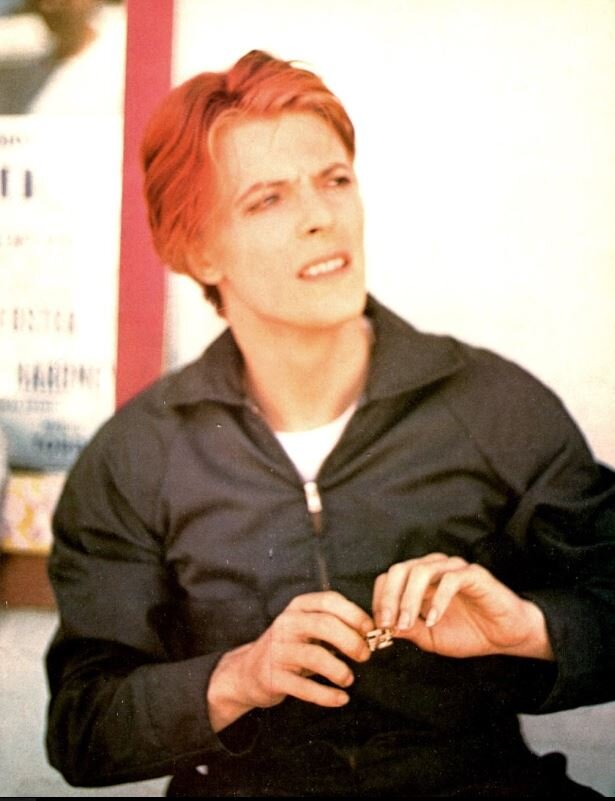
Bowie in particular was physically wrecked. A diet of milk, peppers and cocaine and a paranoid spell in Los Angeles had left him, by his own later account, close to collapse. He wanted to disappear, to work, and to get clean – and the strangest big city in Europe offered exactly that. West Berlin was an island, surrounded by the German Democratic Republic and ringed by the Wall, subsidised by Bonn, full of draft-dodgers, artists and night owls, and famously indifferent to celebrity. Bowie could walk into a bar and be left alone.
He had another reason to choose Germany. Bowie was fascinated by the cool, electronic sound coming out of the country in the mid-1970s – Kraftwerk, Neu!, Tangerine Dream – and by the Expressionist painters of early twentieth-century Berlin. In the city he took up painting again, visited the Brücke Museum to stand in front of the canvases of Kirchner and Heckel, and rode the buses through Kreuzberg and Schöneberg with his notebook. The point of Berlin was to be ordinary, and for a while he managed it.
The Flat at Hauptstraße 155
Bowie settled in an unglamorous turn-of-the-century apartment block at Hauptstraße 155 in Schöneberg, above a car-parts shop, in a working-class and largely Turkish neighbourhood. Iggy Pop moved in too, first sharing the apartment and later taking a smaller flat at the back of the same building, with Bowie’s assistant Coco Schwab keeping the whole fragile operation running. The two musicians cycled to the studio, drank in the local bars, ate in the corner cafes, and – slowly, with relapses – tried to pull themselves out of addiction together.
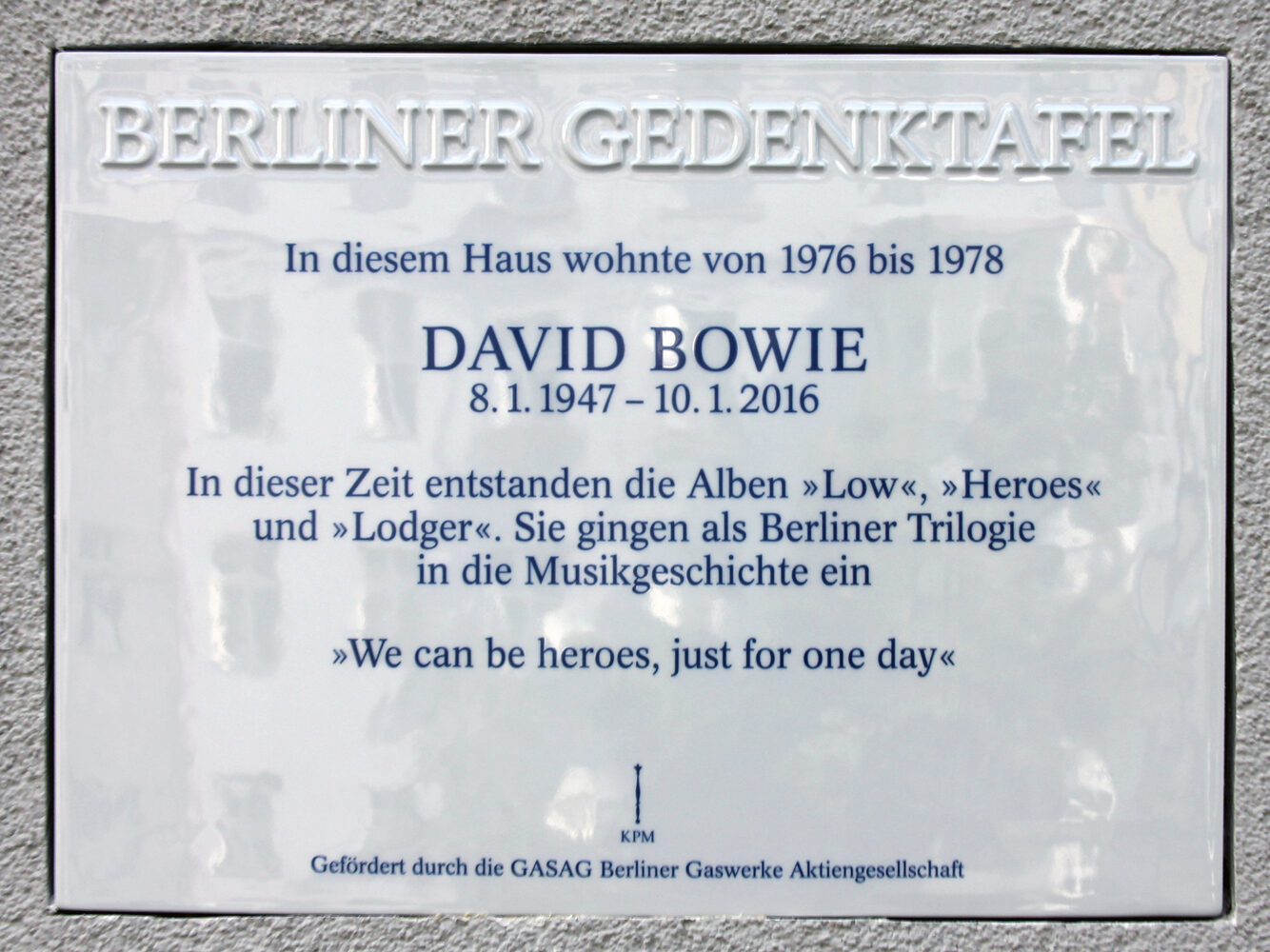
The building still stands, and since 2016 a memorial plaque beside the door marks the spot. Bowie died in January that year, and the following August the Berlin authorities unveiled a porcelain plaque made by the city’s Royal Porcelain Manufactory (KPM), carrying a line from his most famous Berlin song: “We can be heroes, just for one day.” Fans still leave flowers there on the anniversary of his death.
Hansa Studios, Recording by the Wall
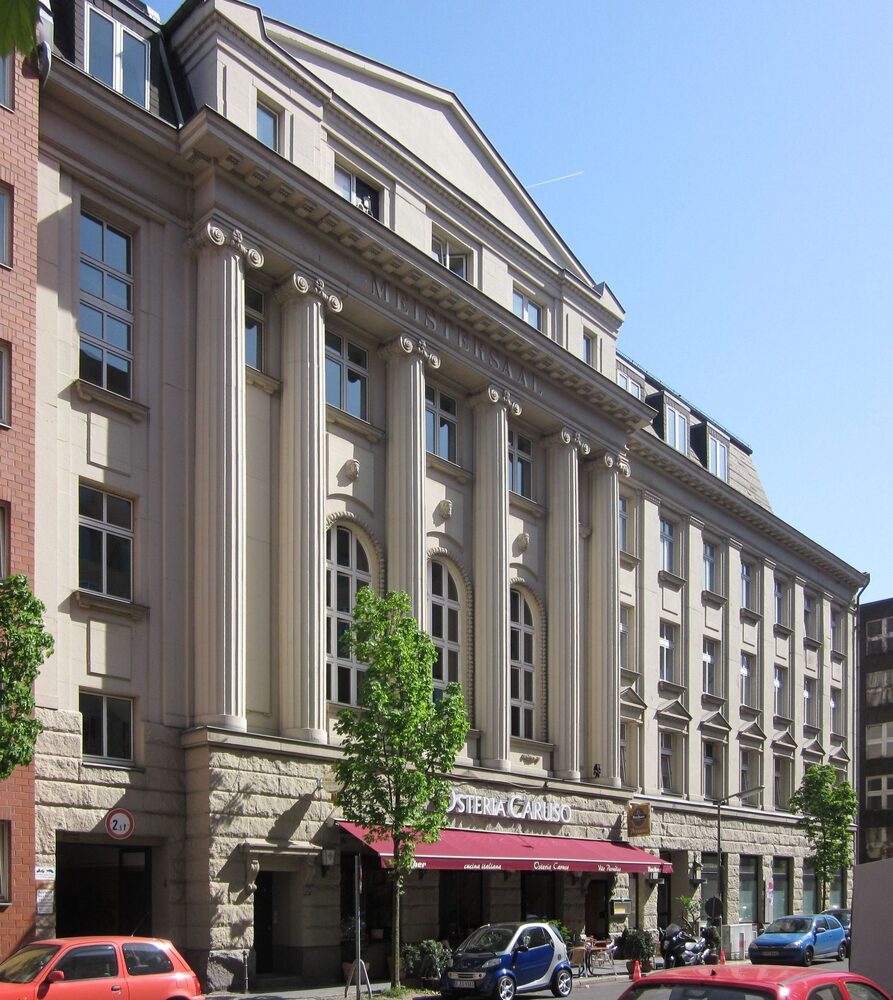
The studio at the centre of the story sits at Köthener Straße 38, just off Potsdamer Platz. Hansa Tonstudio had taken over the Meistersaal, a grand chamber-music hall built in 1910, and turned it into a cavernous recording room. In the years of the division this corner of the city was a dead end: the Wall ran directly behind the building, and from the control-room window the musicians looked straight out over the death strip, the watchtowers and the East German border guards. Bowie and his circle nicknamed the place “the Hall by the Wall”.
The guards were not just scenery. In daylight the musicians could see the watchtower sentries watching them back through binoculars, only a few hundred feet away, for the length of each session. Tony Visconti remembered asking the assistant engineer, Eduard Meyer, whether the constant surveillance unnerved him – Meyer’s answer was to grab the overhead light, flash it into the guards’ eyes and stick out his tongue, while Bowie and Visconti dived under the mixing desk hissing “don’t do that!” As Visconti put it, “all that edge was in the recording.”
It was here, through 1977, that Bowie made the records that defined his Berlin period. He had begun Low at a château outside Paris and finished it at Hansa; then he recorded “Heroes” in the building from start to finish, working with producer Tony Visconti, the conceptual musician Brian Eno, and King Crimson guitarist Robert Fripp, whose soaring, feedback-drenched guitar gives the title track its sound. Together with Lodger, recorded later outside Germany, these albums became known as the Berlin Trilogy. You can find Hansa Studios, and the rest of the divided city’s surviving sites, on our interactive Berlin Wall map.
“Heroes” and the Lovers at the Wall
The song “Heroes” – now Bowie’s signature anthem – was written in that room, looking at that border. For years Bowie said the lyric about two lovers who “kiss, as though nothing could fall” and “stand, by the Wall” was inspired by a couple he saw embracing beneath a guard tower. He kept their identity secret. Long afterwards Tony Visconti admitted that the couple was him and the backing singer Antonia Maaß; Bowie had protected his married producer by leaving the story anonymous. The defiant, fragile romance of the song – lovers snatching one day of freedom in the shadow of the Wall – is inseparable from the place it was made.
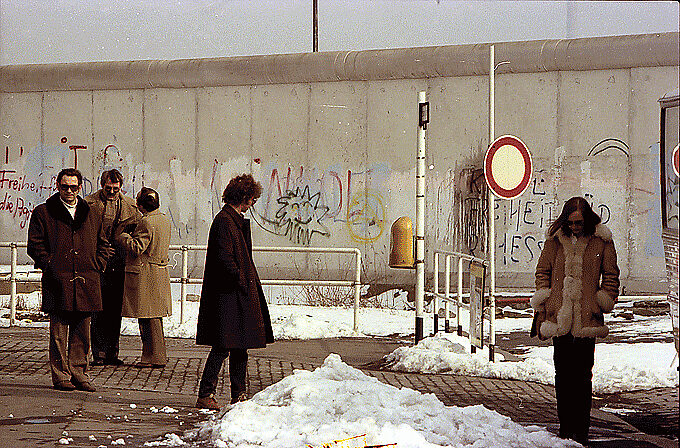
When the Wall finally fell, the song came full circle. Bowie performed “Heroes” at a concert beside the Reichstag in June 1987, loud enough to carry across the border to young East Berliners gathered on the other side, who chanted back and were dispersed by police – a small crack in the system two years before it gave way. After Bowie’s death in 2016, the German Foreign Office thanked him publicly: “Good-bye, David Bowie. You are now among Heroes. Thank you for helping to bring down the Wall.”
Iggy Pop: The Idiot and Lust for Life
Berlin was just as decisive for Iggy Pop. With the Stooges behind him and his own career stalled, Iggy was effectively reborn under Bowie’s production. The Idiot, largely written and recorded before the move and mixed at Hansa, gave him a colder, more European sound; its closing track, “Mass Production”, and the single “China Girl” – later a hit for Bowie himself – came out of this partnership. Iggy released The Idiot in 1977 and toured it with Bowie playing keyboards in his band, content for once to stand at the side of the stage.
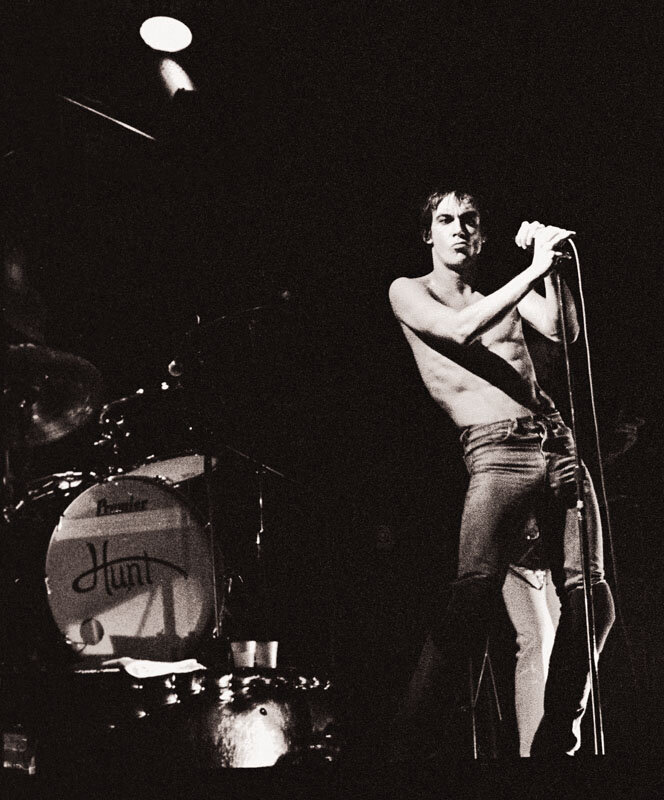
The second album, Lust for Life, was cut quickly at Hansa in the same year and is pure Berlin energy. Bowie wrote the pounding title-track riff on a ukulele, reportedly building it from the Morse-code signal of the American Forces Network station. The album also gave Iggy “The Passenger”, a song inspired by riding Berlin’s S-Bahn around the half-city at night, staring out at a landscape split in two. Both records were commercial slow-burners that became touchstones for punk and post-punk, and they remain the heart of Iggy Pop’s solo catalogue.
Crossing into the East
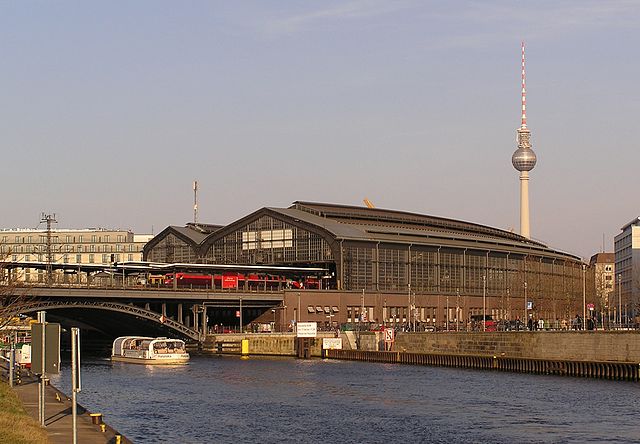
For all that the Wall hemmed West Berlin in, Bowie and Iggy could step through it almost at will. As Westerners they were entitled to day-trips into the East – Bowie on his British passport through Checkpoint Charlie, or by S-Bahn through the Tränenpalast, the “Palace of Tears” border hall at Friedrichstraße station. On the far side they gravitated to Brecht’s Berliner Ensemble theatre and the Ganymed restaurant beside it, where Western hard currency bought a lavish meal for almost nothing among the GDR’s dining elite.
Those crossings sharpened the contrast that runs through all the Berlin music: the grey, watched, half-empty East against the subsidised island of the West. Bowie met West Berliners with relatives stranded on the other side and painted them in a series of isolated portraits, and he later said the Wall “by the end feels as though it’s right around the apartment”. The records made a few hundred metres from the death strip carry that pressure – the same tension that led the regime to file Bowie’s music as “antisocial” Western decadence, even though no Stasi file on him is known to survive.
Reading the Berlin Songs
Bowie almost never names the Wall in a lyric, yet it seeps through the whole Berlin output – most plainly in the two instrumentals that close Low. “Weeping Wall” is the clearest case: Bowie built the piece, playing every instrument himself and finishing it in a single day, around a circling, music-box melody that nods to the folk tune “Scarborough Fair”. Tony Visconti tied it straight to the border – the sight of desperate faces on the Eastern side, he said, was what made Bowie write it, because “on the other side of the wall, those people were crying”. Heard that way, the looping, unresolved phrase becomes a kind of mechanical grief, a sound with no exit – arguably the permanence of the barrier itself turned into music.
Its companion, “Subterraneans”, is the most explicit Wall statement Bowie ever made without words. He said it was about the people “caught in East Berlin after the separation”, and the track is haunted by a faint, half-buried jazz saxophone – the memory, in his telling, of what the city’s nightlife had been before 1961. It is tempting to take the title literally: a whole population pushed underground and out of sight behind the Wall, their old cosmopolitan culture surviving only as a ghost in the mix. The speculation runs the other way too – that the muffled, reversed textures are West Berlin straining to hear an East it can no longer reach.
The title track turns the same border into something defiant. The quotation marks Bowie insisted on – the song is “Heroes”, never simply Heroes – are doing real work: they make the heroism ironic and provisional, a pose held up against impossible odds. The lovers can be king and queen only “just for one day”, and only in the literal shadow of the guns; the Wall is what makes their small act of defiance heroic and, in the same breath, doomed. It is a love song that only works because of the death strip outside the window.
Iggy reads the divided city from inside a train. “The Passenger”, written on his nightly S-Bahn loops around the walled half-city, glides past what he calls the city’s “ripped backsides” – the raw, unglamorous rear of a place, which in a severed Berlin is easy to hear as the scarred edge where the city was cut in two. The passenger sees everything and touches nothing, murmuring that “everything was made for you and me” – a line that lands very differently in a city where free movement was exactly what the Wall existed to deny. Iggy never spelled any of this out; that ambiguity is part of why the song still travels.
The Berlin Legacy and Visiting Today
By 1978 the cure had largely worked and the spell was ending; Bowie drifted away from the city, and the Berlin Trilogy was complete. But the two years left a permanent mark on both musicians and on Berlin’s image of itself as a place where you can come to start again. Today the city quietly honours the connection, and a few sites let you walk the story.
Hansa Studios at Köthener Straße 38 is still a working studio and event venue, and the Meistersaal hosts guided tours that take you into the famous hall where “Heroes” was recorded – you can see it marked on our Berlin Wall map. The apartment at Hauptstraße 155 in Schöneberg, with its memorial plaque, is a short walk from the U-Bahn and is now a small place of pilgrimage. And because the Wall that the musicians watched from the window has almost entirely gone, the best way to picture their Berlin is to stand at Potsdamer Platz – rebuilt beyond recognition – and imagine the death strip that once ran past the studio door.
Frequently Asked Questions
Why did David Bowie move to Berlin?
Bowie moved to West Berlin in 1976 to escape a serious cocaine addiction and the pressures of fame in Los Angeles. The walled, subsidised half-city offered anonymity, a thriving art and music scene, and the German electronic sound he admired. He brought Iggy Pop with him and stayed until around 1978.
Which albums did Bowie record in Berlin?
Bowie finished Low (1977) at Hansa Studios and recorded “Heroes” (1977) there in full. With Lodger (1979), made later outside Germany, the three records are known as the Berlin Trilogy. In the same studio he also produced Iggy Pop’s The Idiot and Lust for Life.
Can you visit Hansa Studios?
Yes. Hansa Studios at Köthener Straße 38, near Potsdamer Platz, is still a working recording studio, and the Meistersaal – the “Hall by the Wall” where “Heroes” was recorded – runs guided tours. The building stood directly against the Berlin Wall during the division.
Where did Bowie and Iggy Pop live in Berlin?
They shared an apartment at Hauptstraße 155 in the Schöneberg district, with Iggy later moving to a smaller flat at the back of the same building. A porcelain memorial plaque, unveiled in 2016, now marks the address.
What inspired the song “Heroes”?
The lovers in “Heroes” were inspired by a couple Bowie watched embracing by the Berlin Wall, visible from the Hansa control-room window. Bowie kept them anonymous; producer Tony Visconti later revealed that the couple was himself and the singer Antonia Maaß.
“Heroes” and “The Passenger” are only two threads in the wider story of the Berlin Wall in music. Trace Bowie and Iggy Pop’s divided Berlin, and every other site of the Wall, on our interactive Berlin Wall map, or see how the city was split and reunited on the Berlin Wall history timeline.
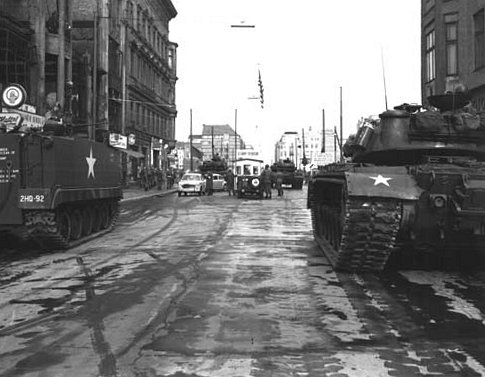
Checkpoint Charlie
East Side Gallery
Bahnhof Friedrichstraße
History of the Berlin Wall: A Complete Guide (1961-1989)
65 Years Ago: US and Soviet Tanks Faced Off at Checkpoint Charlie
The Border Guards of the Berlin Wall: Conscripts, the Order to Shoot, and the Trials That Followed
9 November in Berlin: 37 Years Since the Wall Fell, and What’s On
Gethsemanekirche
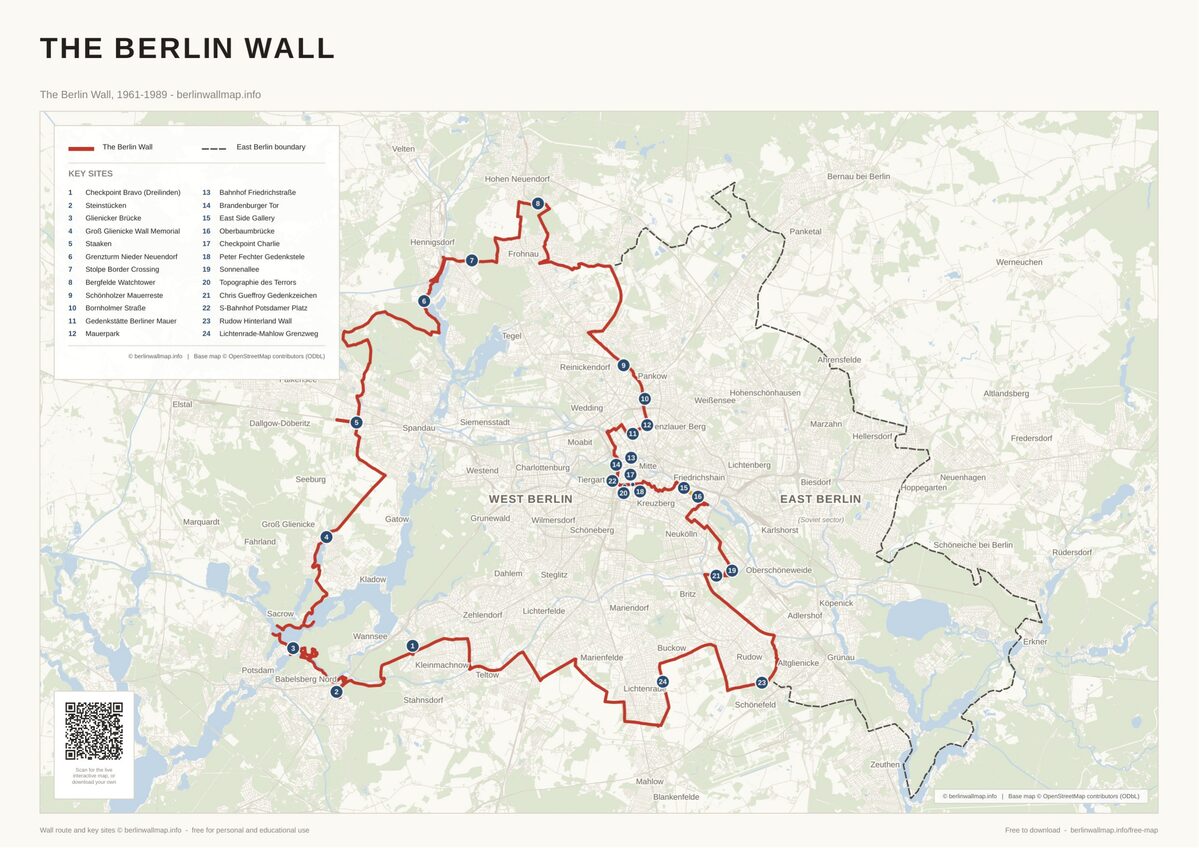
Free map downloads
Free printable PDF maps of the Berlin Wall.
Get the free maps →Explore the Timeline
Journey through Berlin Wall history from 1945 to 1990.
View Timeline →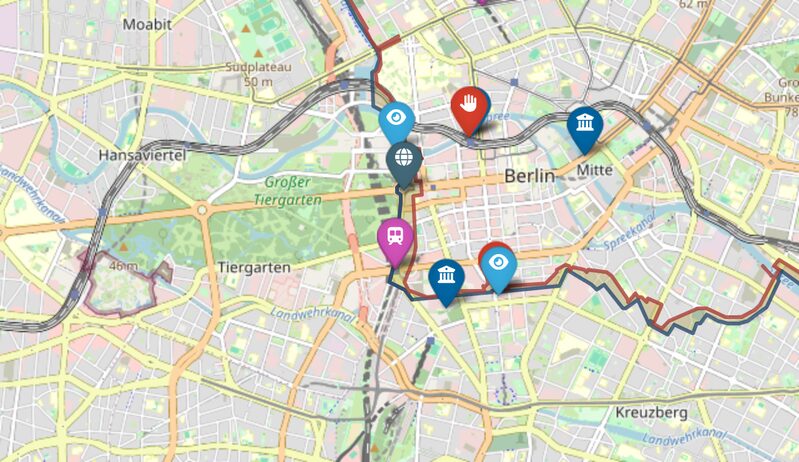
Embed Our Map
Add a free interactive Berlin Wall map to your website or blog.
Get embed code →