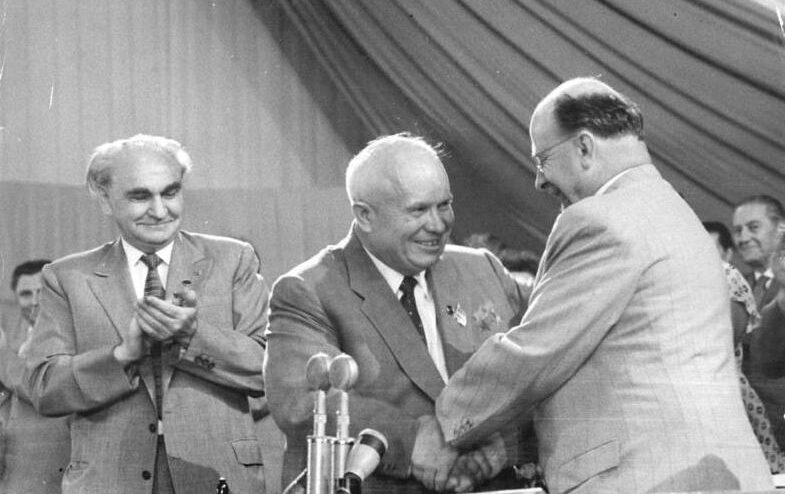
Khrushchev’s Berlin Ultimatum: The Crisis That Built the Wall
The Berlin Wall did not appear out of nowhere on a Sunday morning in August 1961. It was the last move in a crisis that had been running for almost four years – one that began with a diplomatic note, survived two collapsed summits, and ended with American and Soviet tanks pointing their guns at each other across a Berlin street. This is the story of Khrushchev’s Berlin ultimatum: what the Soviet leader actually demanded, why he demanded it, and how the crisis he started produced the one thing he had told his own allies was too provocative to build.
27 November 1958: Six Months to Get Out
On 27 November 1958 the Soviet Foreign Ministry handed a note to the American ambassador in Moscow, with identical copies going to Britain and France and further notes to both German states. History remembers it as the Berlin Ultimatum. The word “ultimatum” appears nowhere in it, and neither does a date. What it gave the West was “half a year”.
The demand was that the Western powers pull their forces out of West Berlin and let it become “an independent political unit – a free city, without any state, including both existing German states, interfering in its life”: demilitarised, self-governing, guaranteed on the model of neutral Austria. If the West would not agree, the Soviet Union would sign a separate peace treaty with East Germany and hand its access rights over, after which the GDR would “exercise its sovereignty on land, on water, and in the air”. For good measure the note declared the four-power protocol of September 1944 null and void.
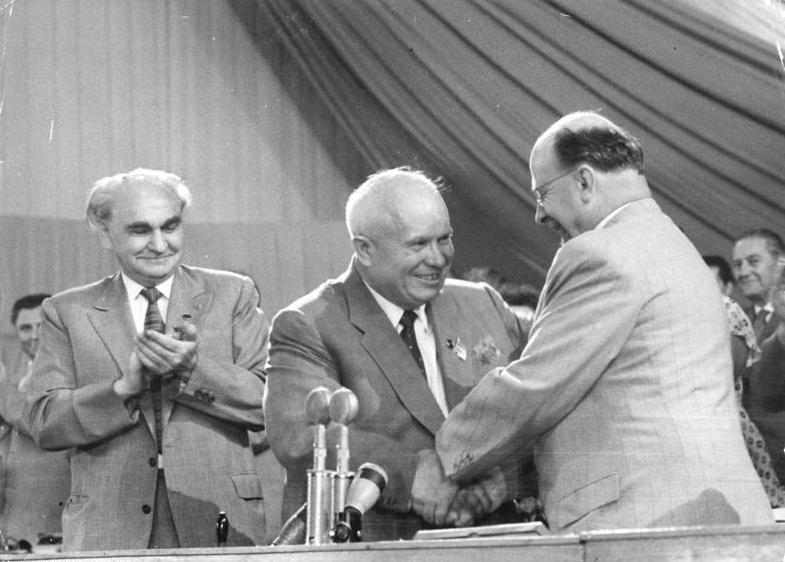
The threat had a sharp edge that is easy to miss. Western rights in Berlin did not come from any Soviet grant; they came from having beaten Germany, and from four-power agreement. Moscow had nothing to hand over. But if the Western powers ever had to ask East German officials for permission to reach their own garrisons, they would in practice be recognising a state they refused to recognise at all. That was the point.
So why 1958? The popular answer – that East Germany was bleeding people and Khrushchev wanted the hole plugged – is the single most common mistake made about this document. The refugee drain is what produced the Wall in 1961; it is barely present in the 1958 papers. Those papers are about the fear that the West German Bundeswehr would be armed with nuclear weapons, and above all about forcing the world to recognise the GDR as a real country. One historian who worked through the Soviet files concluded the ultimatum was “ninety percent improvisation”: Gromyko did not draft the actual peace-treaty texts until Christmas Eve, a month after the note had gone out.
The Deadline That Quietly Lapsed
The six months ran out on 27 May 1959. Nothing happened. There was no Soviet move, no crisis and – contrary to a claim repeated almost everywhere – no formal withdrawal of the ultimatum either. No such document exists. Khrushchev had simply let it go soft: once he agreed that spring to a meeting of foreign ministers, the deadline had already lost its force, because you cannot credibly threaten to act alone while sitting down to negotiate. The foreign ministers duly met in Geneva from May to August 1959 and agreed on nothing at all.
Then came the strangest moment of the whole crisis. In September 1959 Khrushchev toured the United States and spent three days with Eisenhower at Camp David, and there he did lift the deadline – but only by handshake. Eisenhower wanted the words “no fixed time limit” in the joint communiqué and called the point “the nub of their agreement”. Khrushchev refused to sign it. The sentence was cut, and Eisenhower announced the concession separately, carefully flagging how little it was worth: “since it was the agreement of two individuals, I think that I should not attempt to go further.”
That omission is the load-bearing fact of the next two years. Because Khrushchev had never put his name to anything, he could pick the ultimatum back up whenever he liked, and it would cost him nothing.
Vienna, June 1961: He Picks It Back Up
The chance to settle it died first. A four-power summit was due in Paris in May 1960, but on 1 May an American U-2 spy plane was shot down over the Soviet Union. Khrushchev demanded an apology; Eisenhower suspended the flights but would not apologise; the summit was dead within a day of opening. Khrushchev shelved Berlin and waited for the next American president.
He met him in Vienna on 3 and 4 June 1961. At the end of the second morning he handed Kennedy an aide-mémoire putting the demand back on the table with a fresh clock: a settlement within “a period not exceeding six months”. Kennedy is usually said to have been simply overwhelmed at Vienna. In fact he did the most useful thing anyone did in those two days – he made Khrushchev say out loud what his “interim agreement” actually meant. Would Western forces stay, and access stay free? For six months, Khrushchev replied. And after that, would the troops have to leave? He answered yes.
The American record of the meeting closes with Kennedy “observing that it would be a cold winter” – in the note-taker’s indirect speech, not as a quotation. (The crackling exchange in which Kennedy snaps “Then, Mr. Chairman, there will be war” is not in the memorandum at all; it was assembled later by memoirists.) His public answer came on 25 July: a supplemental defence request of $3.2 billion, the Army raised towards a million men, draft calls doubled and tripled, $207 million for civil defence. What he did not do – and Moscow noticed – was say anything about East Berlin. Everything he had promised to defend lay on the western side of the city.
The Hatch: The Exodus That Actually Built the Wall
While the diplomats circled, East Germany was emptying. Between the founding of the GDR in 1949 and the morning of 13 August 1961, 2,686,942 people registered as refugees in the West. That figure is worth stating precisely, because it is the one the records will carry: it counts those who went through the official reception procedure, which makes it a floor rather than an estimate. (The larger number you often see, around 3.5 million, is not a rival count but a different starting line – it runs from 1945.)
The inner-German border had been fenced and mined since 1952. Berlin was the hole in the fence: four-power status kept the sector crossings open, and by 1961 four out of every five refugees were leaving through West Berlin. In the seven and a half months before the Wall, 155,402 people went. Around half of them were under 25, and the number of engineers and technicians leaving roughly doubled between 1960 and 1961. A country was losing its future in its twenties.
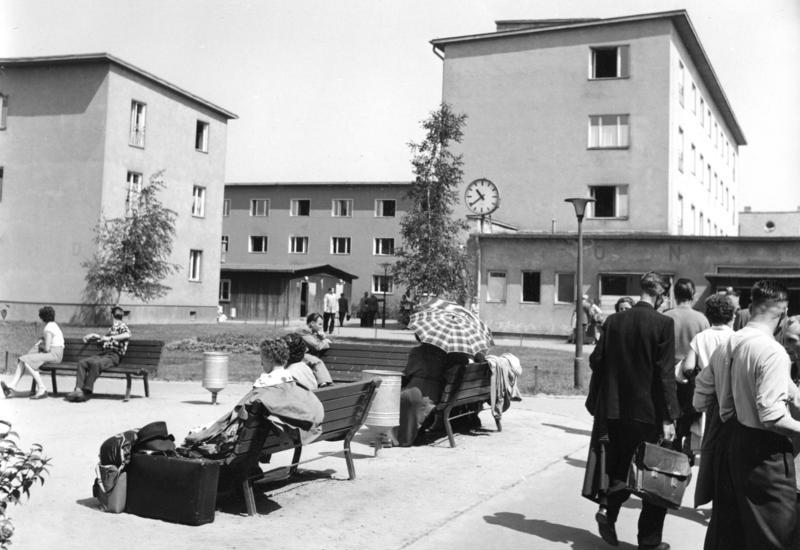
You can still see where they arrived. The reception camp at Marienfelde had been built for about 1,200 people; in the last weeks it was taking 1,500 to 2,400 a day, and the queues ran so far behind the arrivals that the official statistics lag the real flight. At the end it was closer to a stampede: roughly 47,000 people crossed in the first thirteen days of August. Seen from the East German leadership’s desk, the Wall was not ideology. It was plumbing.
“Nobody Has Any Intention of Building a Wall”
On 15 June 1961, eleven days after Vienna, Walter Ulbricht held an international press conference in East Berlin. A West German journalist, Annamarie Doherr of the Frankfurter Rundschau, asked whether turning West Berlin into a free city meant the state border would be put up at the Brandenburg Gate. She did not use the word “wall”.
Ulbricht did. “I understand your question to mean that there are men in West Germany who wish that we would mobilise the construction workers of the capital of the GDR to build a wall,” he answered. “I am not aware of any such intention… Niemand hat die Absicht, eine Mauer zu errichten.” Nobody has any intention of building a wall.
It is the most famous sentence of the crisis, and it is almost always served up as a bare-faced lie. The honest version is better, and stranger. Nobody had asked him about a wall – he put the word into the room himself, fifty-nine days before the first coil of barbed wire went down, and at the time nobody noticed. Whether he was lying is genuinely unresolved; the historians at the Chronik der Mauer lean towards the remark only becoming a lie in retrospect. What is not in doubt is that Ulbricht had wanted a barrier for months, and that in March 1961 Khrushchev had told him no. It would be too provocative.
The Night of 13 August
Khrushchev changed his mind that summer. The pivot is a meeting in Moscow on 1 August 1961, where Ulbricht said he needed two weeks and Khrushchev authorised him to choose his own moment – with one stipulation: build at the border, “and not one millimetre further”. The Warsaw Pact allies signed it off between 3 and 5 August, and the closure appeared nowhere in their communiqué. The Politbüro fixed the date on 7 August.
On the afternoon of 12 August, at a government guest house on the Döllnsee north of Berlin, Ulbricht produced a resolution that had already been drafted, and signed it. The operation began around one o’clock in the morning: some 15,000 police and paramilitaries on the line, 7,000 army troops behind them, Soviet forces behind those. Barbed wire first. The concrete came about a week later.
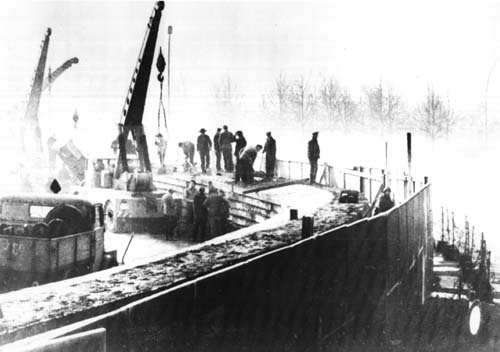
Did the West know? That depends which question you are asking. Strategically, yes: the CIA had warned for years, and in early August Kennedy told an aide, “He will have to do something to stop the flow of refugees. Perhaps a wall. And we won’t be able to prevent it.” Tactically, no – the CIA’s own post-mortem says the event “took everyone by surprise”, and most Soviet officers in Berlin were not told either. And in Washington, for the first day, the dominant feeling was relief. A wall around East Berlin was not an attack on West Berlin, and West Berlin was all Kennedy had promised to defend.
Tanks at Checkpoint Charlie, October 1961
The crisis had one more act. On 22 October an American diplomat, Allan Lightner, was stopped at Checkpoint Charlie and refused to show his papers to East German guards – American policy was to show them to Soviet officers only. Over the following days the Americans ran the crossing again and again on purpose, escorted by armed soldiers. This was not one stubborn diplomat. It was a scripted probe.
What turned it into a tank confrontation was something Washington did not know about. General Lucius Clay, Kennedy’s man in Berlin, had quietly had an engineer company build a replica section of the Wall in a forest outside the city, and had been practising knocking it down with tank bulldozers. It was never authorised; by one account his own superior “bawled him out but didn’t report it back”. Soviet intelligence photographed it, and the pictures were in front of the Politburo around 20-21 October. Khrushchev drew the obvious conclusion: Clay was preparing to tear the Wall down by force.
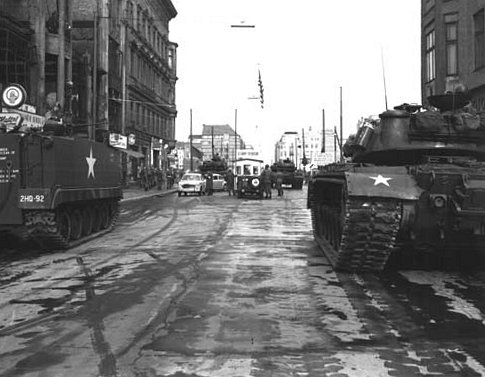
So on 27 October the tanks came – about ten a side at the crossing, Soviet T-54s running without markings, roughly a hundred metres apart, guns loaded. They stood there for some 16 hours: the only direct confrontation between American and Soviet armour in the entire Cold War, produced by a rehearsal in a wood. The Soviets pulled back first, at 10:45 on the morning of 28 October. The Americans followed a little over an hour later.

Afterwards the Americans stopped testing access and stopped the armoured demonstrations. The standoff is often told as the West facing Moscow down. It is more accurate to say that it confirmed the division: both sides had now seen what the alternative looked like, and neither wanted it.
The ultimatum itself never ended so much as evaporated. At the 22nd Party Congress on 17 October 1961 Khrushchev let it go in a face-saving half-sentence – the peace treaty need not “necessarily” be signed before 31 December. No peace treaty was ever signed, by anyone. The practical settlement of the Berlin question waited until the Four Power Agreement of 1971, which was not a treaty and required no ratification. Khrushchev had demanded that the West leave Berlin. The West was still there when he was removed from office in 1964.
What People Get Wrong About the Crisis
This is a story that has attracted more than its share of good lines that turn out not to be evidence.
“Berlin is the testicles of the West – every time I want to make the West scream, I squeeze on Berlin.” Khrushchev’s most quoted sentence about Berlin is almost certainly not his. It is not in his memoirs, it has no traceable source from the crisis years, and the earliest version anyone can point to is a remark reported from Belgrade in August 1963 – two years after the Wall went up. It is routinely used to explain what he was thinking in 1958, which it cannot do.
“Khrushchev withdrew the ultimatum in May 1959.” He did not withdraw it. He let it lapse, and then re-imposed it twice.
“Kennedy’s three essentials.” A tidy label Kennedy never used. The phrase is not in the 25 July speech; the commitments are scattered through it. It was applied later by others and then travelled back into English as though he had coined it.
“A wall is a hell of a lot better than a war.” Kennedy probably did say it, and it certainly matches what he did – but it reaches us through an aide’s memoir published in 1972, eleven years after the event and nine after Kennedy’s death, rather than through any record made at the time.
The refugees caused the ultimatum. They caused the Wall. The ultimatum was about recognition and nuclear weapons. Collapsing the two makes the crisis look like a straight line, when what actually happened was a bluff that ran out of road and was rescued by a building project.
Visiting the Crisis Sites Today
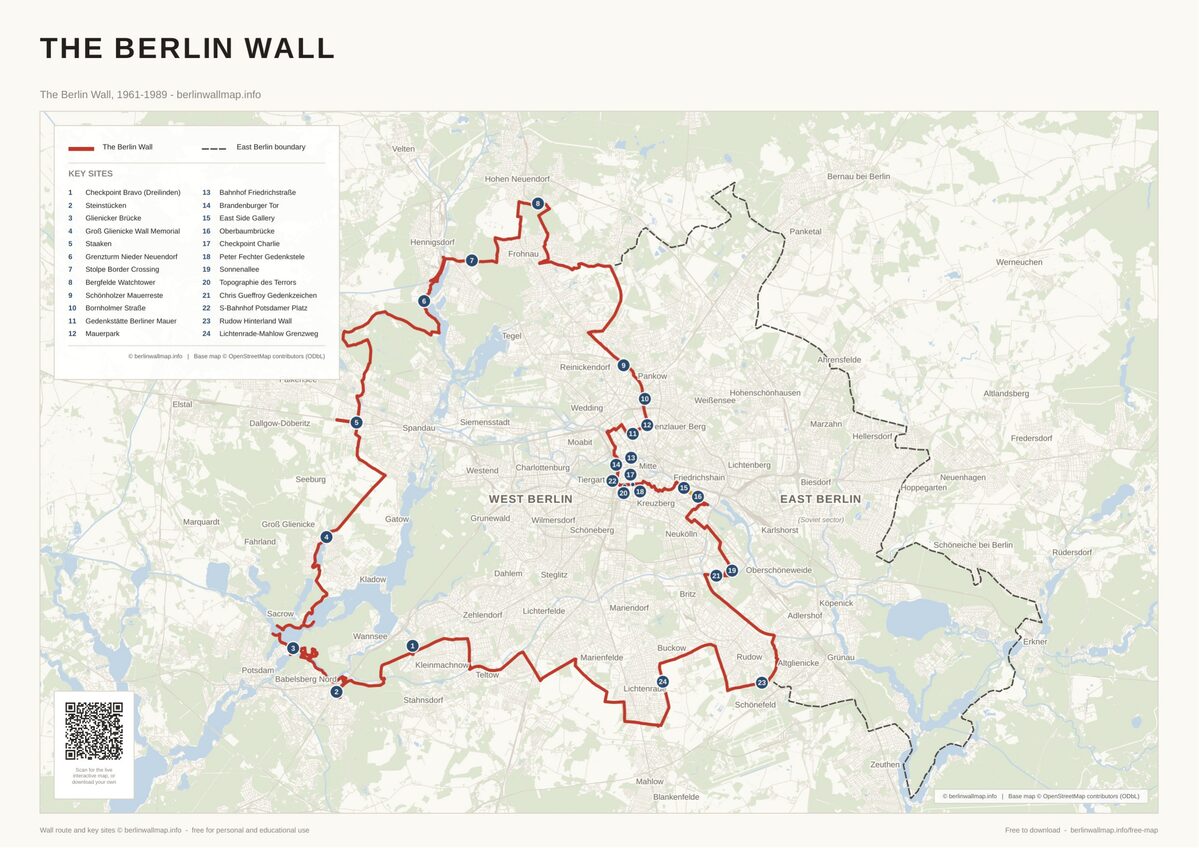
Very little of the crisis is marked as such, because its sites are better known for what came afterwards. Checkpoint Charlie is the obvious one – now the most touristed corner of the old border, with a replica guardhouse standing roughly where the tanks faced each other in October 1961. The Marienfelde refugee centre in the south of the city is the quieter and more surprising visit: the buildings that absorbed the exodus are still there and now hold a museum about it, and it is the one place in Berlin where the actual cause of the Wall is the subject rather than a footnote. And the Brandenburg Gate, where Doherr’s question imagined the border going up, ended up standing in the death strip for twenty-eight years.

You can find all of them, and every other surviving trace of the divided city, on our interactive Berlin Wall map, or follow the whole story from the first day to the last on the Berlin Wall history timeline.
Frequently Asked Questions
Why was the Berlin Wall built?
To stop East Germans leaving. Between 1949 and 13 August 1961, 2,686,942 people registered as refugees in the West, four out of five of them through West Berlin, and by 1961 around half were under 25. The diplomatic crisis Khrushchev began in 1958 was about something else – forcing recognition of East Germany – but it was the exodus that made the GDR leadership demand a barrier, and Khrushchev finally agreed to one in August 1961.
What was Khrushchev’s Berlin Ultimatum?
A Soviet note of 27 November 1958 demanding that American, British and French forces leave West Berlin within six months and that the city become a demilitarised “free city”. If the West refused, Moscow said it would sign a separate peace treaty with East Germany and hand over control of the access routes. The note never used the word “ultimatum” and never named a date.
Did Khrushchev withdraw the ultimatum?
No. The six months expired in May 1959 and nothing happened, but there was never a formal withdrawal. Eisenhower got him to drop the deadline at Camp David that September – verbally only, because Khrushchev refused to put it in the communiqué, which is exactly why he could re-impose it at Vienna in 1961. He finally let it go in October 1961.
Did Ulbricht lie when he said nobody intended to build a wall?
It is genuinely unresolved, and historians lean towards the remark becoming a lie only afterwards. On 15 June 1961 no decision had been taken: Khrushchev had rejected Ulbricht’s barrier idea in March as too provocative, and only authorised it on 1 August. The odd part is that nobody had asked Ulbricht about a wall – he introduced the word himself, 59 days early.
How many East Germans fled before the Wall?
2,686,942 registered refugees between 1949 and 13 August 1961 – and that counts only those who went through the official procedure, so the true number is higher. In 1961 alone, 155,402 left before the border closed, roughly 47,000 of them in the first thirteen days of August.
What happened at Checkpoint Charlie in 1961?
On 27-28 October 1961 about ten American and ten Soviet tanks faced each other roughly a hundred metres apart with live ammunition, for around 16 hours – the only direct armoured standoff of the Cold War. It grew out of disputes over Allied access, sharpened by a mock wall General Clay had secretly built and practised demolishing, which Soviet intelligence photographed. The Soviets withdrew first.
Free map downloads
Free printable PDF maps of the Berlin Wall.
Get the free maps →Explore the Timeline
Journey through Berlin Wall history from 1945 to 1990.
View Timeline →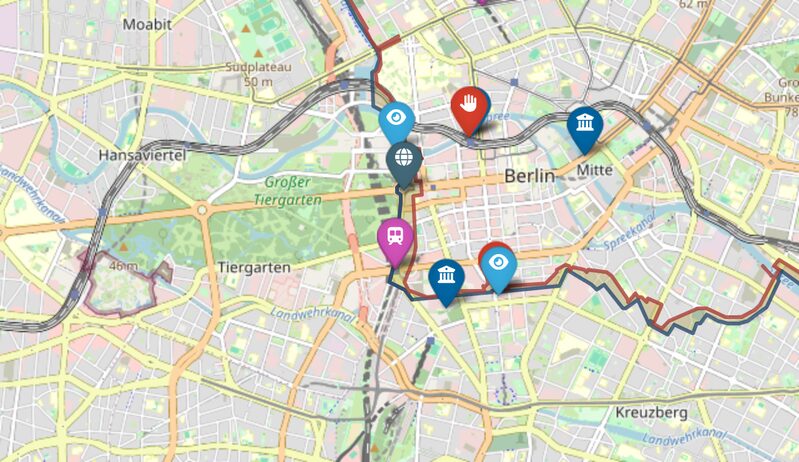
Embed Our Map
Add a free interactive Berlin Wall map to your website or blog.
Get embed code →