The Basic Treaty and Ostpolitik: How Detente Changed Life at the Berlin Wall
By the end of the 1960s the Berlin Wall had been standing for most of a decade, and West Germany still had no official way of talking to the government that built it. Bonn’s position was that the German Democratic Republic did not properly exist. That fiction had a price, and West Berliners paid it: for six years they were not allowed to visit relatives living a few streets away in the East, and the telephone lines between the two halves of the city had been dead since 1952. The treaties signed between 1970 and 1973, of which the Basic Treaty of December 1972 was the centrepiece, did not remove a single block of concrete. What they did was accept the Wall in order to make holes in it. The result was the strangest decade of the Cold War in Berlin, one in which the border became more crossable and more lethal at the same time.
The Decade of Not Talking
West Germany’s founding position was that it alone spoke for all Germans. Under the Hallstein Doctrine, adopted in 1955, Bonn broke off relations with any country that recognised East Berlin, with the Soviet Union grudgingly exempted. It was a policy designed to keep the GDR diplomatically friendless, and for a while it worked. What it could not do was help anyone actually living beside the Wall.
The practical effect in Berlin was total. Direct telephone links between the two halves of the city had been cut in 1952 and stayed dead for nearly twenty years. Divided families could exchange letters, which the Stasi read, and little else. The four Passierschein agreements negotiated between 1963 and 1966 had briefly let West Berliners cross at Christmas and Easter, producing the extraordinary photographs of queues stretching for blocks. Then the talks broke down, the last agreement lapsed in 1966, and the crossings stopped altogether. By 1969 a West Berliner could travel to Moscow more easily than to the district next door.
Wandel durch Annäherung: Change Through Rapprochement
The rethink began in West Berlin, not Bonn. Willy Brandt had been the city’s governing mayor in August 1961, and had watched the Wall go up and the Western allies decide there was nothing to be done about it. His press chief Egon Bahr drew the conclusion in a speech at Tutzing in July 1963: the East German regime could not be overthrown or wished away, so the only route to easing the lives of people trapped behind it was contact with the people who ran it. Bahr called it Wandel durch Annäherung, change through rapprochement. Critics called it surrender, and said so for the next twenty years.
Brandt became Chancellor in October 1969, with Bahr as his negotiator. The new government moved quickly. Brandt met the East German prime minister Willi Stoph at Erfurt in March 1970, the first meeting of the two German heads of government, where a crowd broke through the police line outside the hotel chanting “Willy, Willy” and badly frightened the SED leadership. A second meeting followed at Kassel in May. The Treaty of Moscow came in August 1970 and the Treaty of Warsaw in December, accepting the post-war borders including the Oder-Neisse line. In Warsaw, Brandt knelt unannounced at the memorial to the ghetto uprising. He was given the Nobel Peace Prize in 1971.
The Four Power Agreement, 1971
Berlin itself could not be settled by the two German states, because in law the city remained the business of the four occupying powers. So the decisive Berlin document was signed on 3 September 1971 by the United States, Britain, France and the Soviet Union, with no German signature on it at all.
The Four Power Agreement did three things that mattered. Moscow accepted that civilian traffic between West Germany and West Berlin would move without obstruction, ending nearly a decade in which the GDR had throttled the transit routes whenever it wanted leverage. It accepted that West Berlin could maintain its ties to the Federal Republic, while Bonn accepted that the city was not a constituent part of it. And it committed the Soviet side to letting West Berliners visit the East again. The agreement deliberately left the details to the Germans, which is where the real change came from.
The First Visits Since 1966
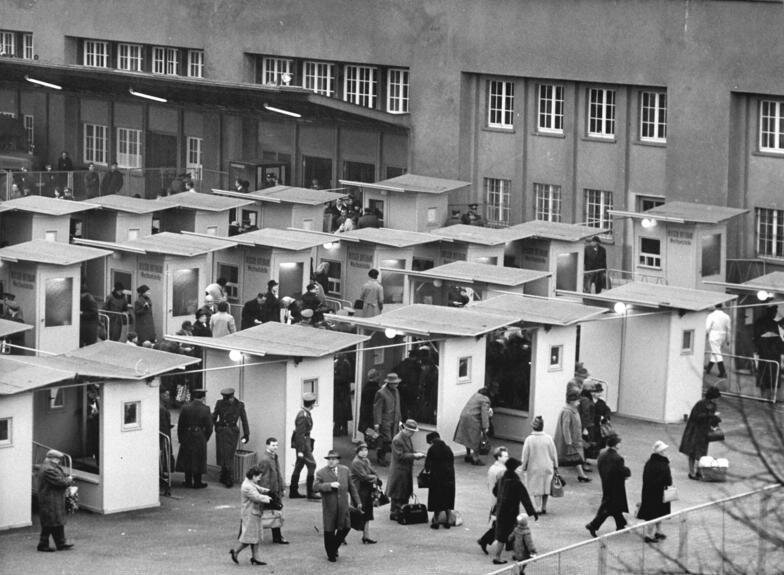
Two German agreements followed within months. The Transit Agreement, signed on 17 December 1971 and in force from 3 June 1972, regulated the road and rail corridors across GDR territory. Alongside it the West Berlin Senate and the GDR signed an arrangement on visits, and its effect was immediate: at Easter 1972 roughly half a million West Berliners crossed into East Berlin and the surrounding countryside, the first mass crossings since the Passierschein system collapsed six years earlier. A Traffic Treaty in May 1972 became the first treaty ever concluded between the two German states.
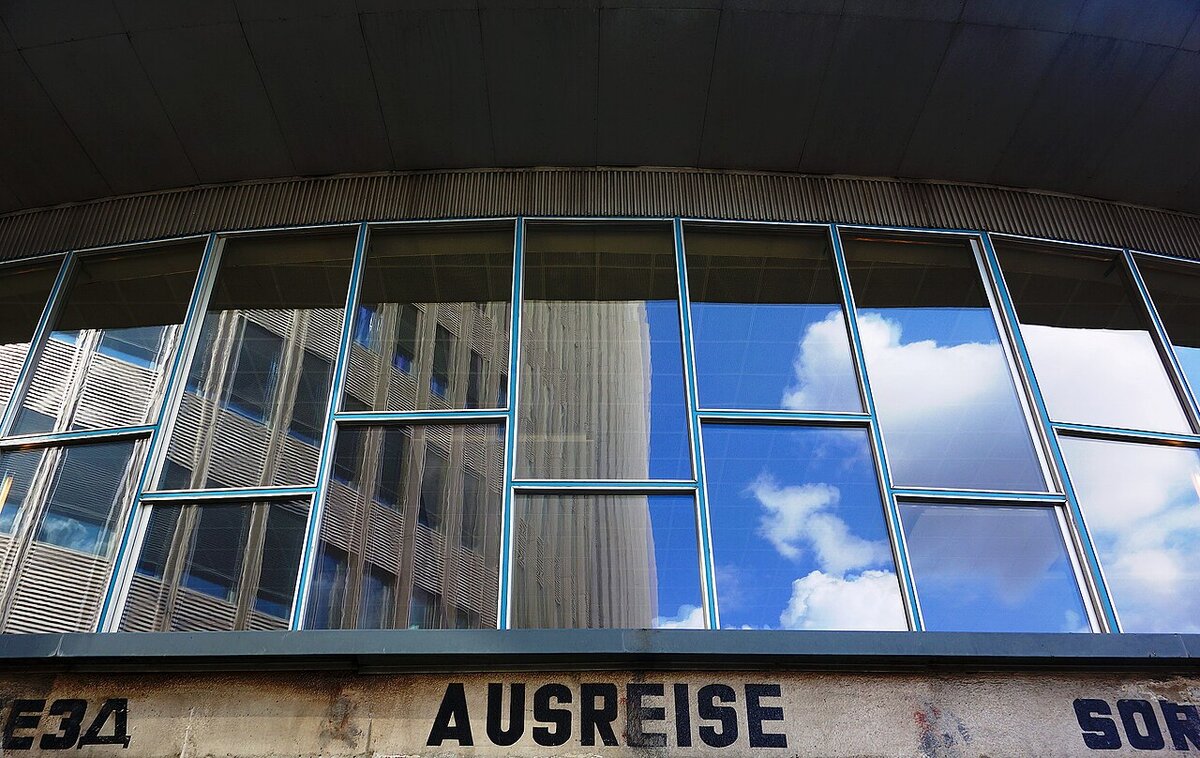
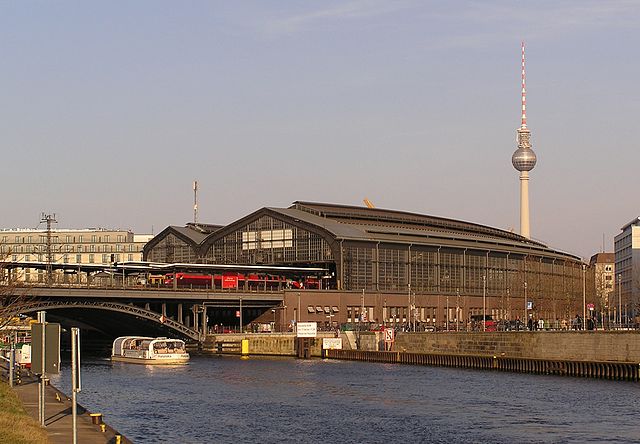
A day visit was not a casual thing. West Berliners queued at the Tränenpalast, the glass and steel departure hall beside Bahnhof Friedrichstraße, filed through passport control staffed by border troops who were often Stasi officers in uniform, changed a compulsory sum of West marks into East marks that could not be taken home or usefully spent, and had to be back on the western side before midnight. West Germans driving in from the Federal Republic entered the transit corridors at crossings such as Checkpoint Bravo at Dreilinden, where leaving the marked route was itself an offence. The crossing points and the rules that governed them are a story in their own right.
21 December 1972: Signing the Basic Treaty
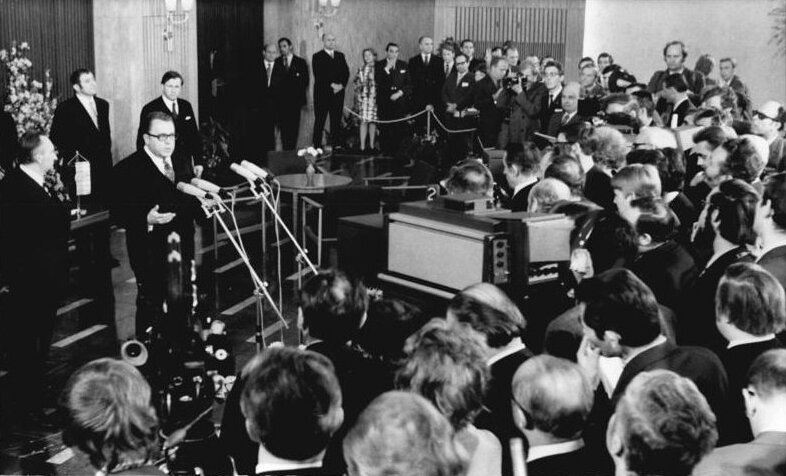
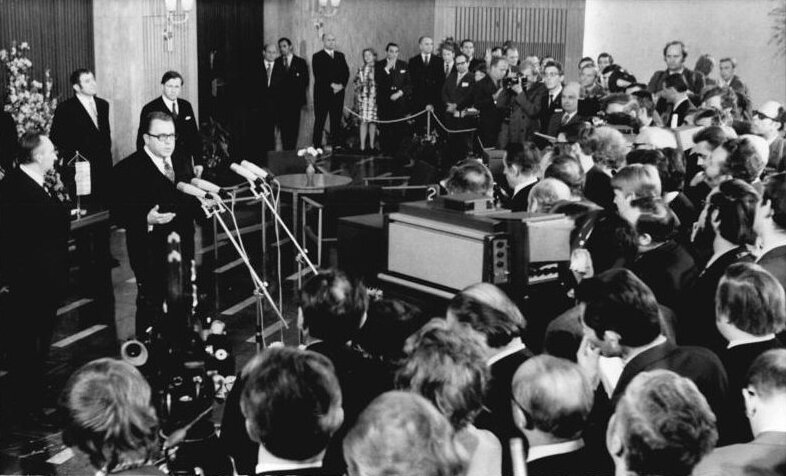
The document signed in East Berlin on 21 December 1972 carried the full name Treaty on the Basis of Relations between the Federal Republic of Germany and the German Democratic Republic, which nobody was ever going to say twice. In German it became the Grundlagenvertrag, from Grundlagen, meaning foundations or basis. English translated that literally and got the Basic Treaty, a name that has misled readers ever since: it does not mean a simple or preliminary treaty, it means the treaty setting out the basis on which the two German states would deal with each other. Egon Bahr signed for the Federal Republic, State Secretary Michael Kohl for the GDR. Its terms were the ordinary furniture of diplomacy, which was exactly the point: respect for each other’s sovereignty and territorial integrity, renunciation of force, non-interference, and an agreement that neither state could speak for the other internationally. Attached to it was a long list of practical matters to be settled next, from posts and telecommunications to health, culture, sport, science and the environment.
What the treaty carefully did not do was recognise the GDR as a foreign country. Bonn granted recognition in fact but not in law, and dressed the distinction in a formula Brandt had used in his first government statement in 1969: two states exist in Germany, but they are not foreign to one another. In practice this meant the two capitals exchanged not embassies but permanent missions, headed by permanent representatives rather than ambassadors, which opened in 1974. West Germany also handed over a Letter on German Unity restating that the treaty did not conflict with the Federal Republic’s constitutional aim of reunification. East Berlin took the letter and ignored it.
The Fight to Ratify It, and the Bribe That Saved It
The CDU and CSU opposition regarded the whole project as the abandonment of reunification, and came within two votes of stopping it. On 27 April 1972 they moved a constructive vote of no confidence to replace Brandt with Rainer Barzel, the first ever attempted under the Basic Law, as West Germany’s constitution is known. It failed. Brandt then went to the country and won the November 1972 election decisively, which settled the argument politically. The Bundestag ratified the treaty on 11 May 1973, the GDR’s People’s Chamber followed on 13 June, and it came into force on 21 June 1973.
The strangest part surfaced later. In June 1973 the CDU deputy Julius Steiner admitted he had abstained in the no-confidence vote in exchange for 50,000 marks, which he said had come from the SPD’s parliamentary manager Karl Wienand. When the Stasi files were opened in the 1990s they showed that Steiner had been paid 50,000 marks by the Stasi itself. Whether he was paid twice, or invented the Wienand payment to cover the East German one, has never been established. What is not in doubt is that East Berlin spent money to keep in office the West German government that was about to recognise it.
Bavaria made a final attempt through the courts, asking the Federal Constitutional Court to strike the treaty down. The judgment of 31 July 1973 upheld it, but with a qualification that turned on the peculiar status of the West German constitution. That document is not called a constitution at all but the Basic Law, the Grundgesetz, because the politicians who drafted it in 1949 refused to pretend that a state covering two thirds of Germany could write a constitution for the whole nation. It was meant as a stopgap, to be replaced once Germans could adopt a real one together, and reunification was written into it as an obligation rather than a hope. The court held that this obligation still bound every West German government, treaty or no treaty, and that the GDR could therefore not be treated as a foreign state. That reading sat quietly on the shelf for seventeen years and then turned out to matter a great deal in 1990.
Two Germanys at the United Nations
On 18 September 1973 the Federal Republic and the German Democratic Republic were admitted to the United Nations on the same day. For East Berlin this was the prize the whole exercise had been about. Within a few years the GDR was recognised by more than a hundred states, had embassies across Africa, Asia and Latin America, and competed at the Olympics as a country rather than as half of one. The Hallstein Doctrine was dead, and the SED had achieved the international normality it had chased since 1949.
Abgrenzung: The GDR Takes Fright
Having spent twenty years demanding recognition, the SED discovered it did not much like what came with it. Recognition meant West German journalists in East Berlin, West German visitors in provincial towns, and West German money and manners circulating among people who could compare. The answer was Abgrenzung, demarcation: take the diplomatic benefits, and wall off the human contact.
The revised constitution of 1974 deleted the references to the German nation and to reunification that the 1968 text still carried. Institutions were renamed to match, so the Deutsche Notenbank became the Staatsbank der DDR and the currency became the Mark der DDR. The most effective instrument, though, was money. The compulsory minimum exchange for visitors, the Zwangsumtausch, was raised and lowered repeatedly as a tap on the flow of people, and from 13 October 1980 every visitor had to change 25 West marks per person per day at a rate of one to one, children included. For a family of four on a weekend visit this was ruinous, and it was meant to be. Visits fell sharply.
The cultural clampdown ran on the same logic. When the singer Wolf Biermann was allowed to tour the West in November 1976, the Politburo stripped him of his citizenship while he was out of the country and refused to let him back, triggering the protest that hollowed out a generation of GDR artists. That story belongs to music behind the Wall. Meanwhile the Stasi grew steadily through the treaty decade, because more contact with the West meant, in the ministry’s reading, more to watch.
The Wall Got Worse While the Door Opened
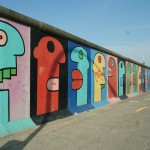
Here is the paradox that makes the 1970s so hard to summarise. Detente coincided with the most thorough rebuilding of the border in its history. From 1975 the improvised barriers of the 1960s were replaced by the fourth-generation Grenzmauer 75, the smooth pale concrete slabs topped with a round pipe that made handholds useless. This is the Wall of the famous photographs, and it is the Wall of the surviving fragments visitors see today. Behind it went signal fences, dog runs, floodlighting and a raked control strip.
Nor did the treaties stop the shooting. People went on dying at the Berlin Wall through the whole detente period and beyond it, the last of them Chris Gueffroy in February 1989. Both things were simultaneously true: by the late 1980s West Germans and West Berliners were making tens of millions of visits to the GDR, and the border they were crossing was more heavily engineered and no less deadly than the one their governments had refused to acknowledge in 1969.
Whether that trade was worth making is still argued about in Germany. The case against Ostpolitik is that it propped up a dictatorship for another fifteen years and gave it the legitimacy it could not earn. The case for it is that a divided family could finally meet, that West Berlin’s access was never again squeezed, and that the contact the SED spent the 1970s trying to limit is part of why so many East Germans in 1989 knew exactly what they were missing.
Guillaume: The Spy Who Brought Brandt Down
The postscript is almost too neat. On 24 April 1974 Günter Guillaume, one of Brandt’s personal aides in the Chancellery, was arrested as an officer of the Stasi’s foreign intelligence arm. Brandt took responsibility and resigned on 7 May. Markus Wolf, who ran the operation, spent the rest of his life explaining that it had been a disaster for his own side: East German intelligence had destroyed the Western politician who had done more for East German interests than any other. Brandt’s successor Helmut Schmidt continued the policy without him.
Following the Treaty Years in Berlin Today
The detente decade left fewer monuments than the Wall’s dramatic moments, but its sites are all still there:
- Tränenpalast – the departure hall where West Berliners said goodbye after a day visit, now a permanent exhibition on the border experience. The single best place to understand what a treaty-era crossing actually felt like.
- Bahnhof Friedrichstraße – the station itself, divided internally into separate worlds for transit passengers, day visitors and East Berliners.
- Checkpoint Bravo, Dreilinden – the southern end of the transit corridor from West Germany, where the 1971 agreement was felt by everyone who drove to West Berlin.
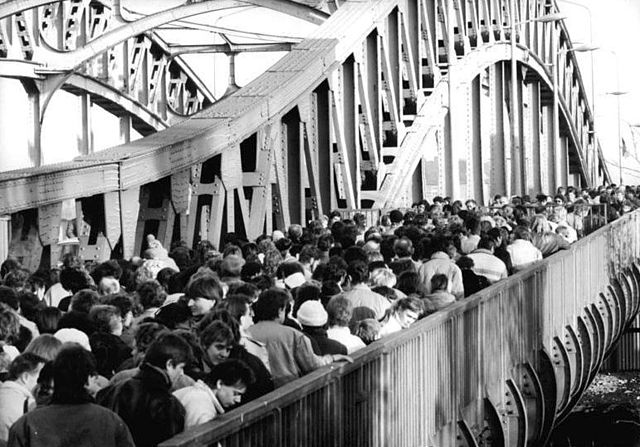
- Bornholmer Straße – a crossing that handled treaty-era day visitors for seventeen years before becoming the first to open on 9 November 1989.
- Notaufnahmelager Marienfelde – the reception centre that processed the East Germans who still got out, including those the Federal Republic quietly bought free.
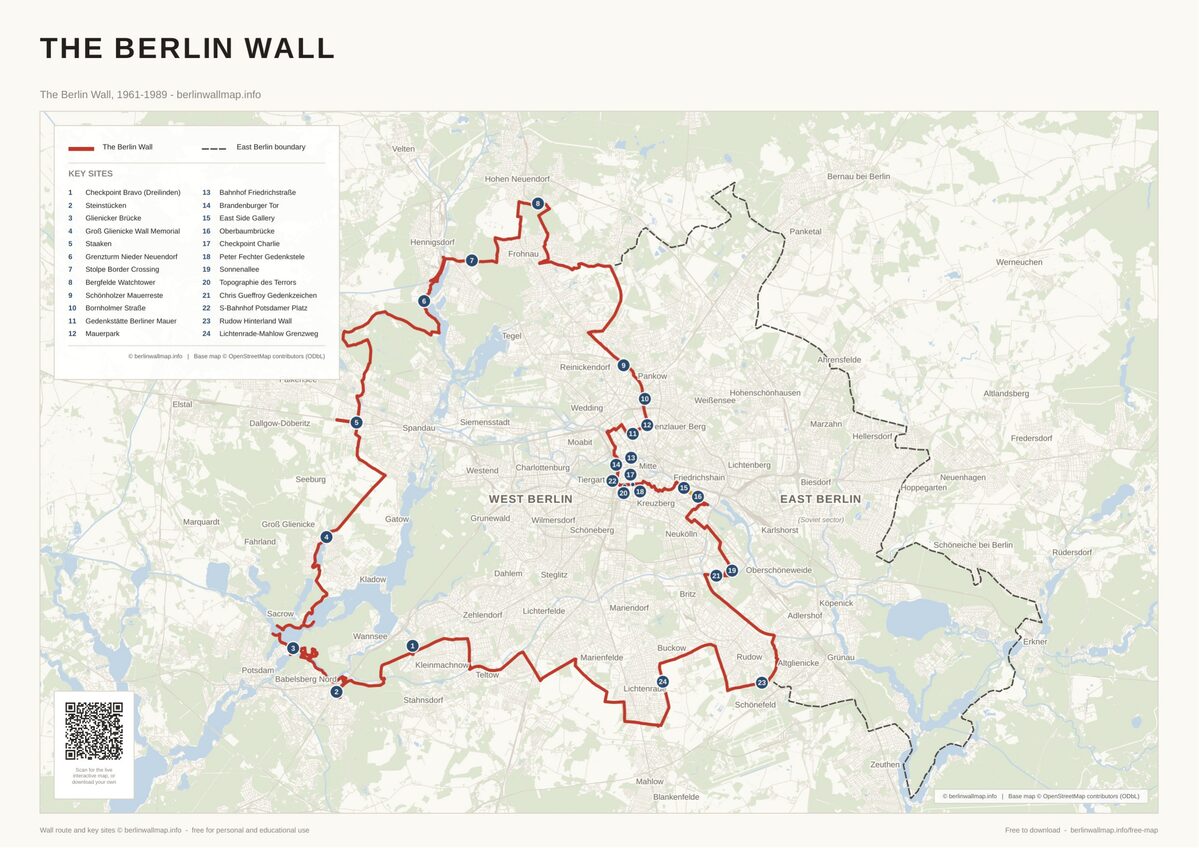
All of them are on our interactive map of the Berlin Wall, and the wider sequence of events sits in the Berlin Wall history timeline.
Frequently Asked Questions
What was the Basic Treaty of 1972?
The Basic Treaty, or Grundlagenvertrag, was signed in East Berlin on 21 December 1972 and came into force on 21 June 1973. In it West Germany and East Germany agreed to respect each other’s sovereignty, renounce the use of force, and develop normal relations, and they set out a programme of practical agreements covering transport, communications, culture and more.
Did the Basic Treaty mean West Germany recognised East Germany?
In fact, yes; in law, no. Bonn recognised the GDR as a state but refused to treat it as a foreign country, which is why the two exchanged permanent missions rather than embassies. The Federal Constitutional Court confirmed in July 1973 that the constitutional goal of reunification remained binding despite the treaty.
Basic Treaty or Basic Law: what is the difference?
They are unrelated documents that happen to collide in English. The Basic Law, the Grundgesetz, is West Germany’s constitution of 1949, and is still Germany’s constitution today. The Basic Treaty, the Grundlagenvertrag, is the 1972 agreement between the two German states. The names sound alike only in translation, because both German words open with Grund-, ground or basis.
What was Ostpolitik?
Ostpolitik was the policy pursued by Willy Brandt’s government from 1969 of seeking agreements with the Soviet Union, Poland and East Germany instead of refusing to deal with them. Its guiding idea, formulated by Egon Bahr in 1963, was Wandel durch Annäherung: change through rapprochement, on the assumption that contact would do more for people behind the Iron Curtain than isolation had.
Did the treaties make it easier to cross the Berlin Wall?
For Westerners, yes. West Berliners could visit the East again from 1972 after six years of being barred, and transit between West Germany and West Berlin was guaranteed. For East Germans almost nothing changed: apart from pensioners and urgent family cases, they still could not travel west, and the border troops still had orders to shoot.
Why did both German states join the United Nations in 1973?
Because the Basic Treaty removed West Germany’s objection. Bonn had previously blocked East German membership by claiming to be the sole legitimate German state, and once it dropped that claim both were admitted together on 18 September 1973.
Did detente make the Berlin Wall less dangerous?
No. The border was comprehensively rebuilt from 1975 in its final and most formidable form, and people continued to be killed trying to cross it until 1989. The treaties made the Wall more permeable for authorised visitors while leaving the shooting orders untouched.
Free map downloads
Free printable PDF maps of the Berlin Wall.
Get the free maps →Explore the Timeline
Journey through Berlin Wall history from 1945 to 1990.
View Timeline →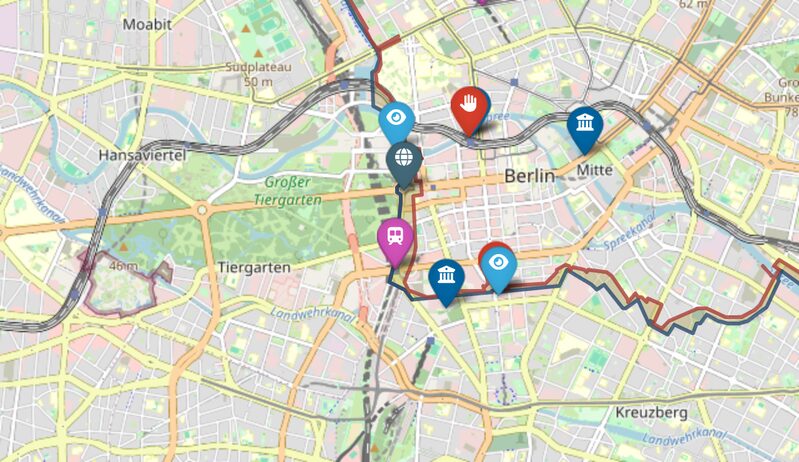
Embed Our Map
Add a free interactive Berlin Wall map to your website or blog.
Get embed code →