The Peaceful Revolution in Berlin: The Protests That Toppled the Wall
The Berlin Wall did not fall because a politician decided it should. It fell because, in the autumn of 1989, ordinary people in East Germany stopped being afraid. In Leipzig they had been marching every Monday since September, the crowds growing from hundreds to tens of thousands. In Prague and Budapest they fled through embassies and open borders. And in Berlin – where the Wall stood tallest and the secret police watched closest – they lit candles outside a church in Prenzlauer Berg and did something that had not happened in forty years of dictatorship: they gathered, they spoke, and they refused to leave.
The story of November 9 is well known – the confused press conference, the crowds at Bornholmer Straße, the Wall breached by a border guard’s decision to open the gate. But that night was the last act, not the first. The revolution that made it possible played out over the weeks before, in specific streets and buildings across East Berlin. Most of them are still standing, and you can visit them today.
The Church Network: Where Dissent Found a Voice
In a state that controlled the press, the unions and every public assembly, the Protestant churches of East Berlin were the one space the regime could not entirely seal. Through the 1980s a network of opposition groups took root under their protection, meeting in parish halls to discuss what could not be discussed anywhere else: peace, ecology, human rights, and the slow suffocation of life behind the Wall.
The centre of gravity was Prenzlauer Berg, the run-down inner-city district where artists, draft resisters and misfits had gathered because the state did not bother to maintain its crumbling apartments. At Zionskirche on Zionskirchplatz, the Umwelt-Bibliothek (Environmental Library) operated an underground printing press, producing illegal opposition magazines on church duplicating machines. When the Stasi raided it in November 1987 and arrested the activists, the international outcry forced their release within days – a small but significant victory that proved the regime could be pushed back.
At Samariterkirche in Friedrichshain, a solidarity service with white carnations on 28 June 1989 – held under the shadow of the Tiananmen Square massacre three weeks earlier – became one of Berlin’s earliest open acts of protest that summer.
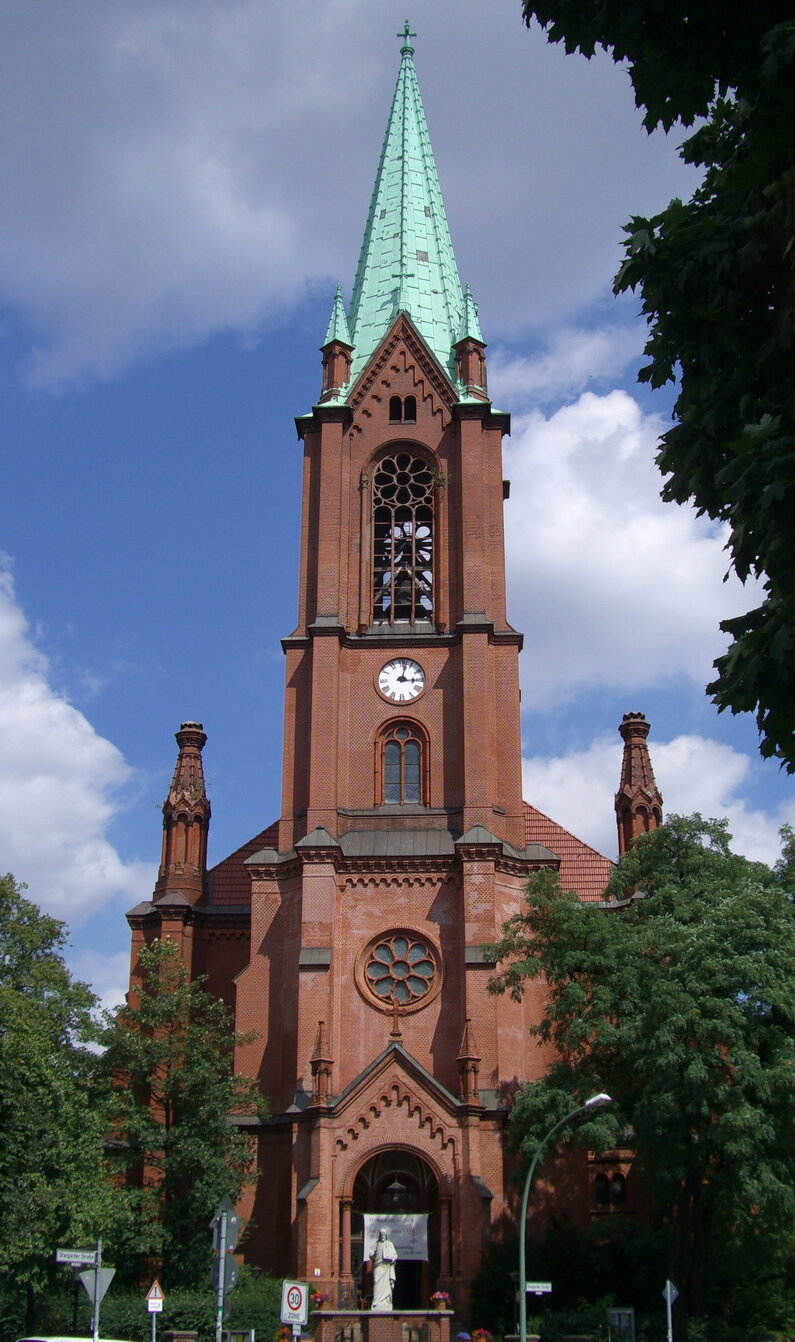
And at Gethsemanekirche on Stargarder Straße, barely a kilometre away, the threads came together.
Gethsemanekirche: Watch and Pray
On 2 October 1989, a handful of activists from the Weißensee Peace Circle, the Environmental Library and the Kirche von Unten (Church from Below) opened the doors of the Gethsemanekirche and began a vigil. The motto was "Wachet und betet" – Watch and Pray. The church stayed open around the clock.
Their immediate cause was the wave of arrests sweeping East Germany as the Monday demonstrations spread from Leipzig. But the vigil quickly became something larger: a twenty-four-hour open assembly where anyone could step up and speak freely, something not possible anywhere else in public life. A contact telephone was set up in the parish hall – staffed by volunteers around the clock, among them a sixteen-year-old, Margitta Kupler – collecting reports of arrests and resistance from across the country and passing them to Western journalists. It was an improvised news agency inside a church.
By 4 October, three thousand people were attending the evening services. The forecourt was covered in burning candles – a gesture borrowed from Leipzig that became the image of Berlin’s autumn.
Meanwhile, the opposition was organising. Neues Forum had been founded on 9 September by Bärbel Bohley, Jens Reich and twenty-eight other signatories. Demokratie Jetzt was established in Berlin three days later. By mid-October, Neues Forum held its first state conference at the Kirche von Unten. The opposition was no longer a scattered handful of church groups. It had names, structures and – at Gethsemane – a public stage.
7 October: The Night the Regime Struck
On 7 October 1989, the GDR celebrated its fortieth anniversary. The ceremony took place at the Palace of the Republic on Marx-Engels-Platz, with Mikhail Gorbachev as the guest of honour. Erich Honecker, East Germany’s head of state and party leader since 1971, declared that socialism stood on "unshakable foundations". The official youth organisation, the FDJ, marched with torches down Karl-Marx-Allee, a hundred thousand strong.
Gorbachev’s visit produced one of the most quoted lines of 1989. In private he is reported to have warned Honecker that "he who is too late is punished by life" – "Wer zu spät kommt, den bestraft das Leben". The phrase was relayed to Western journalists by a spokesman and quickly became shorthand for Moscow’s message: reform or be left behind.
That evening, after Gorbachev left for the airport, the streets erupted. Several thousand people who had gathered opposite the Palace dispersed toward Prenzlauer Berg, chanting "Wir sind das Volk" and "Gorbi, Gorbi!" What followed was the last time the East German state used mass force against demonstrators in Berlin.
Riot police and Stasi special units moved through the streets between Schönhauser Allee and Prenzlauer Allee, beating and arresting people on Mollstraße, Lychener Straße and around the Gethsemanekirche. Water cannon and armoured vehicles were deployed outside the church. Over the nights of 7 and 8 October, more than a thousand people were detained across East Berlin. Many were bystanders; some were dragged from their own doorsteps. Western television broadcast the violence.
In the days that followed, relatives from across the country came to the Gethsemanekirche seeking news of those arrested. On 23 October, opposition groups including Marianne Birthler and Ehrhart Neubert presented a hundred-page report on police brutality to the international press – compiled from the information the church’s contact telephone had been gathering for three weeks.
But the violence of 7 October was the regime’s last show of force, not its first of many. Two days later, on 9 October, seventy thousand people marched in Leipzig – and the security forces, who had been issued live ammunition, did not shoot. The news reached the Gethsemanekirche that evening. The vigil’s night shifts ended on 13 October. The regime had blinked.
Honecker Falls
On 18 October 1989, Erich Honecker was forced to resign at the ZK-Gebäude (Central Committee building) on Werderscher Markt – the former Reichsbank building from which he had directed the state for eighteen years. Egon Krenz, his successor, promised a "turning point" (Wende). Nobody believed him. The marches grew larger.
Half a Million on Alexanderplatz
On 4 November 1989, somewhere between two hundred thousand and half a million people filled Alexanderplatz in what remains the largest demonstration in Berlin’s history – and the largest assembly not organised by the state in the entire forty-year existence of the GDR.
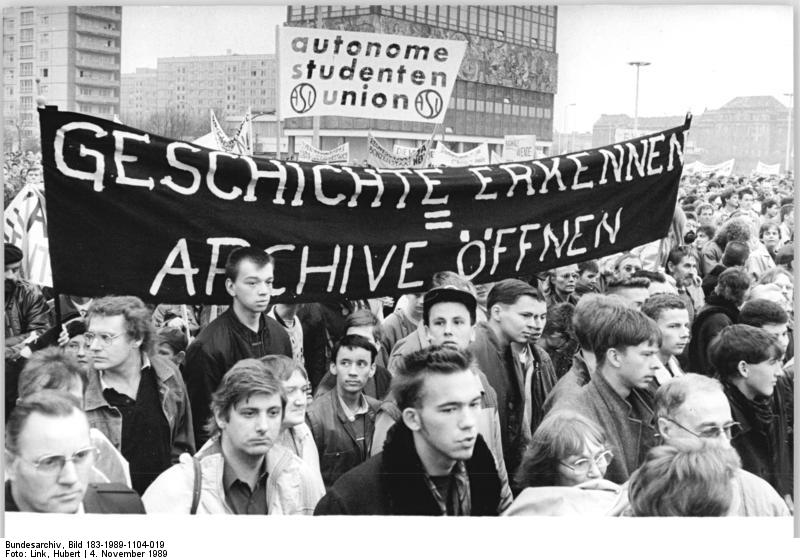
It was also the first legally permitted demonstration organised by private citizens in the country’s history. The permit had been applied for on 17 October by Wolfgang Holz, an actor at the Berliner Ensemble – Brecht’s old theatre. The organisers marshalled the crowd themselves, wearing yellow sashes reading "Keine Gewalt" – No Violence. Armed security forces were stationed inside the Palace of the Republic, and the SED blocked routes toward the Wall. But the march went ahead: assembling at Mollstraße, passing the Palace and the State Council building, and filling the great open square.
Twenty-six people spoke from a flatbed truck, and East German television broadcast it live – another first. Stefan Heym, the grand old man of East German letters, opened with words that captured the mood: "It is as if someone has thrown open the windows after all the years of stagnation, of intellectual, economic, political stagnation." Christa Wolf riffed on the anti-war slogan: "Stell dir vor, es ist Sozialismus, und keiner geht weg!" – "Imagine it is socialism and nobody leaves!"
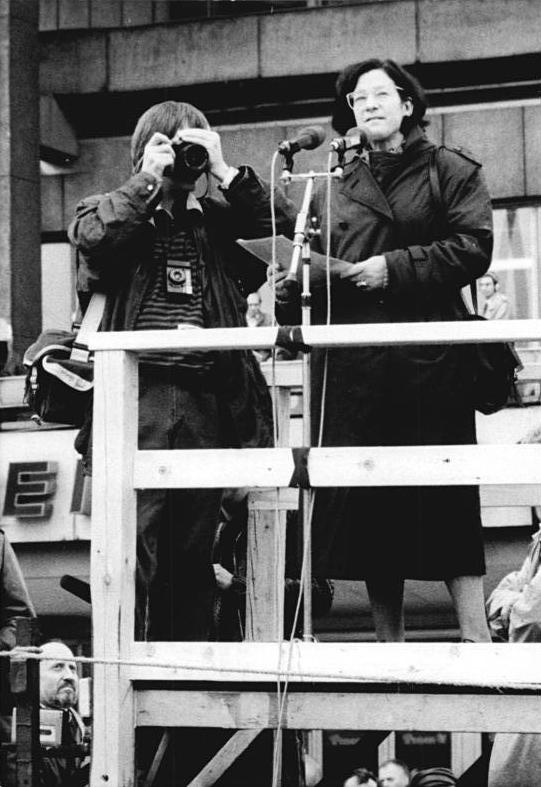
Steffie Spira, an eighty-one-year-old actress, proposed that the Politburo members’ exclusive compound at Wandlitz be turned into a retirement home: "Those over sixty and sixty-five can live there now, if they do what I am doing: step down." Jens Reich of Neues Forum declared: "We have rediscovered language."
When the Stasi’s former foreign intelligence chief Markus Wolf took the microphone, the crowd booed. Activist Bärbel Bohley, watching from the stage, turned to Jens Reich and said: "Now it is all over. The revolution is irreversible."
The banners told the story in sharper words: "Stasi in die Produktion!" (Stasi into the factories), "Freie Wahlen!" (Free elections), "Reisefreiheit statt Massenflucht" (Freedom to travel instead of mass flight). The demand was reform: free elections, a free press, an end to surveillance, a new constitution. This was "Wir sind das Volk" – We are the people – not yet "Wir sind ein Volk", the call for reunification that would come later. On 4 November, most of the speakers still imagined a better East Germany, not a united one.
Five Days to the Wall
The day after the Alexanderplatz demonstration, at a concert in the Gethsemanekirche, conductor Rolf Reuter of the Komische Oper interrupted Beethoven’s Eroica to shout "Die Mauer muss weg!" – "The Wall must go!" The audience spilled into the street and marched down Schönhauser Allee. It may have been the first time the demand was made out loud in East Berlin.
On 6 November the government published a draft travel law: thirty days abroad per year, with permission. The Monday demonstration in Leipzig that evening dismissed it as an insult. The Volkskammer committee rejected the draft the following day.
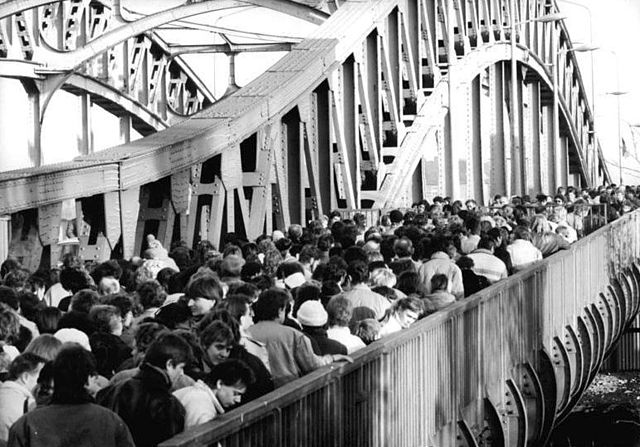
On the evening of 9 November, Politburo spokesman Günter Schabowski sat down at the International Press Centre on Mohrenstraße and read out new travel regulations he had not fully understood. Asked when they took effect, he shuffled his papers and said: "Sofort, unverzüglich" – immediately, without delay. By midnight, tens of thousands were at the checkpoints. At Bornholmer Straße, border guard commander Harald Jäger – overwhelmed, without orders, afraid of what would happen if the crowd pushed forward – made the decision to open the gate.
The rest of that night is its own story. But it began here, in the churches and on the streets, with candles and voices and the slow, collective discovery that a regime that could no longer shoot its own people could no longer stand.
Where to See This History Today
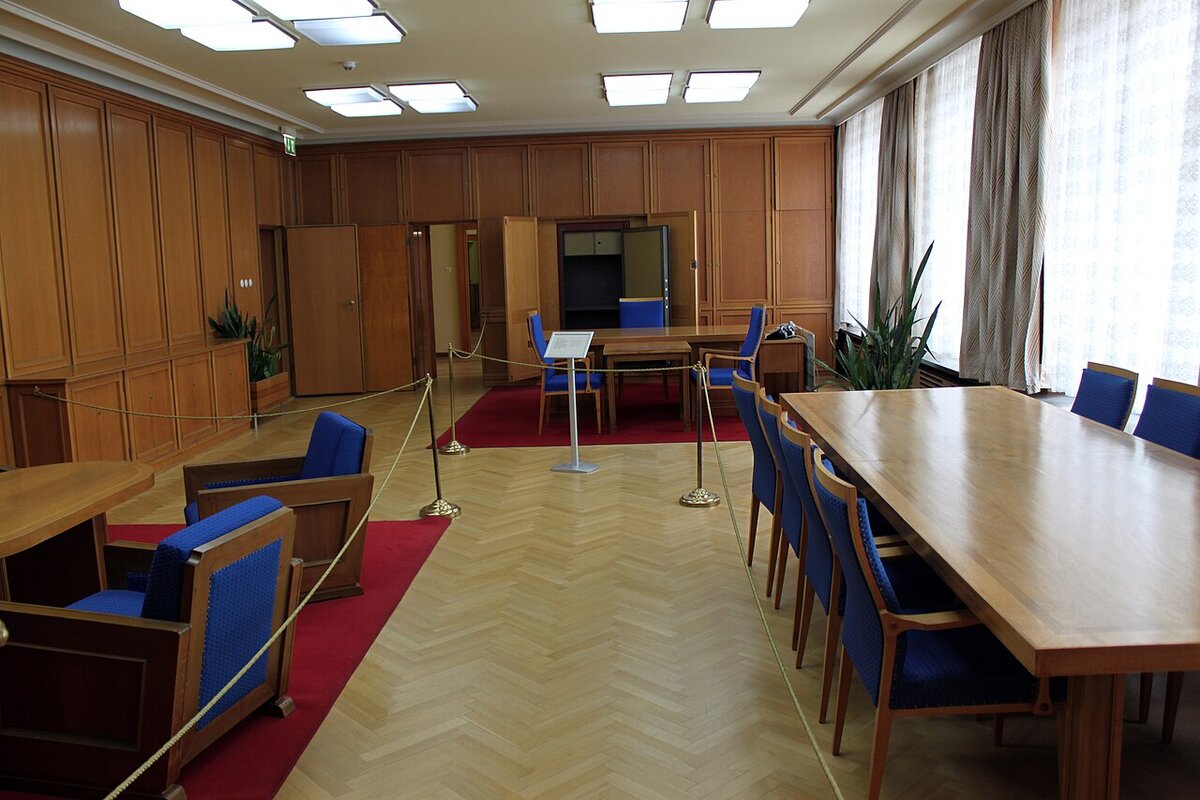
The peaceful revolution left fewer monuments than the Wall itself – it was made of courage, not concrete. But its key sites survive, and walking between them is one of the best ways to understand what happened in Berlin in 1989.
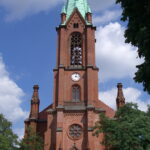
Gethsemanekirche on Stargarder Straße in Prenzlauer Berg is an active parish church and concert venue. A memorial plaque and Karl Biedermann’s low relief Resistance commemorate the autumn of 1989. In front of the west portal stands the Segnende Christus (Blessing Christ) statue, rescued from the Versöhnungskirche – the Church of Reconciliation that stood directly on the death strip until the GDR dynamited it in 1985. Ernst Barlach’s bronze Geistkämpfer (Spirit Fighter), placed by the state of Berlin in 1994, honours the democratic movement born here. Take the U2 to Schönhauser Allee; the church is a five-minute walk north.
Alexanderplatz carries no monument to 4 November 1989. The square has been rebuilt so thoroughly that its 1989 incarnation is gone. But the space is unmistakable, and standing in it with the knowledge of what half a million people did here is its own experience.
The International Press Centre where Schabowski held his press conference stood at Mohrenstraße 36-37. The building now houses a federal ministry, but the room where the Wall’s fate was sealed is preserved for events and occasional public tours.
The Stasi Museum on Normannenstraße in Lichtenberg tells the other half of the story: the surveillance machine the revolution dismantled. On 15 January 1990, tens of thousands surrounded and stormed the headquarters to stop the shredding of files. The Hohenschönhausen Memorial, the Stasi’s secret prison, shows where the regime’s opponents ended up before the revolution made that impossible.
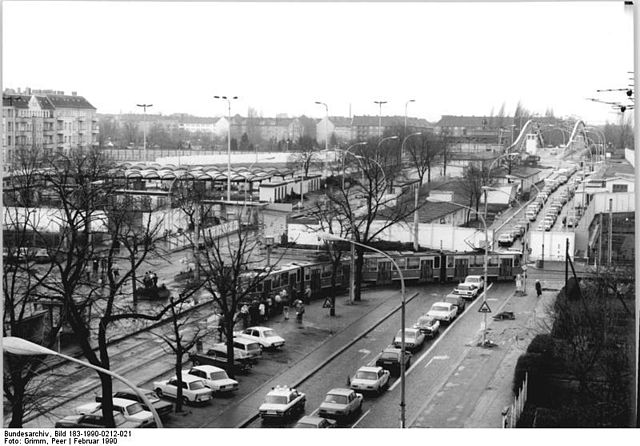
Bornholmer Straße, where the Wall was first breached on the night of 9 November, connects the peaceful revolution directly to the moment it won. An outdoor exhibition at the memorial marks the spot where Harald Jäger opened the barrier.
Find all these sites – and every other trace of the divided city – on our interactive Berlin Wall map, or follow the full arc from construction to collapse on the Berlin Wall history timeline.
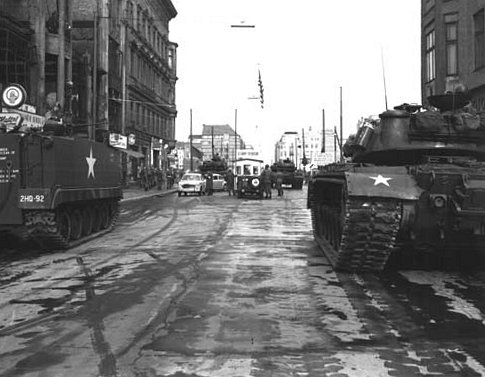
Checkpoint Charlie
East Side Gallery
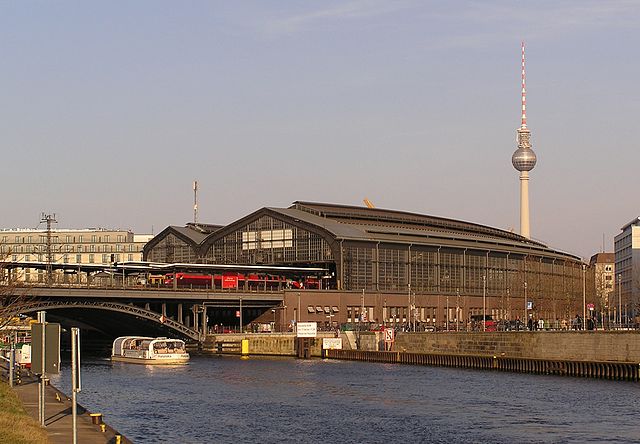
Bahnhof Friedrichstraße
Bornholmer Straße
65 Years Ago: US and Soviet Tanks Faced Off at Checkpoint Charlie
The Border Guards of the Berlin Wall: Conscripts, the Order to Shoot, and the Trials That Followed
9 November in Berlin: 37 Years Since the Wall Fell, and What’s On
Gethsemanekirche
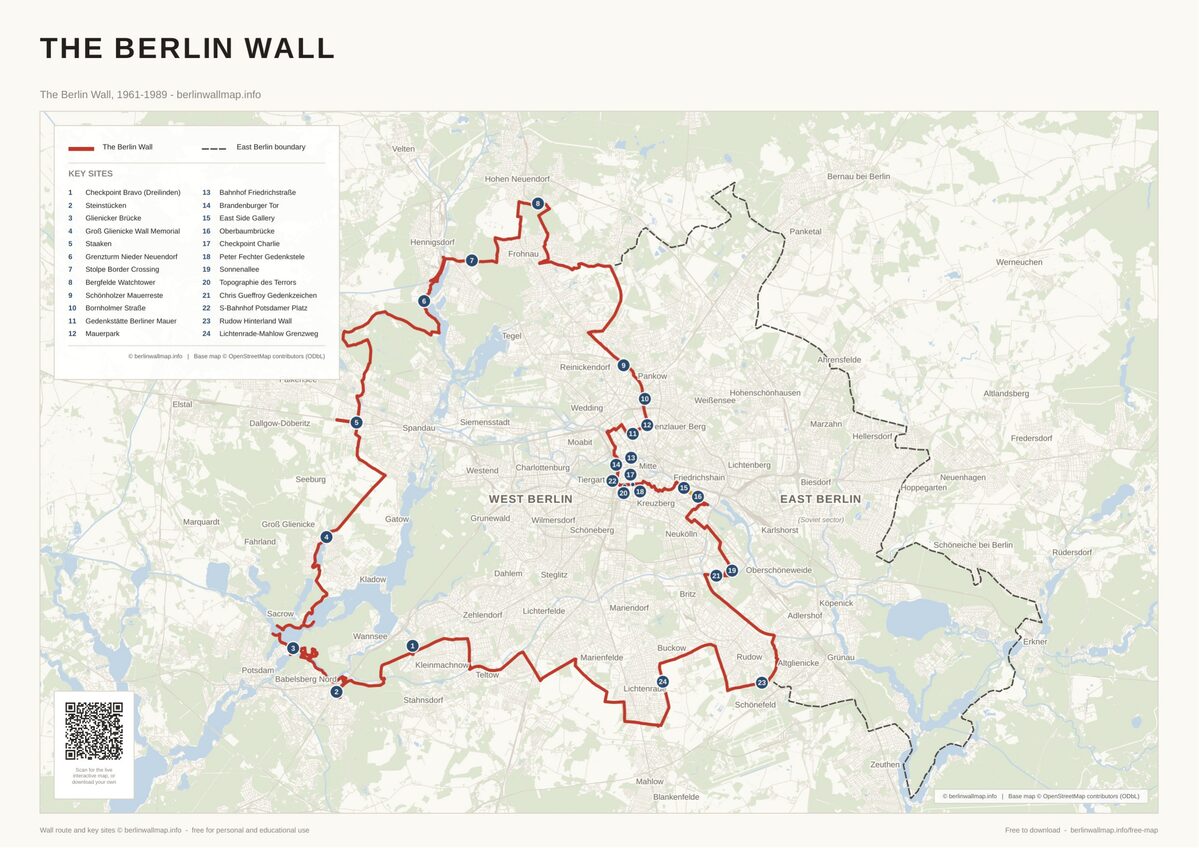
Free map downloads
Free printable PDF maps of the Berlin Wall.
Get the free maps →Explore the Timeline
Journey through Berlin Wall history from 1945 to 1990.
View Timeline →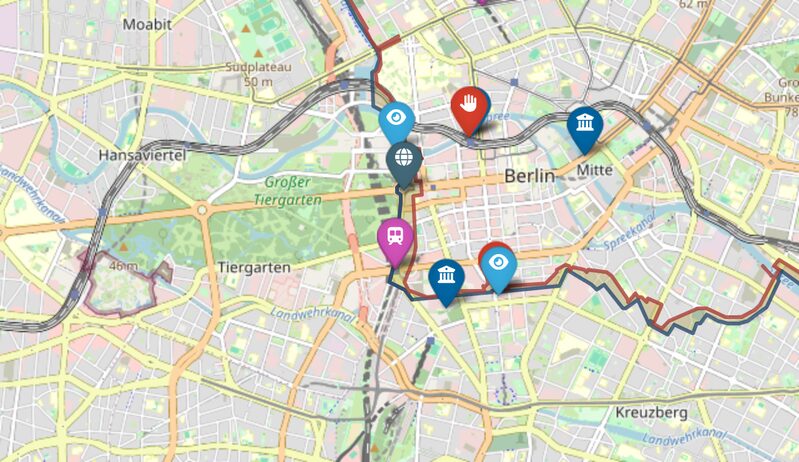
Embed Our Map
Add a free interactive Berlin Wall map to your website or blog.
Get embed code →