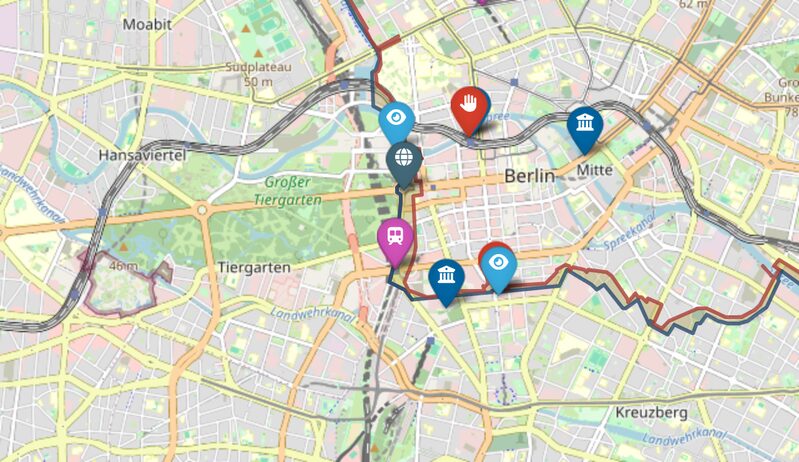
Berlin Wall Sites to Visit
Topographie des Terrors
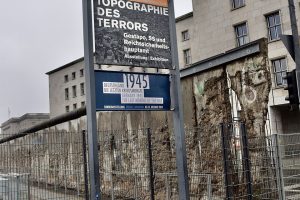
Built on the site of the former Gestapo and SS headquarters, this documentation center features a 200m section of the original Berlin Wall along Niederkirchnerstraße. Unlike the East Side Gallery, this stretch has never been repainted and shows its original weathered state. One of Berlin’s most visited memorial sites, with free outdoor and indoor exhibitions.
More...Tränenpalast
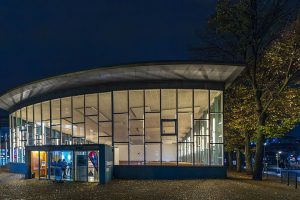
The “Palace of Tears” was the departure hall at Friedrichstraße station where East Germans said goodbye to visiting Western relatives, often not knowing when they would meet again. The glass pavilion earned its name from the tears shed at these farewells. Now a free museum with a permanent exhibition on daily life in divided Germany.
More...Tunnel 29
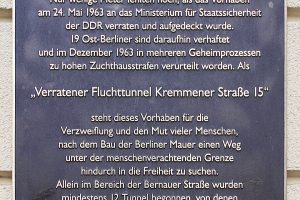
In September 1962, 29 people escaped through a 135-metre tunnel dug from a disused factory on Bernauer Straße to a building on Schönholzer Straße in the East. The escape was filmed by an NBC television crew, producing the Emmy-winning documentary “The Tunnel” that brought worldwide attention to the plight of those trapped behind the wall.
More...Tunnel 37 – Brunnenstraße
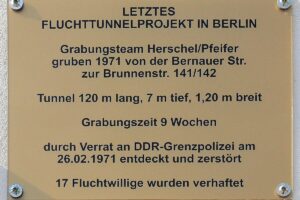
A memorial plaque at Brunnenstraße 141 marks the site of an escape tunnel through which 37 people reached freedom from East to West Berlin. The tunnel was one of at least seven dug within a 350-metre stretch near Bernauer Straße. Today, Berliner Unterwelten e.V. maintains an access point here, allowing visitors to see the only […]
More...Tunnel 57
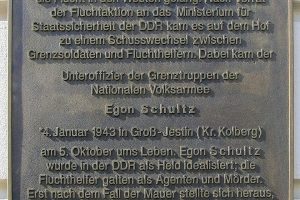
On 3–4 October 1964, 57 people crawled through a 12-metre-deep tunnel from a disused bakery cellar on Bernauer Straße to Strelitzer Straße in the East – the largest single mass escape through a tunnel during the wall’s existence. The operation was discovered during the second night when an East German border guard was fatally shot, […]
More...U-Bahnhof Alexanderplatz (U8)
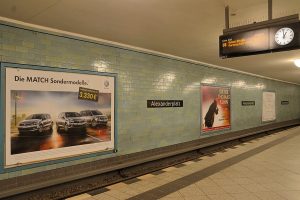
East Berlin’s busiest transport hub was simultaneously a ghost station. The U2 and U5 platforms served East Berliners normally, while the physically separate U8 platform was sealed off and patrolled by guards as Western trains passed through without stopping.
More...U-Bahnhof Bernauer Straße
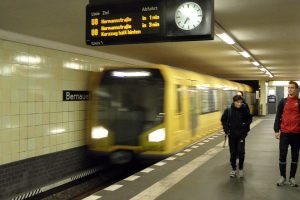
This U8 station sat directly beneath the Berlin Wall boundary on Bernauer Straße. Sealed from 1961, it reopened on 12 April 1990. The Berlin Wall Memorial stands directly above at street level.
More...U-Bahnhof Französische Straße
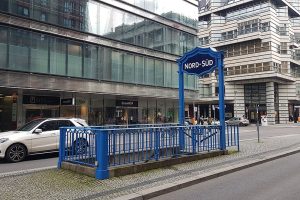
After serving as a U6 ghost station from 1961 to 1990, this station operated normally for 30 years before being permanently closed on 4 December 2020 when the U5 extension opened. The new “Unter den Linden” interchange station 200 metres away replaced it. The platforms remain sealed underground.
More...U-Bahnhof Jannowitzbrücke
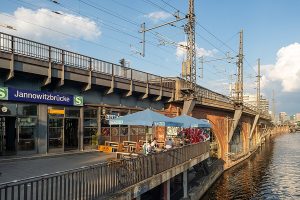
The first ghost station to reopen, on 11 November 1989, just two days after the Wall fell. A provisional border checkpoint was hastily set up on the U8 platform. Designed by Alfred Grenander, the station opened in 1928.
More...U-Bahnhof Naturkundemuseum
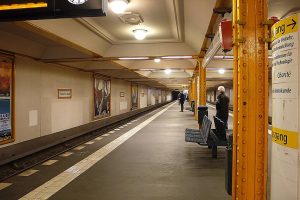
This U6 ghost station has had a confusing naming history. During the Wall era it was called “Nordbahnhof” on East German maps, then renamed “Zinnowitzer Straße” after the wall fell to avoid confusion, and finally “Naturkundemuseum” in 2009 for the nearby Natural History Museum.
More...U-Bahnhof Oranienburger Tor
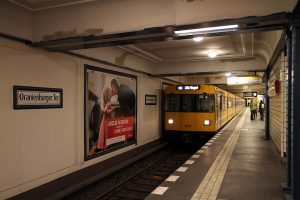
Named after the historic Oranienburger Tor gate that once stood here, this U6 ghost station is just one stop north of Friedrichstraße, the border crossing station. Western trains passed through the sealed platform without stopping. Today it serves Mitte’s cultural district near the Neue Synagoge.
More...U-Bahnhof Rosenthaler Platz
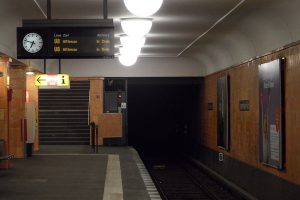
One of the first ghost stations to reopen after the Wall fell, on 22 December 1989, with a provisional border checkpoint hastily set up on the platform. When workers first entered, they found 1961-era advertisements still on the walls, unchanged for 28 years.
More...U-Bahnhof Schwartzkopffstraße
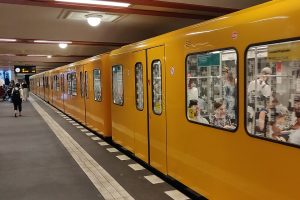
This U6 ghost station was renamed twice while sealed. In 1951 it became “Walter-Ulbricht-Stadion” and in 1973 “Stadion der Weltjugend”. These changes were visible only to guards and Western passengers looking through train windows. Despite being closed for decades, new signs were installed. The original name was restored after the wall fell.
More...U-Bahnhof Stadtmitte (U6)
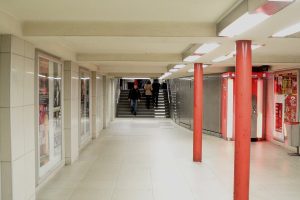
Like Alexanderplatz, Stadtmitte was a split station. The U2 platform operated normally for East Berliners (as “Otto-Grotewohl-Straße”), while the physically separate U6 platform was sealed as a ghost station. Western U6 passengers could see the closed platform as they passed through.
More...U-Bahnhof Weinmeisterstraße
A ghost station on the U8 line in the Scheunenviertel quarter. One of the last to reopen on 1 July 1990, it retains elements of Alfred Grenander’s original 1930 design. Today it sits in a busy shopping area near Hackescher Markt.
More...Wachturm Erna-Berger-Straße
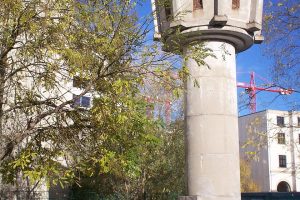
One of the very few surviving Berlin Wall watchtowers, this BT-11 type observation tower stands near Potsdamer Platz. Originally part of the border fortification system, it is now a small exhibition space documenting the construction and function of the wall’s guard towers.
More...Waltersdorfer Chaussee Crossing
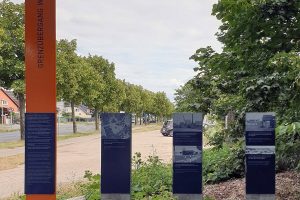
The Waltersdorfer Chaussee Crossing was a unique transit checkpoint created specifically for West Berliners travelling to Schonefeld Airport in East Berlin. Opening in 1963, it served a purely practical function in the otherwise rigid border system.
More...Weiße Kreuze
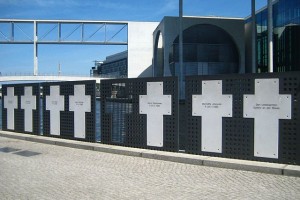
This memorial for those who died at the wall consists of seven white crosses, each inscribed with the name of one of the wall’s victims that was shot or died trying to escape. Nearby: Berlin Wall History Mile, Reichstag
More...Wollankstraße Tunnel
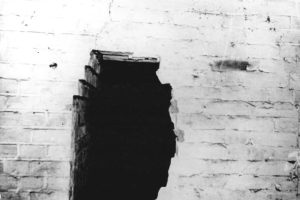
In January 1962, a group of students led by brothers Boris and Eduard Franzke began digging a tunnel beneath the S-Bahnhof Wollankstraße, aiming to reach Schulzestraße in East Berlin. After three weeks and approximately 30 metres of digging, the tunnel collapsed under the station platform on 26 January 1962, revealing the escape attempt before anyone […]
More...Zimmerstraße Escape Tunnels
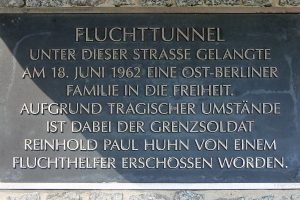
Two escape tunnels were dug on Zimmerstraße, close to Checkpoint Charlie. In summer 1962, a tunnel enabled an East German family to escape, but 20-year-old border guard Reinhold Huhn was shot dead by an escape helper during the attempt. In January 1972, three young East Berliners dug their own tunnel at Nr. 8–9 and reached […]
More...