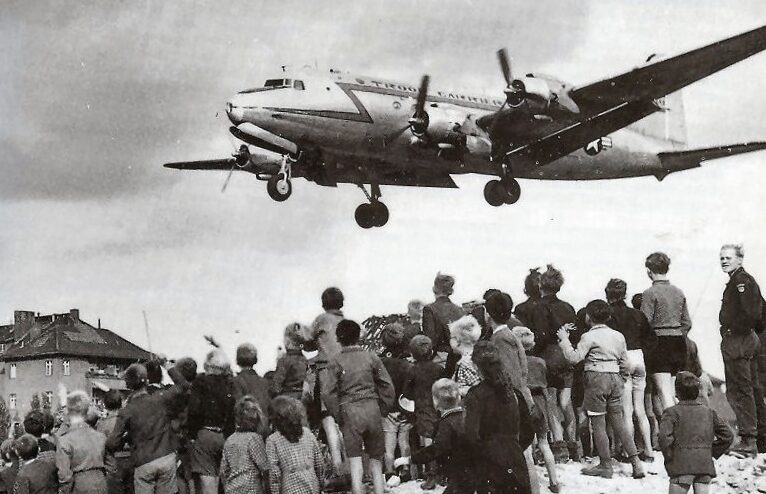
The Berlin Airlift: How West Berlin Survived the Soviet Blockade (1948-49)
On the night of 23 June 1948, the lights went out in West Berlin. The Soviet Union cut every road, railway and canal leading into the western half of the city and switched off the electricity flowing from power stations in the East. Two million people woke up under siege, with roughly five weeks of food and six weeks of coal in stock. What happened next – fifteen months of round-the-clock flying that at its peak put a transport plane on a Berlin runway every 90 seconds – became known as the Berlin Airlift, and it decided the future of the divided city more than a decade before the Berlin Wall went up.
Why Stalin Blockaded West Berlin
After the Second World War, Berlin lay 160 kilometres inside the Soviet occupation zone, an island divided – like Germany itself – into American, British, French and Soviet sectors. The Western Allies could only reach their sectors along agreed road, rail and air routes through Soviet-controlled territory.
In June 1948 the Western powers introduced a new currency, the Deutsche Mark, in their zones and then in their sectors of Berlin. For Stalin, the currency reform was the final proof that the West was building a separate West German state, and Berlin was the pressure point where he could push back. On 24 June 1948, citing “technical difficulties”, the Soviets halted all land and water traffic into West Berlin. The blockade had begun.
There was one loophole. Land access to Berlin had never been guaranteed in writing – but the air corridors had. A 1945 agreement gave the Western Allies three corridors, each 32 kilometres wide, linking Berlin with Hamburg, Hannover and Frankfurt. The Soviets could stop a truck or a train without firing a shot. Stopping an aircraft in a guaranteed corridor would mean shooting it down, and that would mean war.
The Decision to Fly
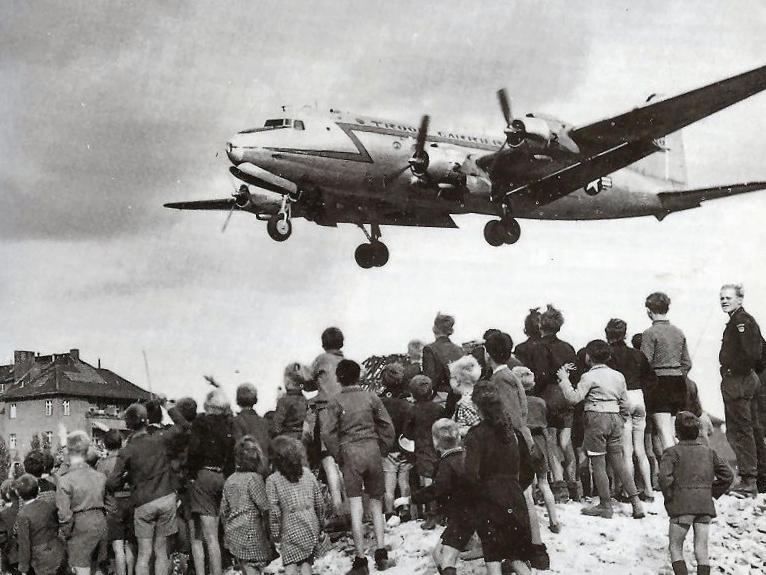
Few people believed a city of two million could be supplied from the sky. Some in Washington and London argued West Berlin was indefensible and should be given up; others wanted to force an armoured convoy up the autobahn, at the risk of starting a third world war. General Lucius D. Clay, the American military governor, refused to consider withdrawal, and an RAF planner, Air Commodore Rex Waite, had already done the arithmetic showing that an airlift – just barely – might work.
On 26 June 1948 the first American C-47s landed at Tempelhof carrying flour, milk and medicine. The Americans called it Operation Vittles; the British launched their own Operation Plainfare two days later. West Berlin needed a minimum of about 4,500 tons of supplies a day to survive. In those first weeks the airlift delivered only a fraction of that, and most experts gave it until autumn before the city starved or the Allies gave in.
Life in the Blockaded City
For West Berliners, the blockade meant dried food and dark evenings. Fresh potatoes were replaced by dehydrated flakes the Americans called POM, eggs and milk came as powder, and electricity ran for only a few hours a day, often in the middle of the night. Factories shut for lack of coal and unemployment soared. The Soviets offered to feed any West Berliner who registered for rations in the East; fewer than two per cent ever did.
Yet the mood hardened rather than broke. On 9 September 1948, some 300,000 Berliners gathered before the ruined Reichstag to hear Mayor Ernst Reuter deliver the most famous speech of the blockade: “Peoples of the world, look upon this city!” The roar of engines overhead became the sound of survival – Berliners joked that the weather was bad when they could not hear the planes.
A Plane Every 90 Seconds: How the Airlift Worked
The man who turned a hastily improvised supply shuttle into an efficient conveyor belt was Major General William H. Tunner, a veteran of wartime supply flights over the Himalayas. In the early weeks, planes took off when they happened to be loaded and circled Berlin waiting for a runway; under Tunner, takeoffs and landings ran to a fixed, relentless rhythm. After “Black Friday” – 13 August 1948, when crashes and circling aircraft brought chaos to Tempelhof – he imposed a brutally simple system. Every crew flew on instruments in every weather, navigating by radio beams and cockpit dials rather than by sight, so fog changed nothing. Every plane got exactly one landing approach, and any pilot who missed it flew straight back to West Germany with his cargo. The point was uniformity: with every aircraft flying the same beams, speeds and altitudes, planes could be slotted into the corridors three minutes apart, in sunshine or in cloud, and the flow never changed. Crews stayed beside their aircraft while jeeps brought coffee and snacks to the runway; turnaround times fell to under half an hour.
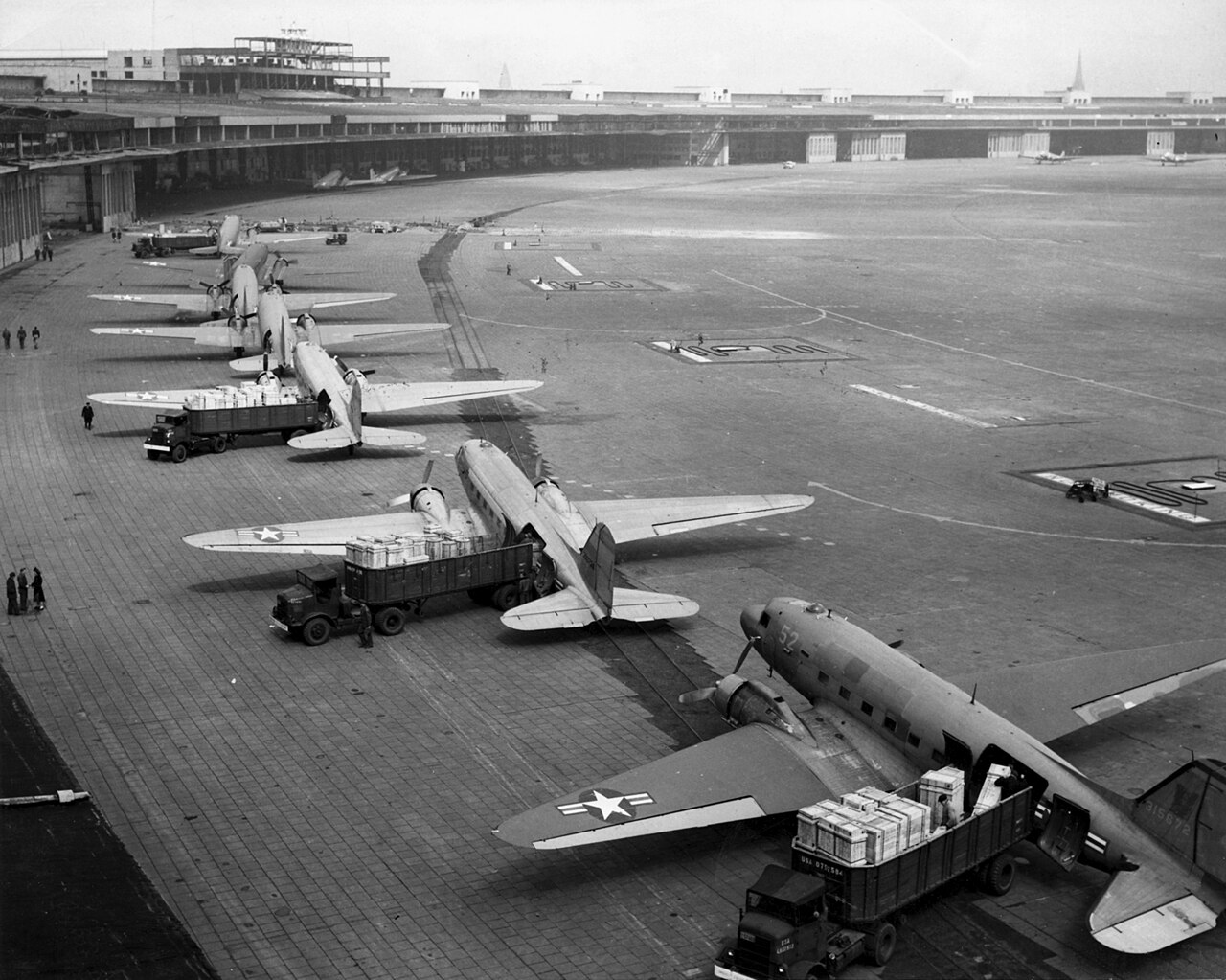
The twin-engined C-47s of the first weeks – wartime workhorses carrying barely three tons – gave way to four-engined C-54 Skymasters carrying ten: one Skymaster did the work of three C-47s. The British flew Yorks and Hastings transports, and even Sunderland flying boats that landed on the Havel river – their corrosion-proofed hulls made them ideal for carrying salt. Two-thirds of everything flown into Berlin was coal.
The city’s two airfields, Tempelhof and Gatow, could not handle the traffic alone, so a third was built from nothing: 19,000 Berliners, more than 40 per cent of them women, built Tegel airport in around 90 days. When two Soviet-controlled radio masts obstructed the approach path, the French commandant Jean Ganeval had them dynamited, telling his outraged Soviet counterpart he had done it “with dynamite, my dear colleague.”
The airlift’s showpiece came at Easter 1949. In a 24-hour “Easter Parade” on 15-16 April, 1,398 flights delivered almost 13,000 tons of coal – a landing in Berlin every 62 seconds. The message to Moscow was unmistakable: the airlift could go on forever.
The Candy Bomber
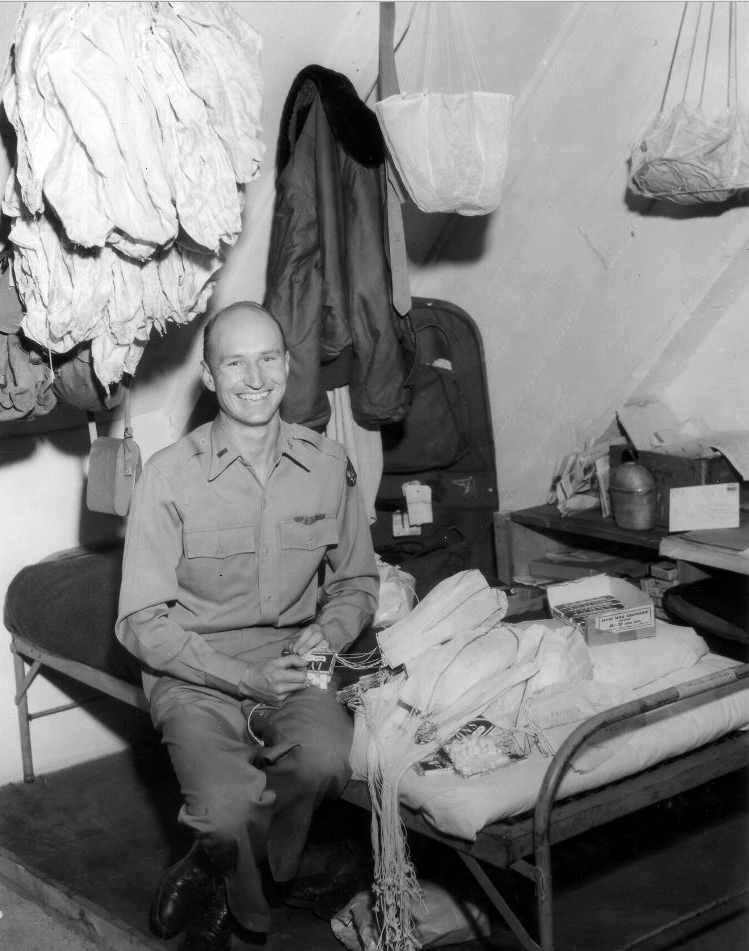
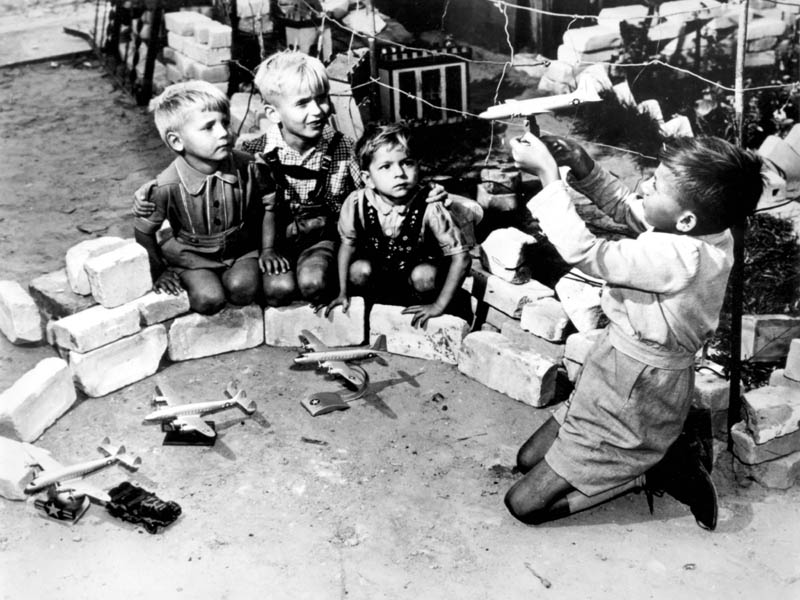
The airlift’s most beloved story began with two sticks of chewing gum. In July 1948, an American pilot named Gail Halvorsen met a group of children watching the planes from the fence at Tempelhof. He handed over the gum he had in his pocket and promised to drop more on his next flight – they would know his plane, he said, because he would wiggle its wings.
“Uncle Wiggly Wings” kept his promise, dropping chocolate and gum on tiny parachutes made from handkerchiefs. What started as one pilot’s gesture grew into Operation Little Vittles: by the end of the airlift, American crews had dropped around 23 tons of sweets over Berlin. Berliners had already nicknamed the supply planes Rosinenbomber – “raisin bombers” – and the name stuck to Halvorsen too. He returned to Berlin again and again until late in his life, and when he died in 2022, aged 101, the city mourned him like one of its own.
The Cost
The airlift was flown at low level, in overloaded aircraft, through Berlin’s fog and ice, around the clock. It killed at least 78 people – 39 British and 31 American airmen, and 8 German ground workers – most of them in crashes during the brutal winter of 1948-49. Some counts, including accidents on the ground, put the toll above 100. Their names are inscribed at the base of the Airlift Memorial at Tempelhof.
The Blockade Ends
By the spring of 1949 the blockade had visibly failed. The airlift was delivering more cargo per day than had arrived by rail before the blockade, while a Western counter-blockade was strangling East German industry. At one minute past midnight on 12 May 1949, the Soviets lifted the barriers. The first cars and trains rolled into West Berlin to street celebrations, and the city’s newspapers printed a one-line verdict: we are still alive.
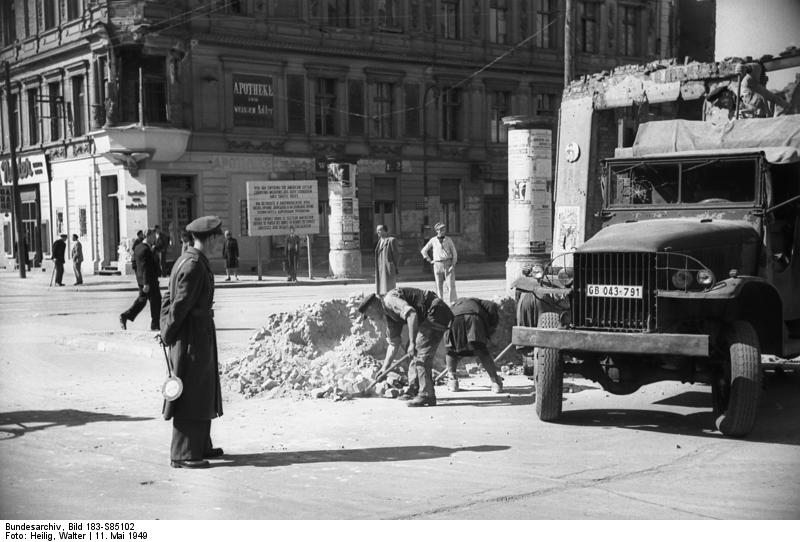
The flights continued until 30 September 1949 to build up reserves in case the Soviets tried again. The final tally: more than 277,000 flights had delivered around 2.3 million tons of food, coal and supplies – the largest humanitarian air operation in history.
From the Blockade to the Wall
Stalin’s blockade achieved the opposite of everything it intended. It turned West Berliners and their occupiers into allies, accelerated the founding of NATO in April 1949, and was followed within months by the creation of two German states – the Federal Republic in May 1949 and the GDR in October. The division the blockade was meant to prevent became permanent, with Berlin as its front line.
But one thing did not change: the border between East and West Berlin stayed open. For the next twelve years that open border was the escape hatch through which some 2.7 million East Germans fled to the West – until the GDR sealed it on 13 August 1961 by building the Berlin Wall. The crisis that finally closed that border opened in 1958 with Khrushchev’s Berlin ultimatum, and the full story of what came next is told in our complete timeline of the Berlin Wall.
Visiting Tempelhof and the Airlift Memorial Today
Tempelhof Airport closed to flights in 2008, and its vast airfield reopened in 2010 as Tempelhofer Feld – one of the world’s stranger and more wonderful city parks. Berliners now cycle, skate and fly kites on the very runways the C-54s used; the park is free and open daily from sunrise to sunset. The colossal 1930s terminal building – once among the largest buildings on earth – can be visited on guided tours (offered in English; book ahead via the THF Berlin website).
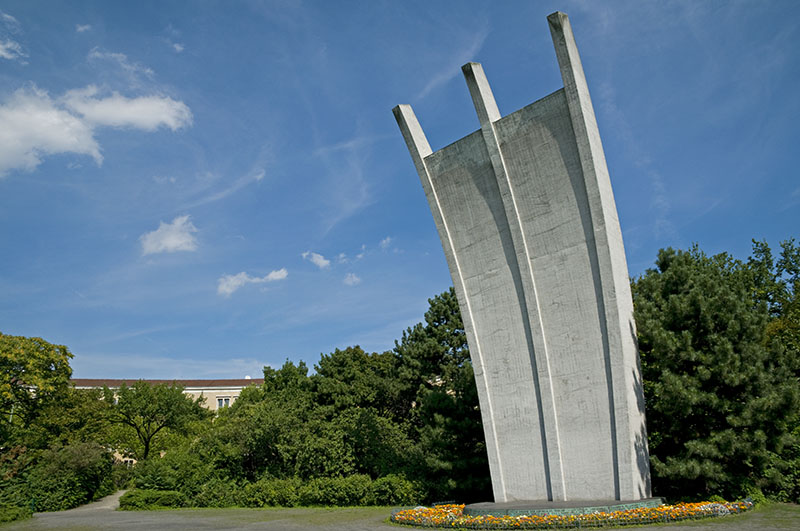
In front of the terminal, on Platz der Luftbrücke, stands the Airlift Memorial (Luftbrückendenkmal), unveiled in 1951. Its three concrete ribs arc westwards, representing the three air corridors that kept the city alive; Berliners promptly nicknamed it the Hungerkralle – the “hunger claw”. The names of those who died for the airlift are inscribed on its base, and twin memorials with ribs arcing towards Berlin stand at Frankfurt and Celle, the corridors’ other ends.
Getting there: take the U6 to Platz der Luftbrücke – the memorial is directly outside the station, with the terminal building behind it and an entrance to Tempelhofer Feld a short walk along Tempelhofer Damm. Aviation fans should also visit the Allied Museum in Dahlem, which displays a British Hastings transport from the airlift alongside the original guardhouse from Checkpoint Charlie. And at Gatow airfield, the RAF’s old Berlin station, the free Military History Museum puts more than 100 aircraft on the very field the British flew the lift from.
Frequently Asked Questions
How long did the Berlin Airlift last?
Fifteen months. The first flights landed on 26 June 1948, two days after the Soviet blockade began. The blockade was lifted on 12 May 1949, but flights continued until 30 September 1949 to stockpile reserves.
Why did the Soviet Union blockade West Berlin?
The trigger was the Western currency reform of June 1948, which Stalin saw as a decisive step towards a separate West German state. By cutting off West Berlin, deep inside the Soviet zone, he hoped to force the Western Allies either to abandon the city or abandon their plans for West Germany. The blockade failed on both counts.
How many flights did the Berlin Airlift make?
More than 277,000 flights delivered around 2.3 million tons of supplies between June 1948 and September 1949. About two-thirds of the cargo was coal. At the operation’s peak, an aircraft landed in Berlin every 62 seconds.
What was a Rosinenbomber?
Rosinenbomber – “raisin bomber” – was the Berliners’ affectionate nickname for the airlift’s supply planes, inspired by pilots like Gail Halvorsen who dropped sweets on small parachutes for the city’s children.
Can you visit Tempelhof Airport today?
Yes. The airfield is now Tempelhofer Feld, a free public park open daily from sunrise to sunset, and the historic terminal can be seen on guided tours. The Airlift Memorial stands outside the entrance at Platz der Luftbrücke.
Is the Berlin Airlift connected to the Berlin Wall?
Directly. The blockade of 1948-49 was the first great battle of the Cold War over Berlin, and it froze the city’s division in place. The border between East and West Berlin remained open until the GDR built the Berlin Wall in August 1961 to stop the flow of refugees to the West.
Explore Tempelhof and every other site of divided Berlin on our interactive Berlin Wall map, or find out where to see the Berlin Wall today.
Checkpoint Charlie
East Side Gallery
Bahnhof Friedrichstraße
History of the Berlin Wall: A Complete Guide (1961-1989)
65 Years Ago: US and Soviet Tanks Faced Off at Checkpoint Charlie
The Border Guards of the Berlin Wall: Conscripts, the Order to Shoot, and the Trials That Followed
9 November in Berlin: 37 Years Since the Wall Fell, and What’s On
Gethsemanekirche
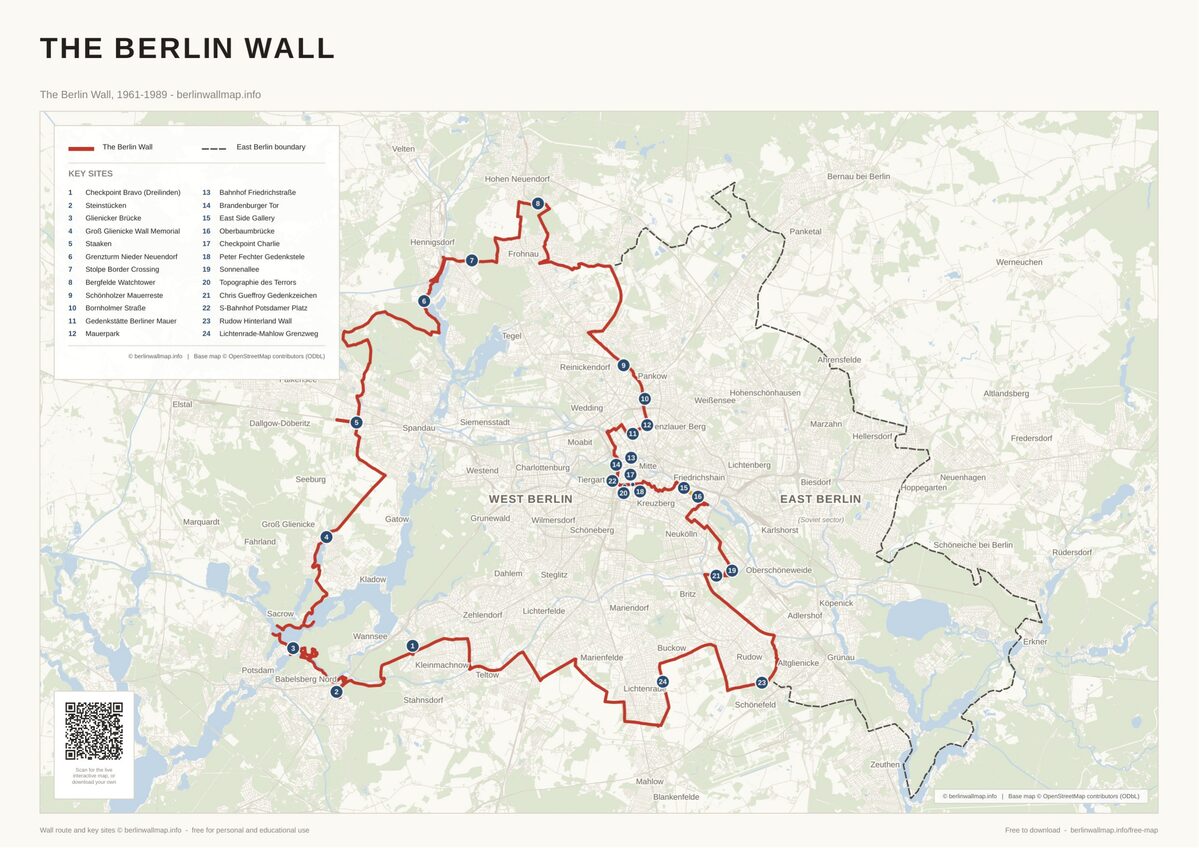
Free map downloads
Free printable PDF maps of the Berlin Wall.
Get the free maps →Explore the Timeline
Journey through Berlin Wall history from 1945 to 1990.
View Timeline →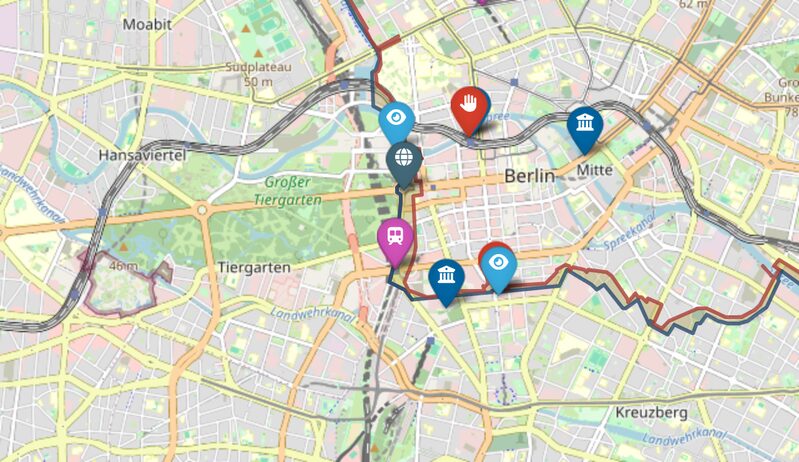
Embed Our Map
Add a free interactive Berlin Wall map to your website or blog.
Get embed code →