East Side Gallery: The Last 1990 Original Is Being Conserved, and an Exiled Painting Has Come Home
On 9 September 2026 the Berlin Wall Foundation announced a set of conservation measures at the East Side Gallery for this autumn: the securing of the oldest Wall remnants on the site, the restoration of two paintings, and a new open-air space for art. Most visitors do not know it, but of the more than a hundred murals painted along Mühlenstrasse in 1990 only one still carries its original paint. It is now being conserved. A second painting, removed from the gallery in 1997, was returned to it on 8 and 9 September.
One original, out of more than a hundred
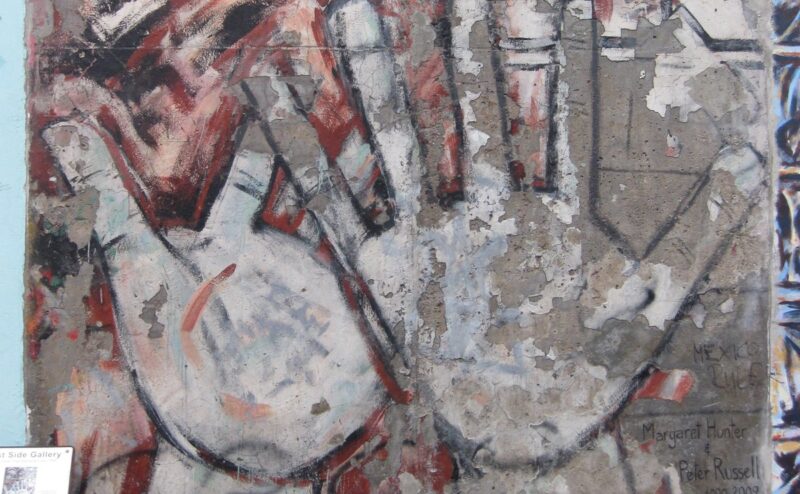
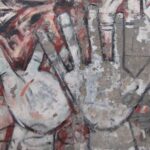
“Hands”, by the Scottish painters Margaret Hunter and Peter Russell, shows outstretched hands, a reference to the peaceful protests in East Germany that helped bring the Wall down; Hunter had painted a picture called “Berlin 09.11.89” on the night the Wall fell and took the motif from there, and Russell’s geometric forms in the upper right tie it to his own mural next door, “Himmel und Sucher”. It has been under conservation for several weeks. The Foundation explains why: “Es ist das einzige erhaltene Originalgemälde der East Side Gallery aus dem Jahr 1990” – it is the only surviving original painting of the East Side Gallery from 1990. “Ziel ist es, dieses wichtige Zeugnis der Entstehungszeit der Galerie möglichst langfristig zu bewahren” – the aim is to preserve this important witness of the gallery’s founding period for as long as possible.
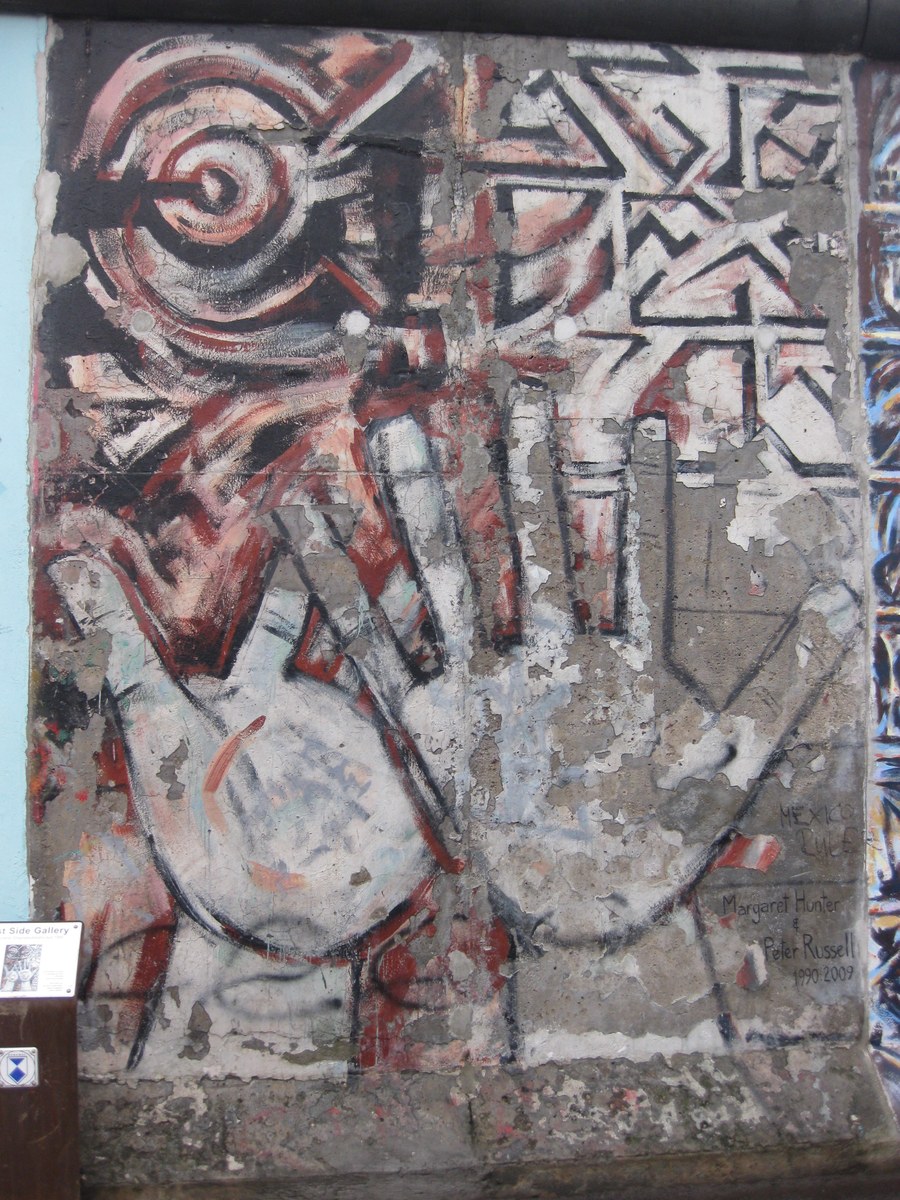
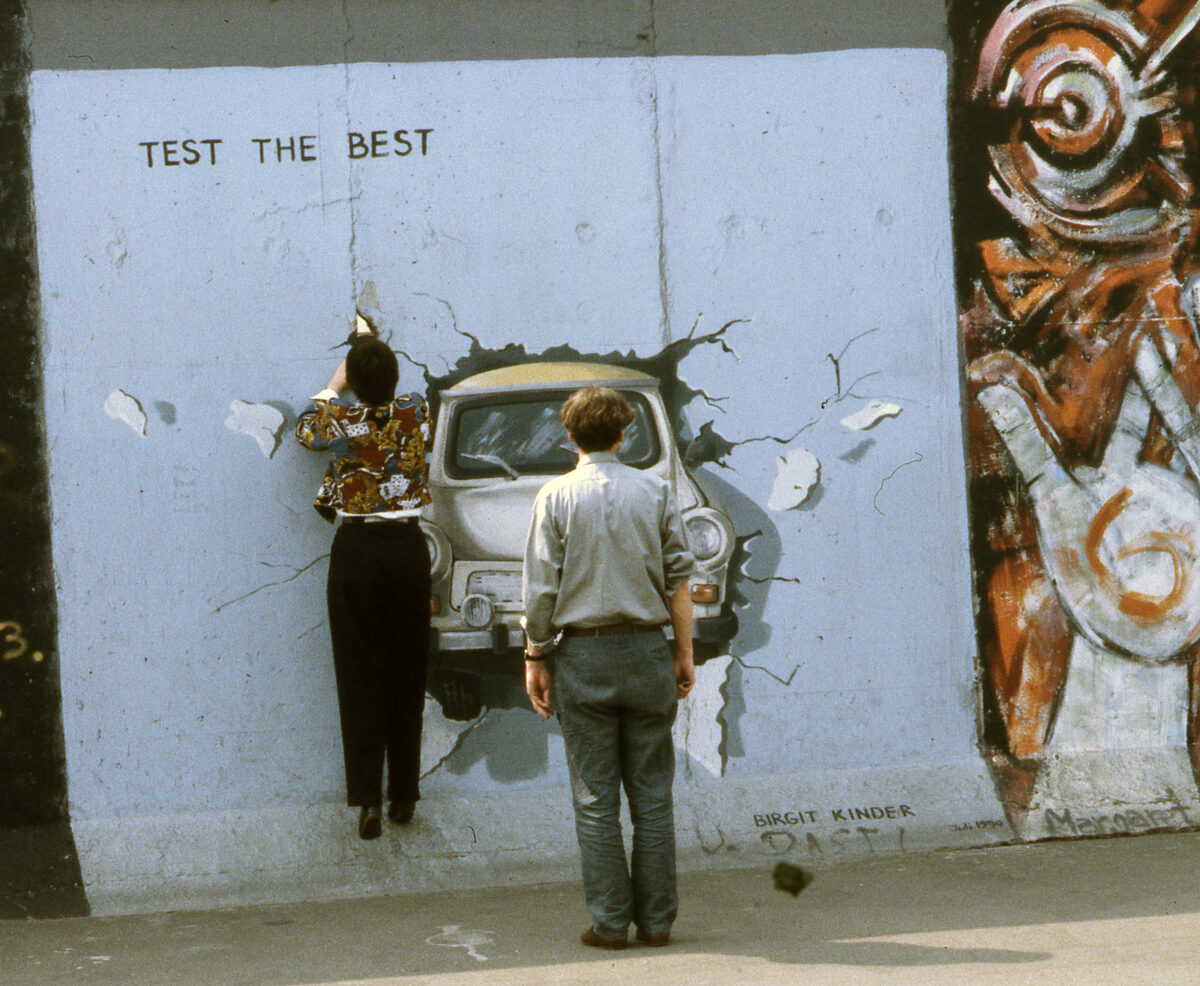
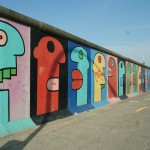
That continues a story our guide to the East Side Gallery already tells. By 2009 the murals were twenty years old, weathered, tagged and flaking, and the city’s answer was a restoration in which the artists were invited back to paint their works again on freshly prepared concrete. Many did; some refused, on the grounds that a repainted mural is a copy, and the argument about what the gallery is – an artwork, a copy of one, or a monument with paintings on it – has never really closed. The Foundation’s announcement confirms how complete the 2009 repainting was. Across the whole 1.3 kilometres, one painting was not repainted, and that is the one now being conserved.
A painting that spent twenty-nine years in the park
Kikue Miyatake’s “Paradise out of the Darkness” – a blue ring for the joint strength of the two German states, clouds of colour, a grey patch for the Wall – was one of twelve murals vandalised within months of being painted in 1990. Miyatake came back from New York to repair it and wrote “Save Art from Violence” into it, later changed to “all you need is hope” and “Coexist”. Then, in 1997, construction work behind the gallery displaced the segment it was painted on, and it was moved into the park behind the Wall, where it has stood ever since.
On 8 and 9 September it was moved back. “Durch die Neuaufstellung wird es wieder als Teil der Galerie sichtbar” – through the re-siting it becomes visible again as part of the gallery. From 20 October the work, which is buried under graffiti, is to be restored together with the artist, who is travelling from Japan for the purpose; she is the only Japanese artist in the gallery. The move and the restoration are paid for, of all things, out of the public-art budget of the project to upgrade the Berlin Wall Trail, the cycling and walking route along the old border – the walking map on this site follows its central section.
The Foundation has not said where along Mühlenstrasse the returned segment now stands.
Older than the gallery itself
The third measure concerns the oldest Wall remnants on the site. “65 Jahre nach dem Mauerbau richtet die Stiftung Berliner Mauer den Blick zudem auf selten erhaltene Mauerreste aus dem Jahr 1961” – sixty-five years after the Wall was built, the Foundation is also turning its attention to rarely surviving Wall remnants from 1961. These are hollow concrete blocks of the kind used for the very first Wall of 1961, standing directly beside the border-wall segments of 1977 near the gallery. They are to be conserved and given a graffiti-resistant coating. First-generation fabric like this is rare anywhere in Berlin; the best-known surviving stretch is far out at Gross Glienicke, on the western edge of the city.
And a wall you are meant to paint on
The fourth measure answers the gallery’s oldest practical problem – people want to paint on it – by giving them somewhere to do it. The “East Side Lab” opens in October as an open-air space for art beside the gallery: a canvas twelve metres wide, painted first with pupils of the Heinrich-Hertz-Gymnasium, and from April 2027 the venue for regular art workshops and open sessions. “Das East Side Lab schafft einen Raum, in dem künstlerische Auseinandersetzung ausdrücklich erwünscht ist” – the East Side Lab creates a space in which artistic engagement is explicitly wanted – “und ergänzt den Denkmal- und Erinnerungsort East Side”, and complements the East Side as a monument and memorial. The distinction is the point: the gallery is a listed monument on which painting is vandalism, and the Lab is the place where it is not.
All four measures belong to an initiative the Foundation launched for the gallery’s 35th anniversary in 2025, “Ein Denkmal, das bleibt!” – a monument that stays – which bundles maintenance, research and monitoring into a long-term plan for restoring and caring for the gallery. The Deutsche Stiftung Denkmalschutz, the German foundation for monument protection, is supporting the work on “Hands” and on the 1961 blocks.
If you go
The East Side Gallery is open-air, free and accessible at any time, on Mühlenstrasse between the Ostbahnhof and the Oberbaumbrücke. From 20 October the restoration of the Miyatake painting is work you can watch, and the East Side Lab should be taking shape in the same weeks. The guide sets out what the gallery is and how it differs from the Wall you came to see, and the place page has the practical details.
Event details last checked 17 Sep 2026
Checkpoint Charlie
East Side Gallery
Bahnhof Friedrichstraße
Bornholmer Straße
East Side Gallery: The Last 1990 Original Is Being Conserved, and an Exiled Painting Has Come Home
Checkpoint Charlie’s New Design Has Been Chosen, and the Guard House Stays
The Berlin Spy Tunnel: The CIA, MI6 and Operation Gold
Berlin Spy Tunnel Memorial
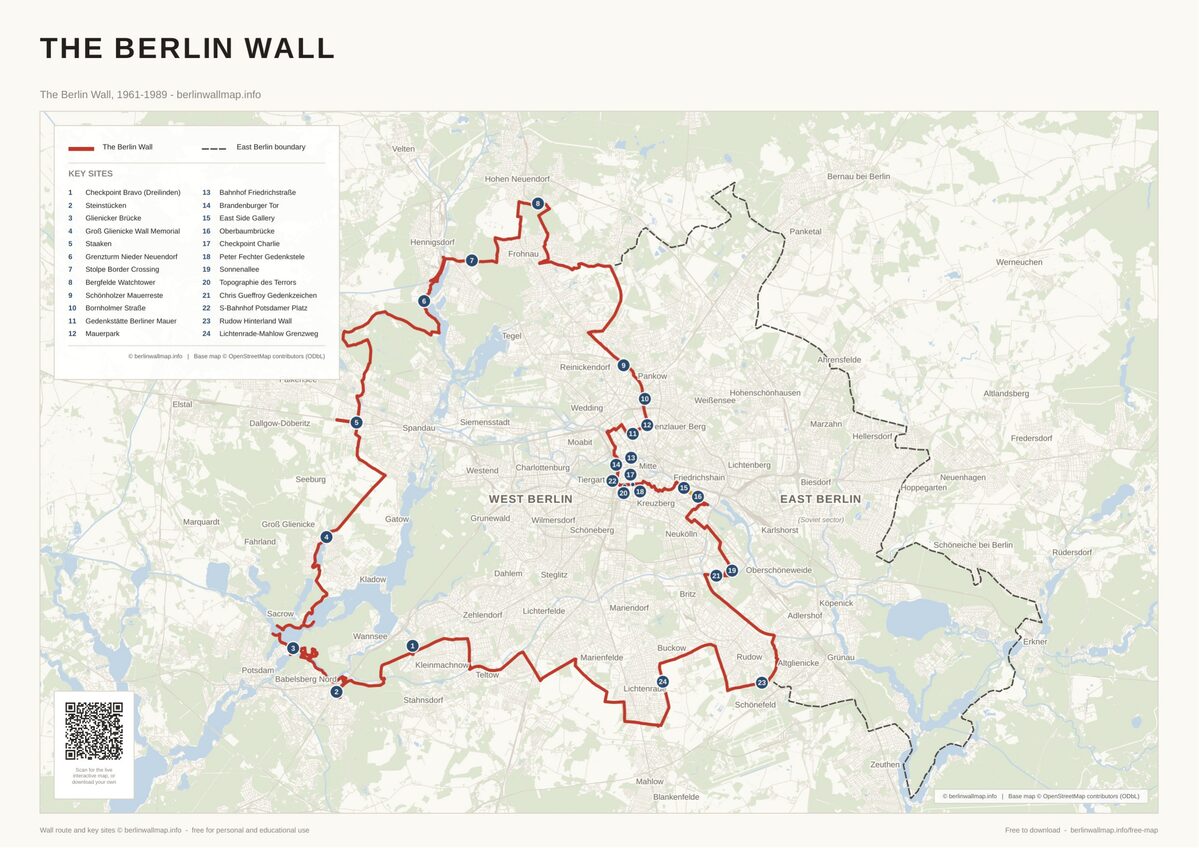
Free map downloads
Free printable PDF maps of the Berlin Wall.
Get the free maps →Explore the Timeline
Journey through Berlin Wall history from 1945 to 1990.
View Timeline →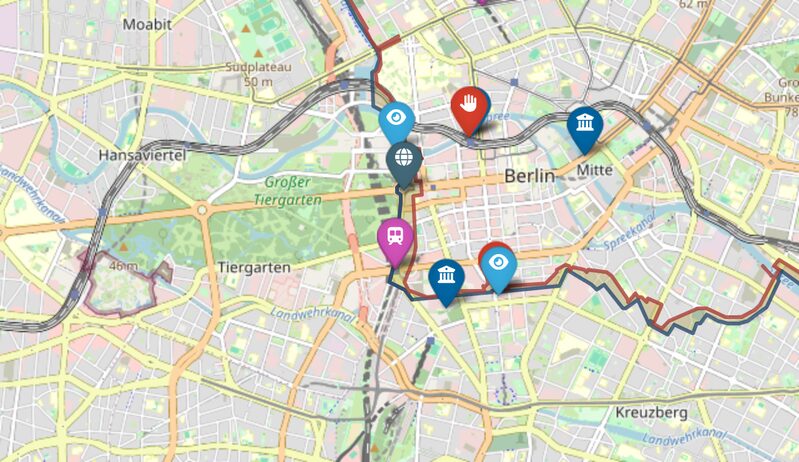
Embed Our Map
Add a free interactive Berlin Wall map to your website or blog.
Get embed code →