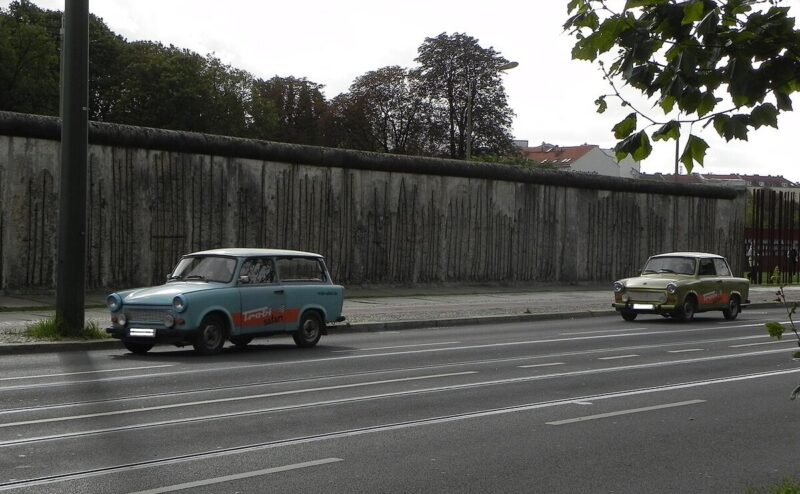
Stasi Photos and Family Albums: The Wall at Märkisches Viertel
In a neighbourhood centre in the middle of a West Berlin housing estate, two sets of photographs of the same border hang beside each other. One set was made by the Stasi, which photographed the frontier because policing it was the job. The other came out of the drawers and albums of the people who lived in sight of it, where, as the curators put it, the Wall turns up sometimes almost by accident and sometimes squarely as the subject.
The exhibition is “Die Berliner Mauer am Märkischen Viertel – Stasi-Fotos, Pressefotos und private Erinnerungen”, the Berlin Wall at Märkisches Viertel: Stasi photos, press photos and private memories. It opened on 19 May 2026 at the Stadtteilzentrum in the Ribbeck-Haus in Reinickendorf, and it runs until 3 October 2026. Entry is free.
An estate built facing the border
Märkisches Viertel is not on the tourist map of the Wall, and that is most of the reason to write about it. It is a large modernist housing estate in Reinickendorf, in what was the French sector of West Berlin, built between 1963 and the spring of 1974 – which is to say it was planned straight after the border closed and finished while it was still standing. Around 17,000 flats went up for a planned population of up to 50,000, on ground that had been farmland, single-family houses and a shack-and-allotment quarter where more than 12,000 people had been living since the war, some of them in poor sanitary conditions.
The Wall ran along the estate’s southern and eastern edge, where Reinickendorf met Pankow on the East Berlin side. From the upper floors of the towers, residents looked down into the death strip and far into East Berlin. Berlin’s commissioner for the reappraisal of the SED dictatorship, whose programme opened the exhibition, records that protests went out from the estate more than once, and that border installations were damaged in some of them.
The estate’s own reputation swung just as hard. It was first celebrated as “built democracy”, then became a byword for West Berlin’s social problems and for inhumane post-war architecture – the subject, among other things, of a 1973 East German television film, “Mord im Märkischen Viertel”, which used it as a stage set for propaganda about poverty in the West.
One detail from the historian’s guided walk is worth keeping, because it sharpens the question the exhibition asks. At Dannenwalder Weg the Wall did not cut through an established neighbourhood: new flats on one side, industry, allotments and cemeteries on the other. The proximity was total and the human connection across it was thin. What did people here picture about the people over there, and at what point did any of it start to feel ordinary?
Two archives of the same fence
The private half of the show comes out of a neighbourhood project. “Kiezreporter” Lux, one of the Viertelreporter – residents who report on their own district under a federal and state urban regeneration programme – has spent years collecting and restoring private photographs from Märkisches Viertel. The Wall keeps appearing in them, sometimes incidentally, sometimes as the point of the picture.
Set against those are the Stasi’s own photographs of the course of the border, including images that have been little seen, together with press photography from the period. The historian Elena Demke curated the exhibition with Lux, and the Reinickendorf district office is the host.
“The Berlin Wall was not only history for many people in Märkisches Viertel, it was part of their daily life,” Harald Muschner, the district councillor for culture, said at the opening. “All the more important that these memories are not lost.”
Everything else in the season has already happened: architectural walks with Christiane Borgelt, storytelling walks along the former border strip with Demke, and the film evening in May. The exhibition is the part that stayed.
If you want to go
STZ im Ribbeck-Haus, Senftenberger Ring 54, 13435 Berlin, free of charge. The centre publishes its opening hours as Monday, Wednesday and Friday from 9:00 to 16:00, and Tuesday and Thursday from 10:00 to 18:00. No separate exhibition hours have been announced, so those are the times to work with.
Two practical notes. The closing date, 3 October 2026, falls on a Saturday and a public holiday, and the centre publishes weekday hours only – so if you are timing a visit to the end of the run, treat Friday 2 October as the last dependable day, and ring 030 47 064 920 before travelling either way. And the estate has no station of its own: the nearest rail is Wittenau (U8, S1, S85), with the 122 bus running on into the estate from there.
The exhibition hangs about 1.4 kilometres from the line the Wall actually followed. If you want to see the thing itself while you are this far north, the nearest surviving stretch on the same Reinickendorf-Pankow boundary is the Schönholz wall remnant, an 80-metre early-era section that lay forgotten for thirty years and was only listed as a monument in 2018.
This is a small show in a community centre rather than a museum, and it is worth the detour for one reason. Almost everything preserved about the Wall was preserved in the middle of the city, at Bernauer Straße and along the tourist axis. This is what the border looked like from an ordinary kitchen window at the edge of it.
Event details last checked 19 Aug 2026
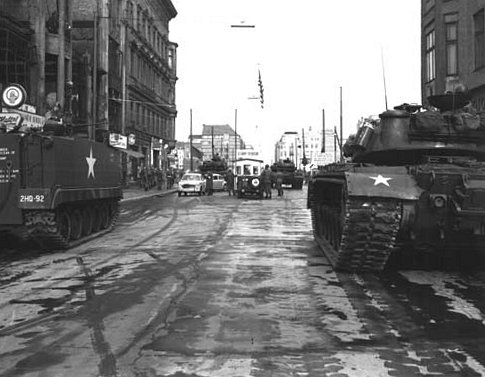
Checkpoint Charlie
East Side Gallery
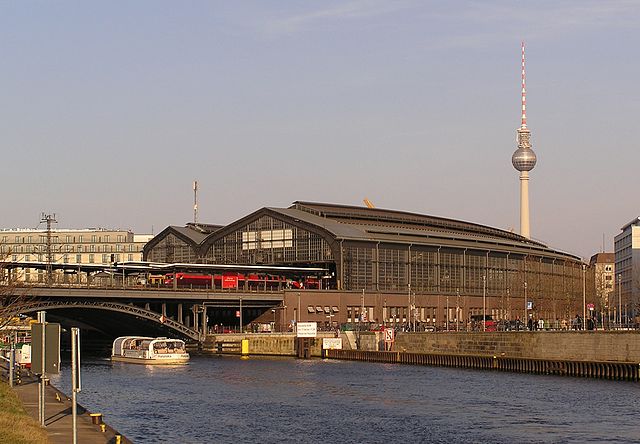
Bahnhof Friedrichstraße
Bornholmer Straße
65 Years Ago: US and Soviet Tanks Faced Off at Checkpoint Charlie
The Border Guards of the Berlin Wall: Conscripts, the Order to Shoot, and the Trials That Followed
9 November in Berlin: 37 Years Since the Wall Fell, and What’s On
Gethsemanekirche
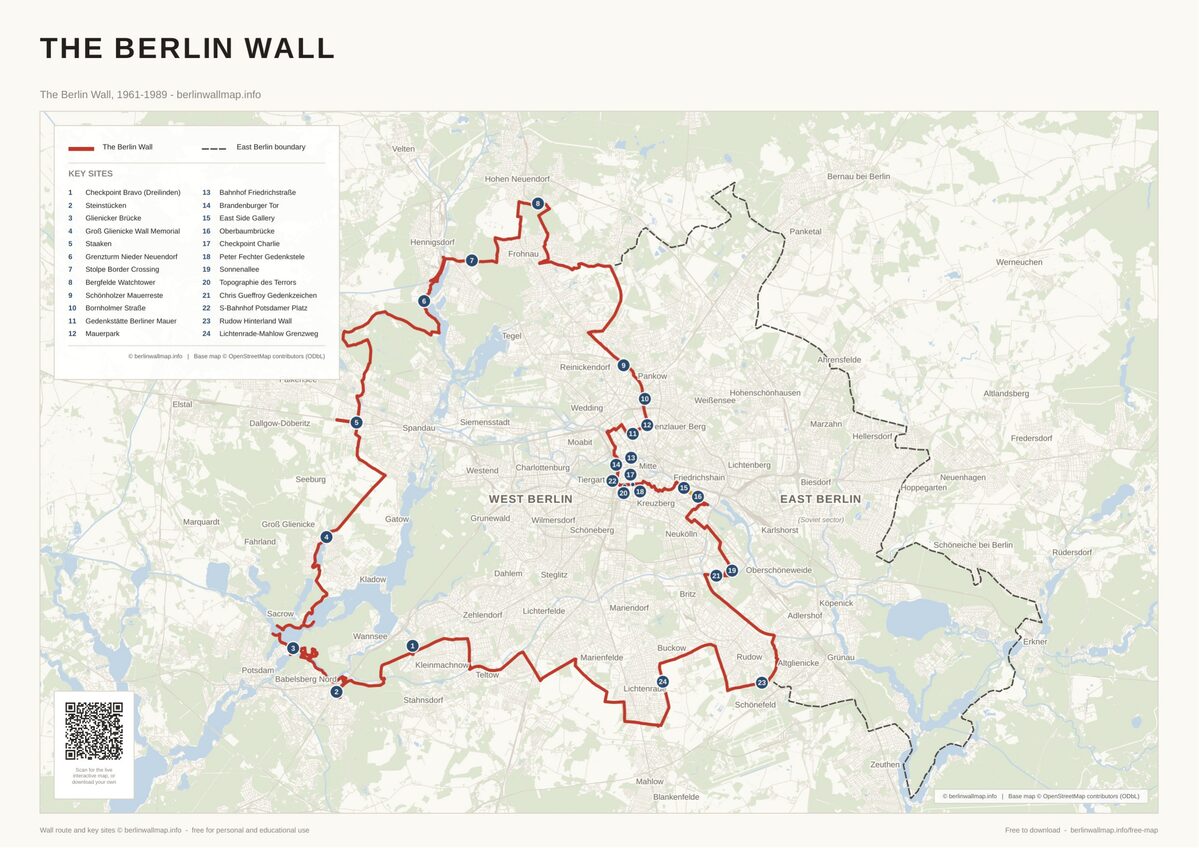
Free map downloads
Free printable PDF maps of the Berlin Wall.
Get the free maps →Explore the Timeline
Journey through Berlin Wall history from 1945 to 1990.
View Timeline →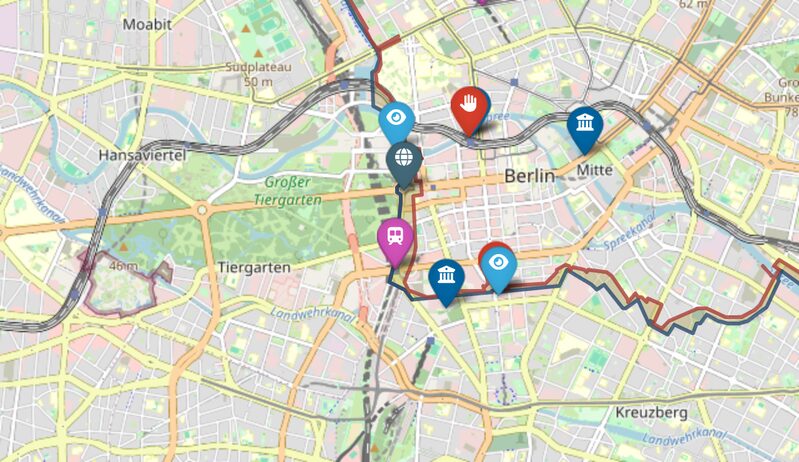
Embed Our Map
Add a free interactive Berlin Wall map to your website or blog.
Get embed code →