Berlin Wall Sites Near Flughafen Tegel
The Berlin Airlift's great construction feat: Tegel airport was built from nothing in around 90 days by 19,000 Berliners - more than 40 per cent of them women - working around the clock in the French sector. Its 2,428-metre runway was the longest in Europe when the first aircraft landed in November 1948. When two Soviet-controlled radio masts obstructed the approach path, the French commandant Jean Ganeval had them dynamited. Tegel went on to become West Berlin's main airport, with its iconic hexagonal terminal, until it closed in 2020; the site is now being redeveloped as a technology and residential quarter.
15 Berlin Wall Sites Within Walking Distance

Flughafen Tegel
The Berlin Airlift's great construction feat: Tegel airport was built from nothing in around 90 days by 19,000 Berliners - more than 40 per cent...

Gedenkstätte Günter Litfin
A former watchtower, named after Günter Litfin, a tailor from Weissensee, who was the first person to be shot dead by border guards while trying...

Invalidenfriedhof
The Invalidenfriedhof, one of Berlin's oldest military cemeteries (founded 1748), was bisected by the Berlin Wall from 1961. The Wall ran directly through the cemetery,...

Chausseestraße
A lesser-known border crossing at the intersection of Chausseestraße and Liesenstraße, used primarily for West Berlin residents visiting relatives in the East. On 8 April...

U-Bahnhof Schwartzkopffstraße
This U6 ghost station was renamed twice while sealed. In 1951 it became "Walter-Ulbricht-Stadion" and in 1973 "Stadion der Weltjugend". These changes were visible only...

Invalidenstraße
A former border crossing at Sandkrugbrücke bridge over the Berlin-Spandau Shipping Canal (Spandauer Schifffahrtskanal). Numerous escape attempts took place here, including that of Günter Litfin,...

Schönholzer Mauerreste
80-metre early-era wall triangle preserved in its original form. Built from World War II house rubble in the early 1960s. Concealed and forgotten for 30...

Berliner Unterwelten
The Berliner Unterwelten association offers guided tours through underground bunkers, tunnels, and infrastructure connected to Berlin's Cold War history. Their 'Escape Tunnels' tour follows the...

U-Bahnhof Naturkundemuseum
This U6 ghost station has had a confusing naming history. During the Wall era it was called "Nordbahnhof" on East German maps, then renamed "Zinnowitzer...

S-Bahnhof Bornholmer Straße
The only above-ground ghost station. West and East S-Bahn tracks ran parallel through the station but were separated by a tall fence. Western trains did...

Wollankstraße Tunnel
In January 1962, a group of students led by brothers Boris and Eduard Franzke began digging a tunnel beneath the S-Bahnhof Wollankstraße, aiming to reach...

Parlament der Bäume
At the Marie-Elisabeth-Lüders-Haus, the Parliament of Trees against War and Violence is a memorial commemorating the 258 people who died at the wall. Begun in...

Weiße Kreuze
Located on the bank of the Spree near the Reichstag building, this memorial consists of seven white wooden crosses commemorating victims who died attempting to...

Gedenkstätte Berliner Mauer
The "Berlin Wall Memorial", was built in 1998 to commemorate the division the wall created, and the deaths that occurred because of it. It includes...

Nordbahnhof – Geisterbahnhof
This S-Bahn station was sealed from 1961 to 1989 while Western trains passed through East Berlin territory without stopping. Today the station houses "Grenzübergänge" (Border...
Explore Berlin Wall Sites Near Other Landmarks

Free map downloads
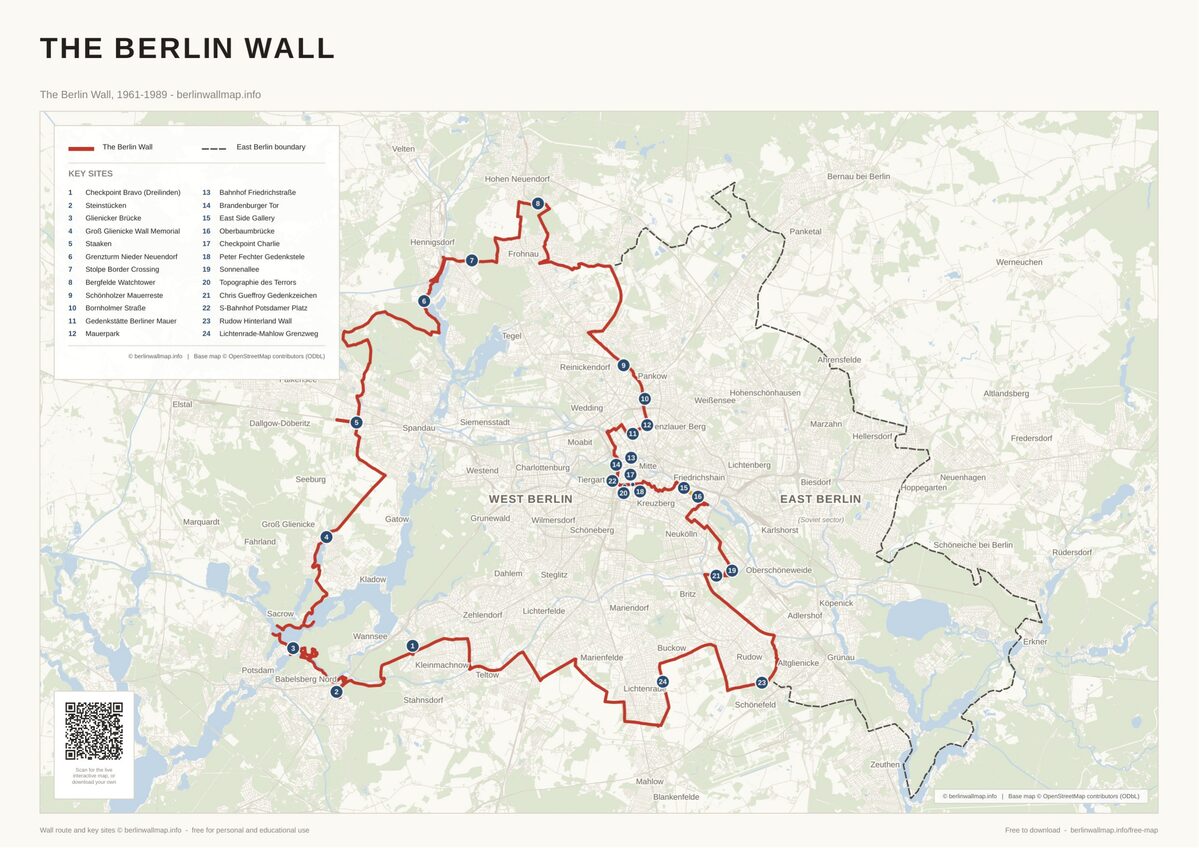
Free printable PDF maps of the Berlin Wall.
Get the free maps →Explore the Timeline
Journey through Berlin Wall history from 1945 to 1990.
View Timeline →
Embed Our Map
Add a free interactive Berlin Wall map to your website or blog.
Get embed code →