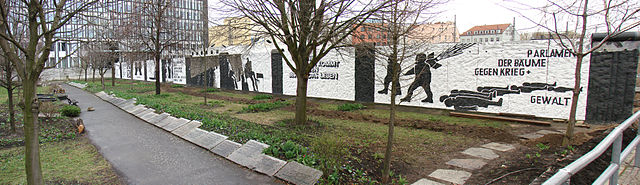
Parlament der Bäume
At the Marie-Elisabeth-Lüders-Haus, the Parliament of Trees against War and Violence is a memorial commemorating the 258 people who died at the wall. Begun in 1990 by the artist Ben Wagin, it is made up of trees, memorial stones, and original parts of the wall. The names of the 258 dead are inscribed on stones. The memorial had to be scaled down to make way for the construction of the Marie-Elisabeth-Lüders-Haus, which is home to the Bundestag library.
Begun in 1990 by the artist Ben Wagin, it is made up of trees, memorial stones, and original parts of the wall. The names of the 258 dead are inscribed on stones. The memorial had to be scaled down to make way for the construction of the Marie-Elisabeth-Lüders-Haus, which is home to the Bundestag library.
Ben Wagin planted the first trees on the former death strip shortly after the wall fell, creating an open-air memorial that blends nature, art, and remembrance. Segments of the Berlin Wall are incorporated into the installation, painted by artists with images reflecting on war, violence, and division. The memorial occupies a narrow strip of land along the Spree riverbank.
The memorial’s location directly beside the German parliamentary buildings gives it a powerful symbolic resonance – a permanent reminder to lawmakers of the consequences of division and totalitarianism. Despite being threatened by construction projects several times, the Parliament of Trees was placed under heritage protection by the German Bundestag in 2017.
Show me on the mapGallery


Nearby Berlin Wall Sites


Explore the Timeline
Journey through Berlin Wall history from 1945 to 1990.
View Timeline →
Embed Our Map
Add a free interactive Berlin Wall map to your website or blog.
Get embed code →