Berlin Wall Sites Near Parlament der Bäume
At the Marie-Elisabeth-Lüders-Haus, the Parliament of Trees against War and Violence is a memorial commemorating the 258 people who died at the wall. Begun in 1990 by the artist Ben Wagin, it is made up of trees, memorial stones, and original parts of the wall. The names of the 258 dead are inscribed on stones. The memorial had to be scaled down to make way for the construction of the Marie-Elisabeth-Lüders-Haus, which is home to the Bundestag library.
15 Berlin Wall Sites Within Walking Distance

Parlament der Bäume
At the Marie-Elisabeth-Lüders-Haus, the Parliament of Trees against War and Violence is a memorial commemorating the 258 people who died at the wall. Begun in...

Weiße Kreuze
Located on the bank of the Spree near the Reichstag building, this memorial consists of seven white wooden crosses commemorating victims who died attempting to...

U-Bahnhof Naturkundemuseum
This U6 ghost station has had a confusing naming history. During the Wall era it was called "Nordbahnhof" on East German maps, then renamed "Zinnowitzer...

Brandenburger Tor
The Brandenburg Gate became the main symbol of Berlin's division. From 1961 to 1989, it stood inaccessible in the death strip, visible but unreachable from...

U-Bahnhof Oranienburger Tor
Named after the historic Oranienburger Tor gate that once stood here, this U6 ghost station is just one stop north of Friedrichstraße, the border crossing...

S-Bahnhof Brandenburger Tor
Originally named "Unter den Linden" when it opened in 1936, this S-Bahn station sits directly beneath the Brandenburg Gate. During the Cold War, Western trains...

Bahnhof Friedrichstraße
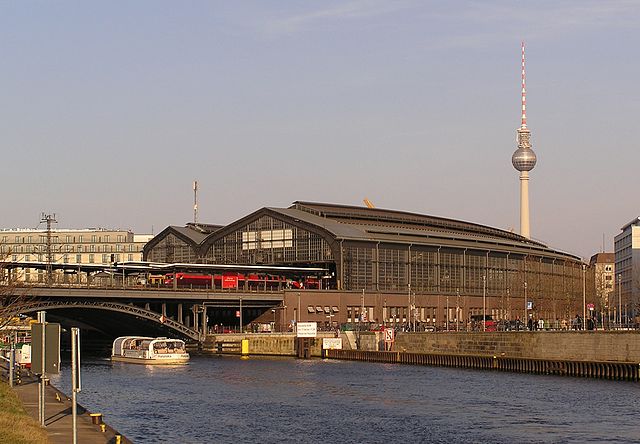
As an important travel hub between the West Berlin sectors, despite it being located entirely in the Soviet occupied West Berlin, its underground U and...

Tränenpalast
The "Palace of Tears" was the departure hall at Friedrichstraße station where East Germans said goodbye to visiting Western relatives, often not knowing when they...

Invalidenstraße
A former border crossing at Sandkrugbrücke bridge over the Berlin-Spandau Shipping Canal (Spandauer Schifffahrtskanal). Numerous escape attempts took place here, including that of Günter Litfin,...

U-Bahnhof Französische Straße
After serving as a U6 ghost station from 1961 to 1990, this station operated normally for 30 years before being permanently closed on 4 December...

Invalidenfriedhof
The Invalidenfriedhof, one of Berlin's oldest military cemeteries (founded 1748), was bisected by the Berlin Wall from 1961. The Wall ran directly through the cemetery,...

S-Bahnhof Oranienburger Straße
The first ghost station on the north-south S-Bahn tunnel to reopen, on 2 July 1990. During the Wall era it lay sealed underground while the...

Ausstellung zum Mauergedenken
This open-air exhibition at Potsdamer Platz features informational displays mounted between original segments of the Berlin Wall. Created in 2005 to mark the 20th anniversary...

S-Bahnhof Potsdamer Platz
One of the best-known ghost stations. The Wall ran directly through Potsdamer Platz above, turning what was once Europe's busiest intersection into empty wasteland. Below,...

Leipziger Platz Wall Segments
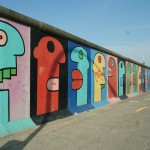
On the green between Potsdamer Platz and Leipziger Platz stand several original Berlin Wall segments painted by the pioneers Thierry Noir and Kiddy Citny, whose...
Explore Berlin Wall Sites Near Other Landmarks

Free map downloads
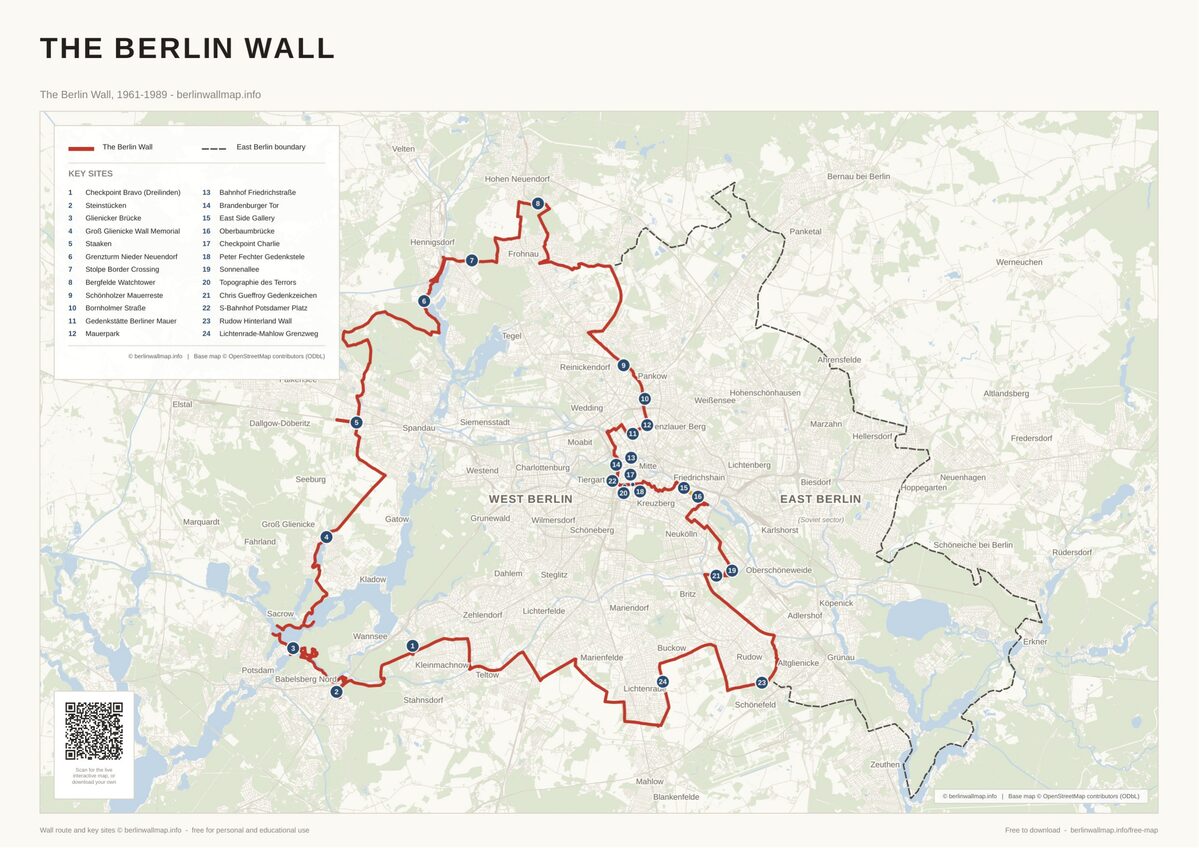
Free printable PDF maps of the Berlin Wall.
Get the free maps →Explore the Timeline
Journey through Berlin Wall history from 1945 to 1990.
View Timeline →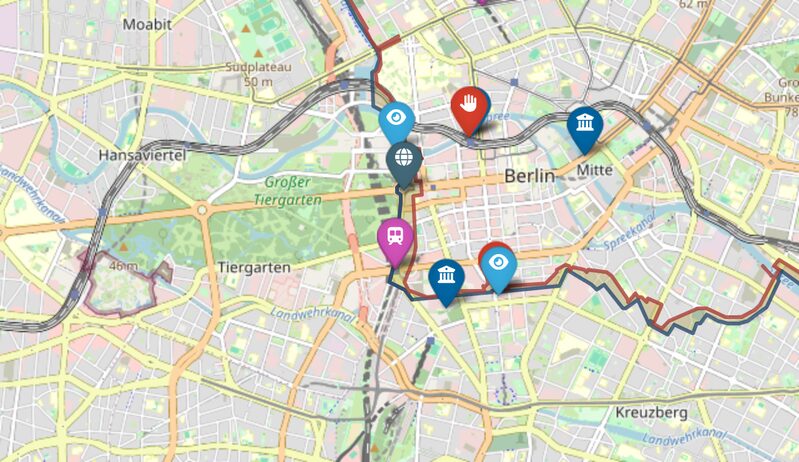
Embed Our Map
Add a free interactive Berlin Wall map to your website or blog.
Get embed code →