Half-Day Tour: Western Spy Stations
This half-day tour visits two Cold War landmarks on the western outskirts of Berlin: the hilltop where the NSA eavesdropped on the Eastern Bloc, and the bridge where captured spies were exchanged at the frontier. Both sites are outside the city centre and require S-Bahn and bus travel, but the journey is part of the experience – you cross through the Grunewald forest and along the Havel lakes that once formed the edge of the Western enclave. Allow 4–5 hours including transit.
Best for: Cold War buffs, photographers, and anyone who has already seen the central sites and wants to go deeper. Both locations appear on our interactive map.
Site 1: Teufelsberg – the ears of the West
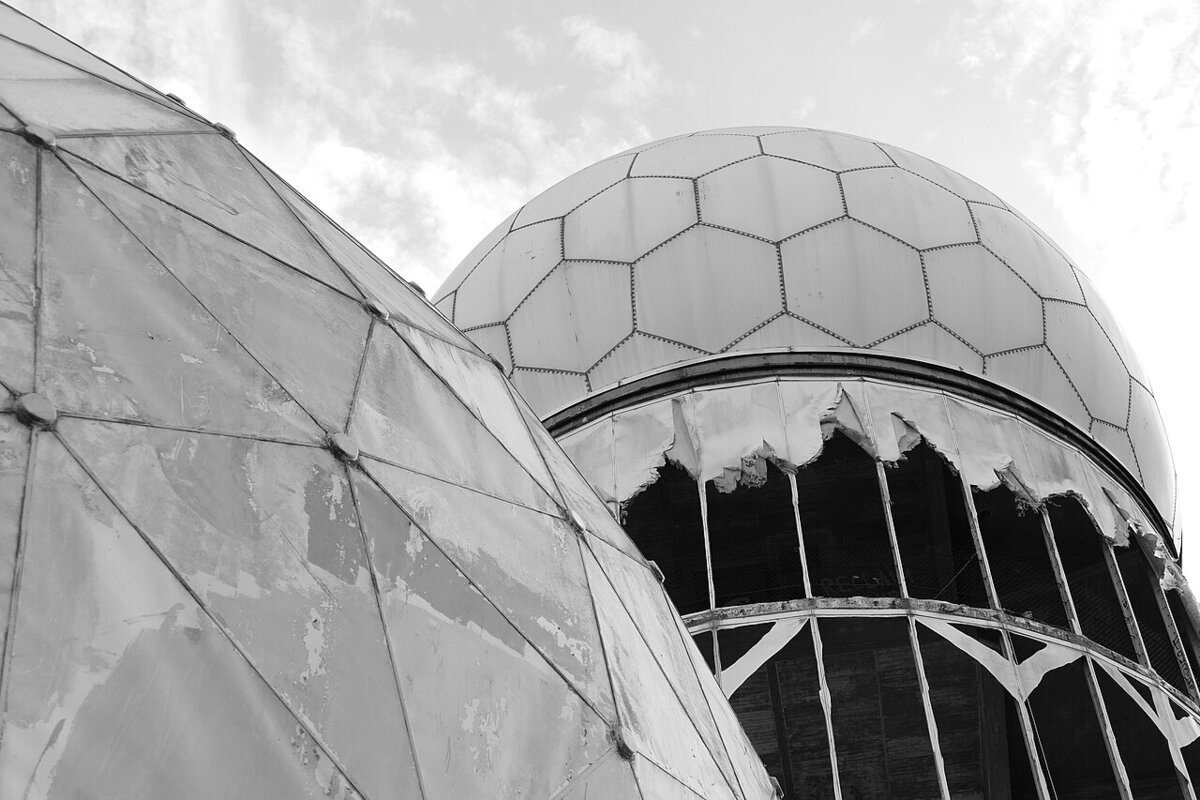
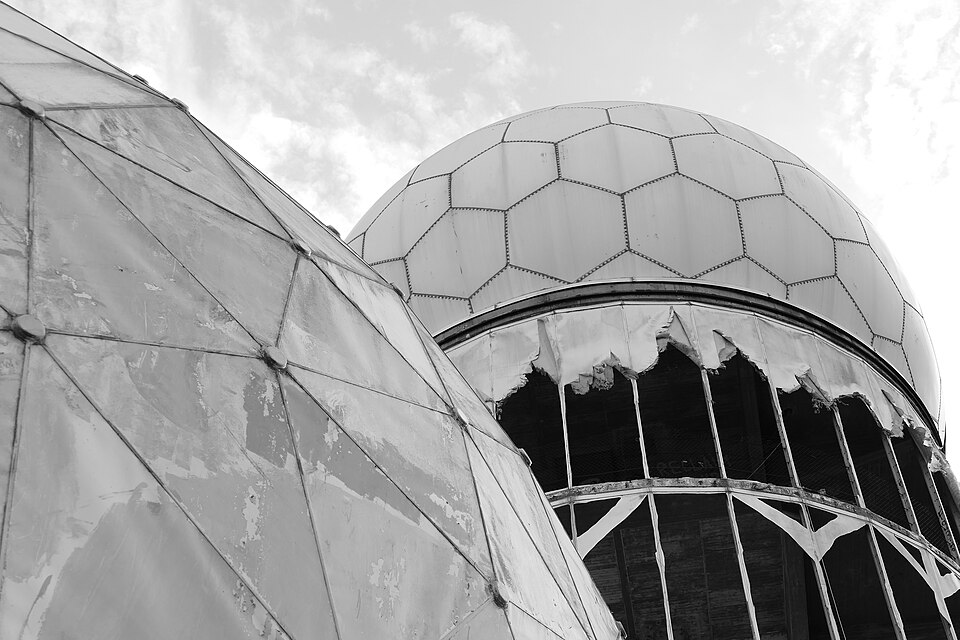
Teufelsberg is an artificial hill in the Grunewald forest, rising 120 metres above sea level. It was built from roughly 75 million cubic metres of wartime rubble dumped on top of an unfinished Nazi military college that the Allies could not demolish.
In 1963 the NSA built a signals intelligence station on the summit, topped with the distinctive white radar domes still visible for miles. Up to 1,500 intelligence officers monitored Soviet and Warsaw Pact military radio traffic around the clock, intercepting communications up to 500 kilometres away. Field Station Berlin won the NSA’s Travis Trophy for the world’s best SIGINT collection station four times.
After reunification the equipment was stripped out and the archives destroyed. Today the ruins are accessible via guided tours – book in advance. The domes, covered in street art, offer panoramic views over Berlin and a strange atmosphere that mixes Cold War history with post-industrial decay.
Getting there: S7 to Heerstraße, then a 30-minute walk through the forest (follow signs to Teufelsberg). Alternatively, bus 218 from S-Bahnhof Grunewald gets closer.
Transit to Site 2: S7 from Heerstraße to Wannsee, then bus 316 to Glienicker Brücke (about 45 minutes).
Site 2: Glienicker Brücke – the Bridge of Spies
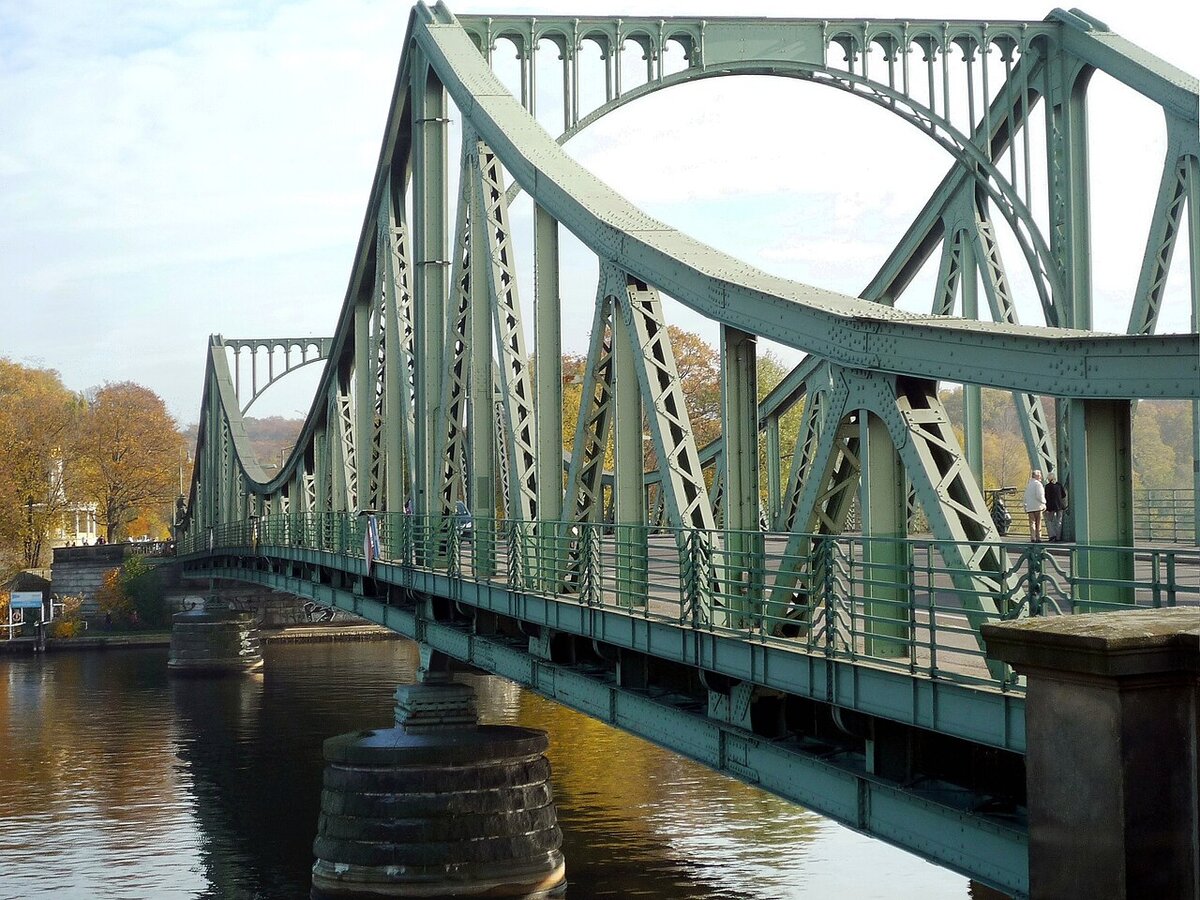
The Glienicker Brücke spans the Havel between Berlin-Wannsee and Potsdam. During the Cold War the bridge’s midpoint marked the border between West Berlin and East Germany, making it the stage for the era’s most dramatic prisoner swaps.
On 10 February 1962, Soviet spy Rudolf Abel walked east while U-2 pilot Francis Gary Powers walked west – the exchange that gave the bridge its famous nickname and inspired Spielberg’s 2015 film. The final swap came on 11 February 1986 when dissident Anatoly Shcharansky and three Western agents were traded for five Eastern-bloc agents. In all, exchanges involving some 40 people took place here.
The white centre line, once the frontier, is still painted on the road. Walk to the midpoint and you are standing on what was the border between two worlds. The bridge is quiet today – a suburban crossing over a beautiful lake – and the contrast with its history is part of what makes it so striking.
Information panels on both ends of the bridge describe the exchanges and the border regime. On the Potsdam side, the grounds of Schloss Glienicke (viewable from outside) offer a pleasant 15-minute stroll along the water.
Practical notes
- Total time: 4–5 hours including transit and visits.
- A Berlin ABC day ticket covers all journeys, including the Potsdam side of the bridge.
- Book Teufelsberg tours online in advance, especially for English-language slots.
- Start early – Teufelsberg tours often begin at 11:00 or 12:00, and you want time at the bridge before it gets late.
- This route pairs with our Central Berlin walking tour and Stasi & Surveillance tour for a comprehensive espionage experience, or see all five sites in our Full-Day Tour: Cold War Espionage Trail.
- Browse all locations on our places page or interactive map.
Checkpoint Charlie
East Side Gallery
Bahnhof Friedrichstraße
History of the Berlin Wall: A Complete Guide (1961-1989)
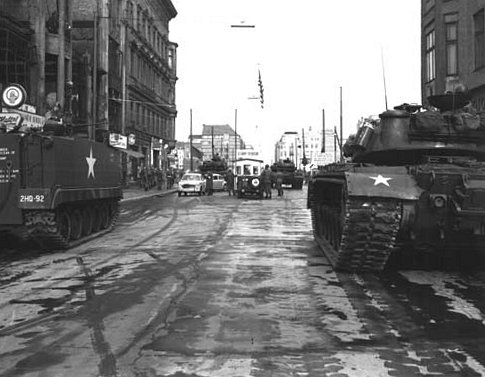
65 Years Ago: US and Soviet Tanks Faced Off at Checkpoint Charlie
The Border Guards of the Berlin Wall: Conscripts, the Order to Shoot, and the Trials That Followed
9 November in Berlin: 37 Years Since the Wall Fell, and What’s On
Gethsemanekirche
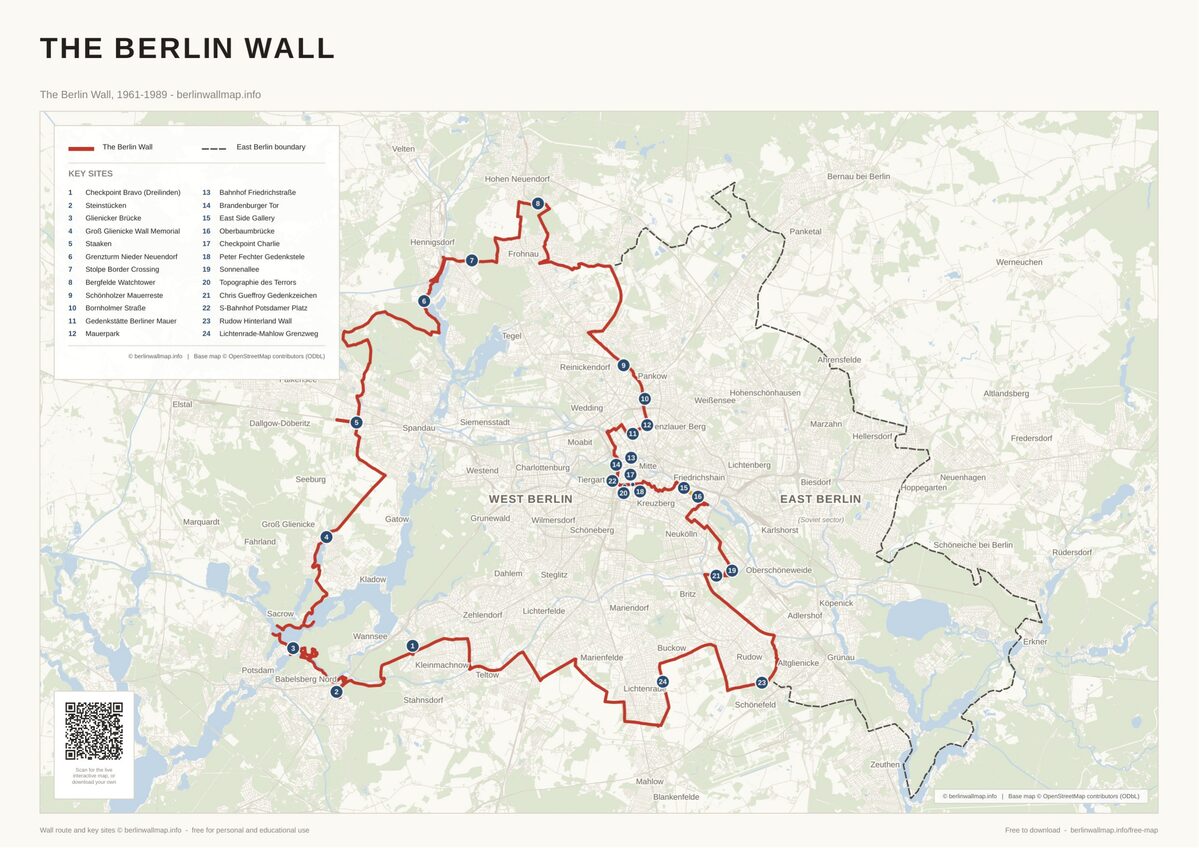
Free map downloads
Free printable PDF maps of the Berlin Wall.
Get the free maps →Explore the Timeline
Journey through Berlin Wall history from 1945 to 1990.
View Timeline →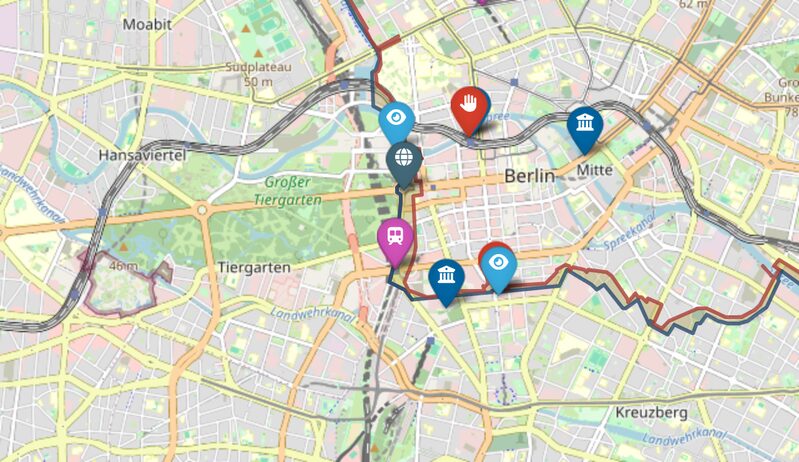
Embed Our Map
Add a free interactive Berlin Wall map to your website or blog.
Get embed code →