The 1953 East German Uprising: June 17 and the Road to the Wall
Eight years before the Berlin Wall went up, East Germans had already tried to bring down the communist system that would later wall them in. On 17 June 1953 the workers who were meant to be the heroes of that “workers’ and peasants’ state” walked off the building sites, filled the streets of East Berlin, and were met by Soviet tanks. Within two days the revolt had spread to some 700 towns and drawn in around a million people – the first mass uprising anywhere in the Soviet bloc. It was crushed in a single afternoon, but its consequences ran straight through the next decade: it hardened the regime, swelled the flood of refugees to the West, and set East Germany on the road that led to the Wall.
The Spark: Higher Quotas After Stalin’s Death
To understand why building workers would face down Soviet tanks, you have to start with the state they lived in. The German Democratic Republic was only four years old in 1953 – a communist one-party dictatorship carved out of the Soviet occupation zone in 1949 and run by the Socialist Unity Party (SED) under close supervision from Moscow. Elections were a sham with a single approved list, the press and the courts answered to the party, and the promised “workers’ and peasants’ paradise” was in practice the poorer, less free half of a divided nation – a gap its people could measure for themselves, because the sector border in Berlin was still open.
The discontent came to a head over the economy. In 1952 the ruling SED under Walter Ulbricht had proclaimed the “accelerated construction of socialism” – a crash programme of heavy industry, collectivised farms and rearmament, paid for by squeezing ordinary people. Food was rationed and scarce, prices rose, and East Germans voted with their feet: in 1952 alone more than 180,000 of them fled to the West, most simply walking across the still-open sector border in Berlin.
Then, in March 1953, Joseph Stalin died. His nervous successors in Moscow, alarmed by the haemorrhage of people, ordered the SED to change course. On 9 June the East German leadership announced a “New Course” in the party paper Neues Deutschland, admitting past “mistakes” and rolling back much of the campaign. But it left one grievance untouched: at the end of May the government had decreed that from 30 June workers must produce ten percent more for the same wages. As the regime backed down on everything else, the wage cut disguised as a “work quota” stayed – and to the men on the building sites it looked like weakness ripe for a push.
16 June: The Builders of Stalinallee Walk Out
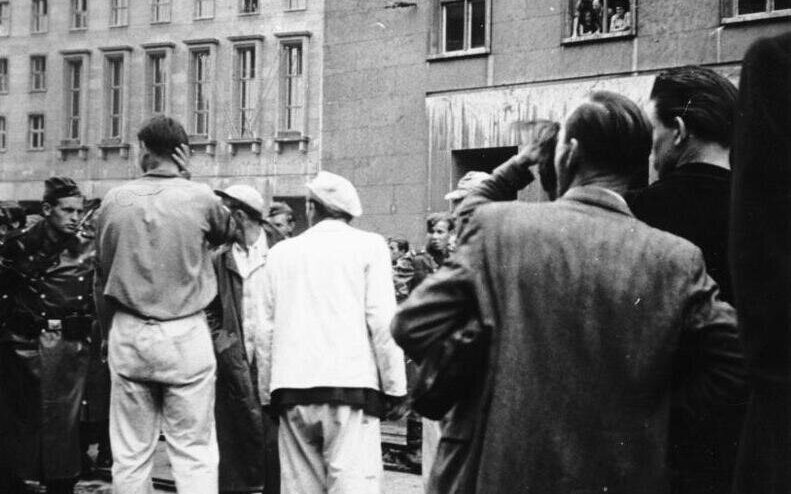
On the morning of 16 June, around 300 construction workers on the showpiece Stalinallee – today’s Karl-Marx-Allee – put down their tools. They marched west down the boulevard and on toward the House of Ministries on Leipziger Strasse, the vast former Reich Aviation Ministry that housed the East German government, their numbers swelling as they went. They demanded to speak to Ulbricht and Prime Minister Otto Grotewohl; instead a junior minister was sent out and shouted down.
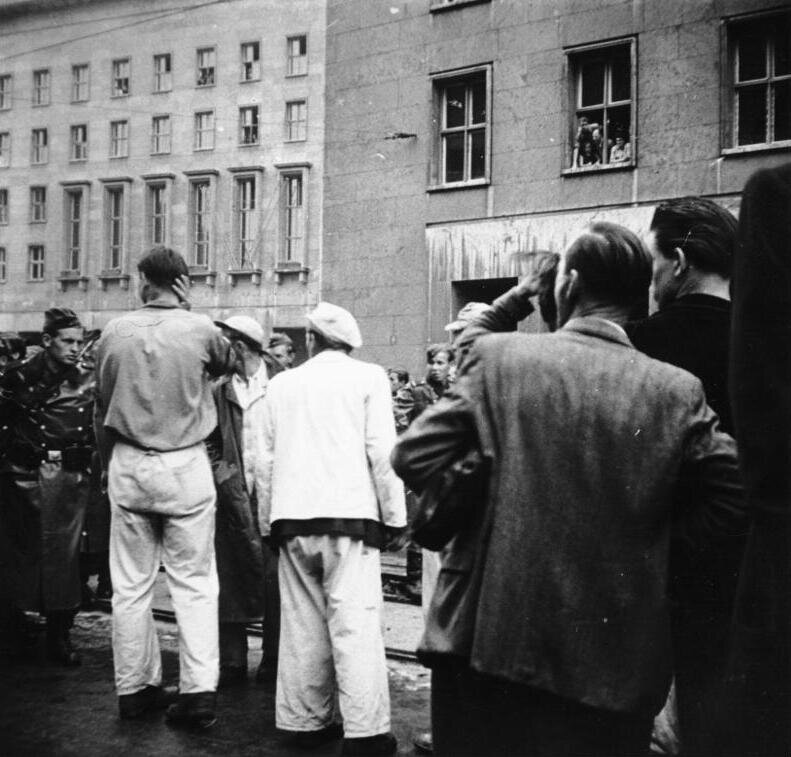
The strikers commandeered a sound truck and drove through the city calling for a general strike and a mass demonstration the next morning at 7 o’clock on Strausberger Platz. Their appeal reached far beyond earshot. In West Berlin, the American-run station RIAS – Radio in the American Sector – reported the strike and its demands through the evening and into the night, and its broadcasts carried the news across the whole of East Germany. What had started as a pay dispute on one building site became, overnight, a countrywide summons.
17 June: A Nation on Strike
By dawn on 17 June the strike had become a rebellion. Crowds gathered at Strausberger Platz and marched into the centre; by nine in the morning some 25,000 people were massed in front of the House of Ministries, with tens of thousands more converging on Leipziger Strasse and Potsdamer Platz. Across the country the same thing was happening at once – by the end of the day around a million people had come out on strike in roughly 700 cities, towns and villages, from the industrial south to the Baltic coast.
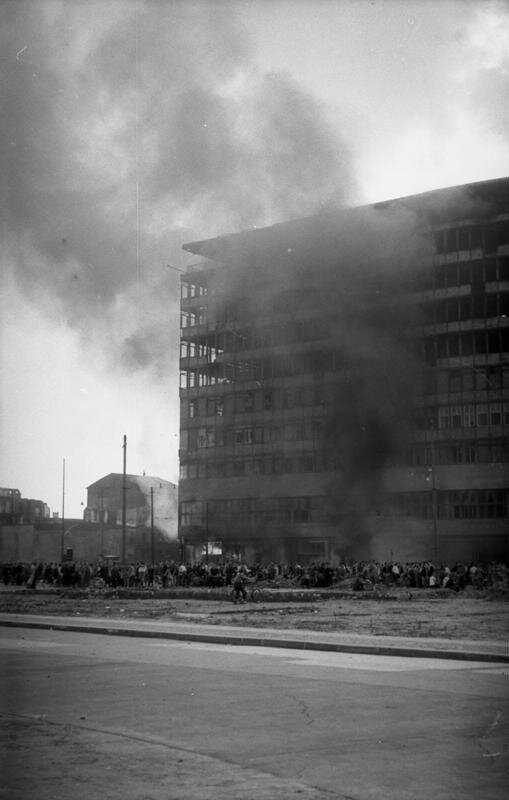
And the demands had changed. Overnight they had leapt from bread-and-butter grievances to open politics: free elections by secret ballot, the release of political prisoners, the resignation of the government, and the reunification of Germany. Crowds chanted “Wir wollen freie Wahlen” (we want free elections) and “Nieder mit der Regierung” (down with the government), tore up party banners, and set fire to propaganda kiosks and SED offices. At Potsdamer Platz, on the sector border, demonstrators torched the Columbushaus and the neighbouring Haus Vaterland; at the Brandenburg Gate, they climbed the monument and pulled down the red flag flying above it.
Tanks on Potsdamer Platz
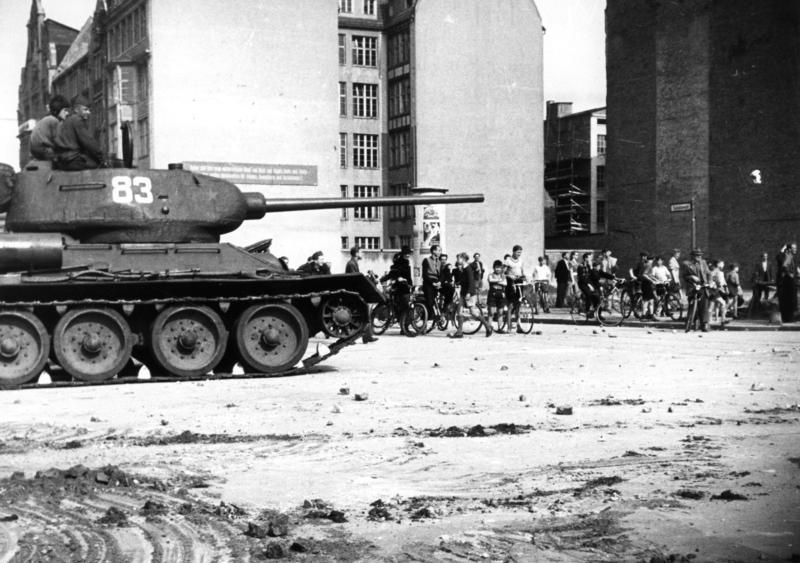
The East German police could not hold the streets, and the regime turned to its guarantor. Early in the afternoon the Soviet military commandant declared a state of emergency across East Berlin, banning gatherings and imposing a curfew. Into the crowds rolled the tanks: around twenty thousand Soviet soldiers with T-34s, backed by some eight thousand of East Germany’s own paramilitary police, moved to clear the city. At Potsdamer Platz and along Leipziger Strasse, unarmed protesters threw stones at the advancing armour.
It was an unequal fight. Troops and the Volkspolizei opened fire on unarmed demonstrators, and the tanks drove into the crowds: people were shot dead in the streets – around Potsdamer Platz, along Leipziger Strasse, outside the police headquarters – and many more were wounded. By evening the resistance in Berlin was broken, and over the following days the army stamped out the last strikes in the provinces. The regime concealed the death toll for decades; the researched figures, in Berlin and across the country, are set out below. The image that went around the world – a Soviet T-34 halted in a Berlin street, ringed by watching civilians – captured the whole day in a single frame: a workers’ state sending its ally’s tanks against its own workers.
The Reckoning: Deaths, Executions and Arrests
Because the regime buried the true figures for decades, the human cost was long disputed. Careful research since reunification, led by historians at the Centre for Contemporary History in Potsdam, has confirmed the names of at least 55 people who died in connection with the uprising – shot in the streets, killed in custody, or executed – and the real total may be higher. Among the dead was Willi Goettling, a 35-year-old unemployed West Berliner and father of two who happened to be in the East; arrested during the chaos and branded a Western “provocateur”, he was condemned by a Soviet military tribunal and shot on 18 June 1953.
In the weeks that followed the Stasi and Soviet forces arrested around 15,000 people. Courts handed down long prison terms, and death sentences beyond Goettling’s. The message to the population was unmistakable: the door the regime had briefly seemed to open was slammed shut, and this time it was backed by tanks.
Aftermath: The Road to the Wall
The uprising failed on its own terms, but it changed everything that came after. Walter Ulbricht, whose leadership had looked doomed only days earlier, was saved almost by accident: on 26 June Moscow arrested the Soviet security chief Lavrentiy Beria, the sponsor of a softer line on Germany, and in the confusion the Kremlin chose to keep the hardline Ulbricht in place. He used the reprieve to purge his rivals inside the party and tighten his grip.
The regime drew two lasting lessons. It never again dared impose a blanket wage cut on the workers, and it built up the machinery to make sure it would never again be caught off guard: the Stasi was expanded, and a new paramilitary force, the Combat Groups of the Working Class, was created to put factory militias on the streets at short notice. Above all, June 17 did nothing to stop the exodus. East Germans kept leaving through the open border in Berlin – some three and a half million in all by 1961 – until the leadership settled on the only answer that had ever really worked for it: on 13 August 1961 it sealed the city with the Berlin Wall. How it travelled from here to that morning in August is a story of its own: a four-year stand-off that opened with Khrushchev’s Berlin ultimatum.
Two Germanys, Two Memories
For nearly forty years the two German states remembered the day in opposite ways. In the East it became an unmentionable subject, dismissed in the official line as a “fascist putsch” stirred up by Western agents. In the West it was made a national holiday almost at once: from 1954 until reunification, 17 June was the Federal Republic’s “Day of German Unity” (Tag der deutschen Einheit), and the grand avenue running west from the Brandenburg Gate through the Tiergarten was renamed the Straße des 17. Juni – the name it still carries today. When Germany reunified in 1990 the national holiday moved to 3 October, but the street kept its date.
The playwright Bertolt Brecht, living in East Berlin, caught the regime’s response in a poem he did not dare publish in his lifetime. After the party declared that the people had “forfeited the confidence of the government”, Brecht asked in Die Lösung (“The Solution”) whether it would not then be simpler for the government “to dissolve the people and elect another”.
Visiting the Sites of the Uprising in Berlin Today
The uprising left its traces on the map of central Berlin, within easy reach of the Wall sites. The clearest is the Straße des 17. Juni itself, the wide boulevard that runs from the Brandenburg Gate west through the Tiergarten – you almost certainly cross it while sightseeing, and the name is a memorial in its own right.
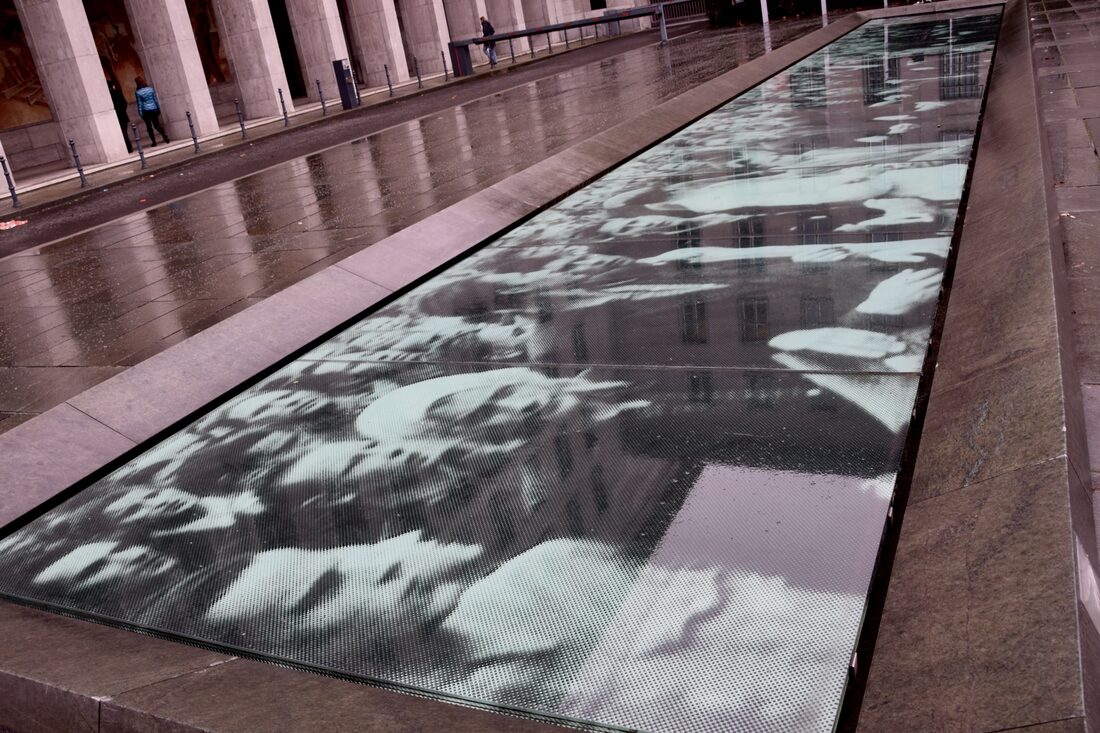
The heart of the story stands a few hundred metres south, on Leipziger Strasse. The building the strikers marched on, the old House of Ministries, still stands – it is now the Detlev-Rohwedder-Haus, home to the Federal Ministry of Finance. Set into the pavement outside is a sunken glass memorial by Wolfgang Rüppel, showing a photograph of the marchers of 17 June, and in 2013 the square beside the Leipziger Strasse entrance was named the Platz des Volksaufstandes von 1953 (Square of the 1953 Uprising). The irony is written on the building itself: along its colonnade runs a huge socialist-realist mural by Max Lingner of happy, contented workers building the republic – installed in 1953, the very year the real workers rose against it.
Frequently Asked Questions
What was the June 17, 1953 uprising?
It was a spontaneous revolt against the East German communist government. A construction workers’ strike in East Berlin on 16 June grew overnight into a nationwide uprising on 17 June, with around a million people striking in some 700 towns and demanding free elections, the government’s resignation and German reunification. Soviet troops and tanks crushed it within a day.
What caused the uprising?
The immediate trigger was a decree ordering workers to produce ten percent more for the same pay. It came on top of food shortages, high prices and a mass flight of people to the West. When the regime rolled back other unpopular policies after Stalin’s death but kept the wage cut, the building workers of Stalinallee walked out – and the strike spread.
How many people died?
The regime concealed the figures for decades. Research since 1990 has confirmed at least 55 dead, killed in the streets, in custody or by execution, with the true number probably higher. Around 15,000 people were arrested in the aftermath. One of those executed was Willi Goettling, a West Berliner shot by a Soviet tribunal on 18 June 1953.
Was this the Berlin Wall going up?
No – the uprising happened in 1953, eight years before the Wall. But the two are directly connected. The revolt failed to loosen the regime, the flight of East Germans to the West continued, and that exodus is exactly what drove the government to seal the border with the Berlin Wall in August 1961.
Why is there a Strasse des 17. Juni in Berlin?
West Berlin renamed the avenue running west from the Brandenburg Gate through the Tiergarten in memory of the uprising, and 17 June became West Germany’s national day from 1954 to 1990. The street still bears the name today, a permanent reminder of the day East Germans rose against the dictatorship.
Can you visit sites of the uprising today?
Yes. Walk the Straße des 17. Juni through the Tiergarten, and visit the old House of Ministries on Leipziger Strasse – now the Federal Ministry of Finance – where a sunken glass memorial and the Platz des Volksaufstandes von 1953 mark the strikers’ destination. Both are minutes from the Brandenburg Gate and the main Berlin Wall sites.
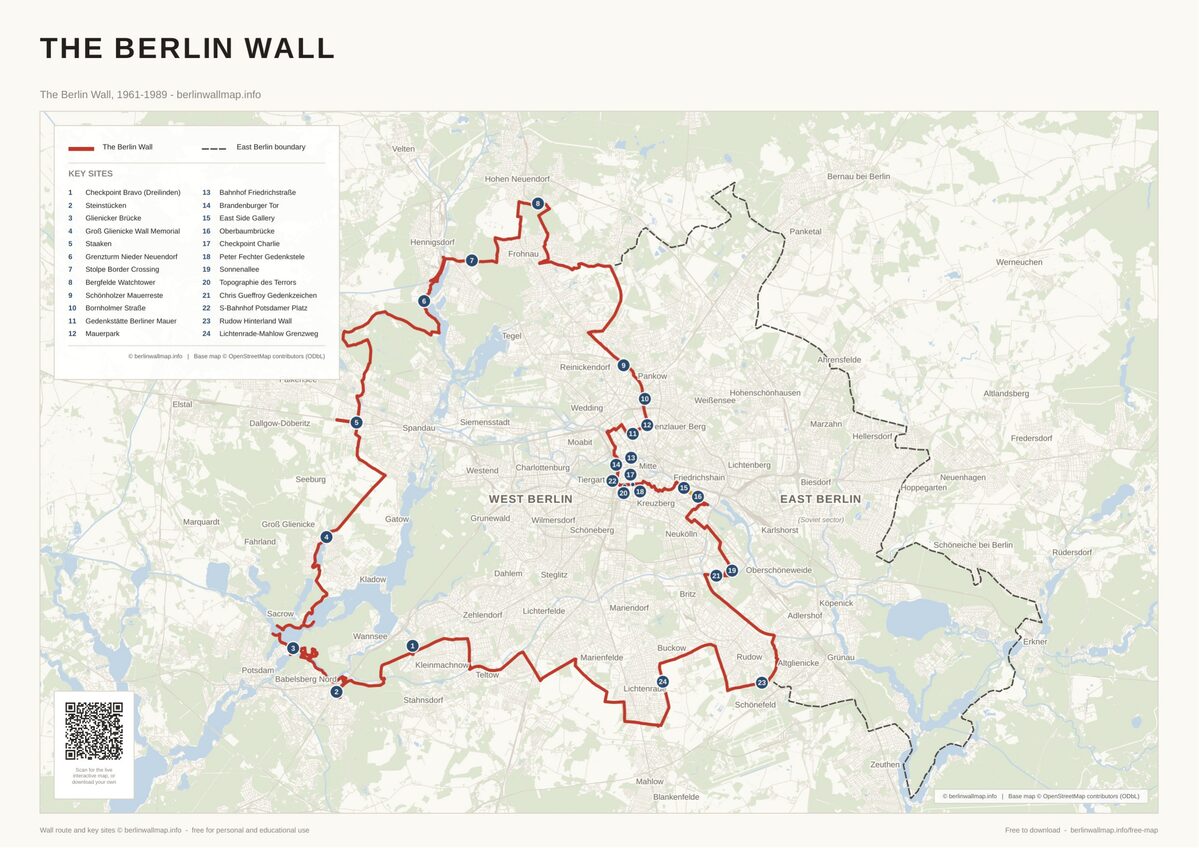
Trace the divided city from the 1953 uprising to the fall of the Wall on our Berlin Wall history timeline, or find every crossing, memorial and remnant on the interactive Berlin Wall map.
Free map downloads
Free printable PDF maps of the Berlin Wall.
Get the free maps →Explore the Timeline
Journey through Berlin Wall history from 1945 to 1990.
View Timeline →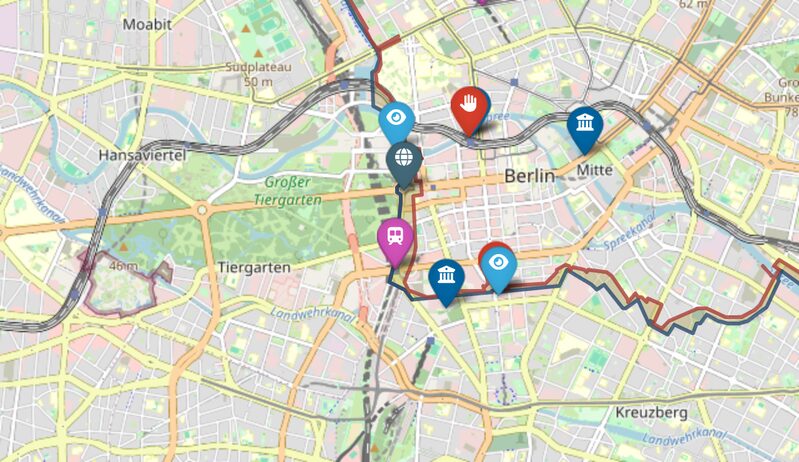
Embed Our Map
Add a free interactive Berlin Wall map to your website or blog.
Get embed code →